
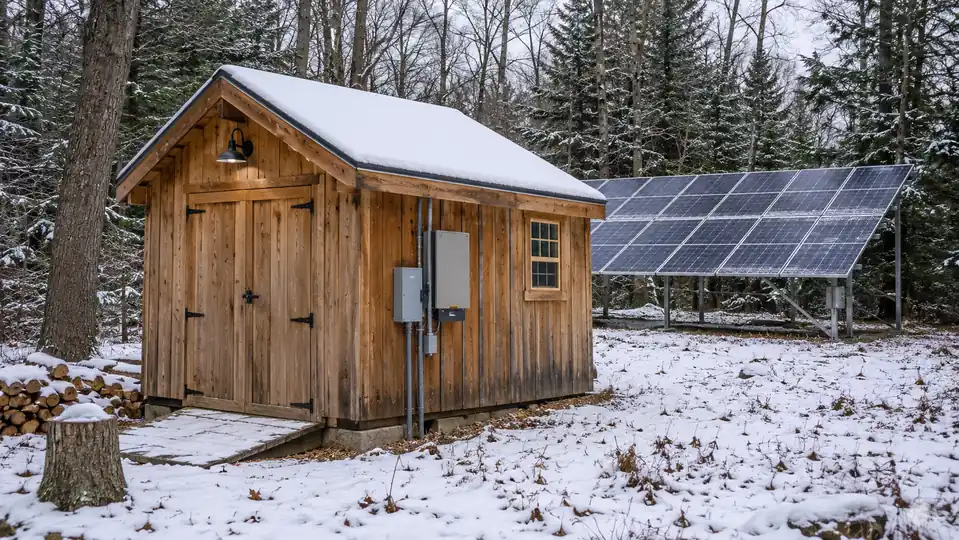
Six years ago I finished this cabin, 24 by 32 feet of frame and board and batten I put up myself, and moved in with a drilled well, a wood stove, and a ground-mounted solar array that runs the whole place. What I did not have was a way to make the water safe to drink that did not depend on the sun showing up. That is the whole reason a gravity filter ended up in my kitchen, and it is why a Big Berkey has sat on the same counter ever since. Not because it is fancy. Because it works on the mornings when nothing else in the house does.
What follows are ten reasons a gravity filter suits off-grid living, written from six years of living with one rather than from a spec sheet. If you are setting up a cabin, a homestead, or a rural place that has to run on its own power and water, these are the things I would want to know before I made the decision. Some of them are about convenience. A few are about the difference between a system you maintain and a system you abandon.
The filter that keeps working when the array is under snow
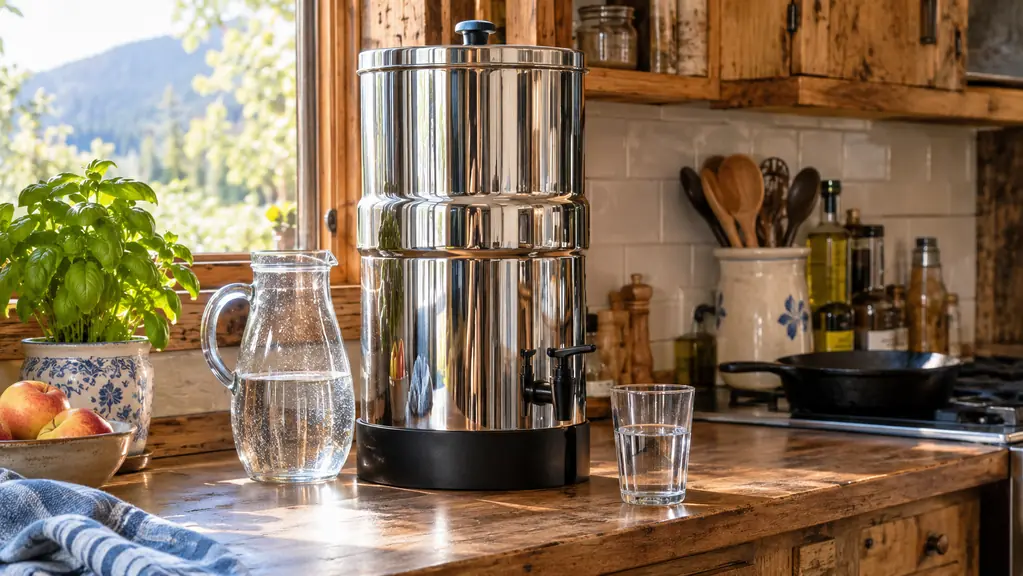
Gravity fed, 2.25 gallons, two Black Berkey elements included. No pump, no cord, nothing to restart after an outage.
Amazon Check Today's Price on Amazon →It moves water with nothing but gravity
There is no pump on this thing and no cord. The power source on the spec sheet is literally gravity, and that is not a marketing line, it is the entire mechanism. Water goes in the top chamber, works down through the Black Berkey elements, and collects in the lower chamber. The rated maximum flow rate is 0.03 gallons per minute, which is honest and it is slow, and I will take slow and certain over fast and dependent on a battery bank every time. In February, when the panels are under a foot of snow and the inverter is sulking, my filter still makes drinking water.
Two Black Berkey elements come in the box
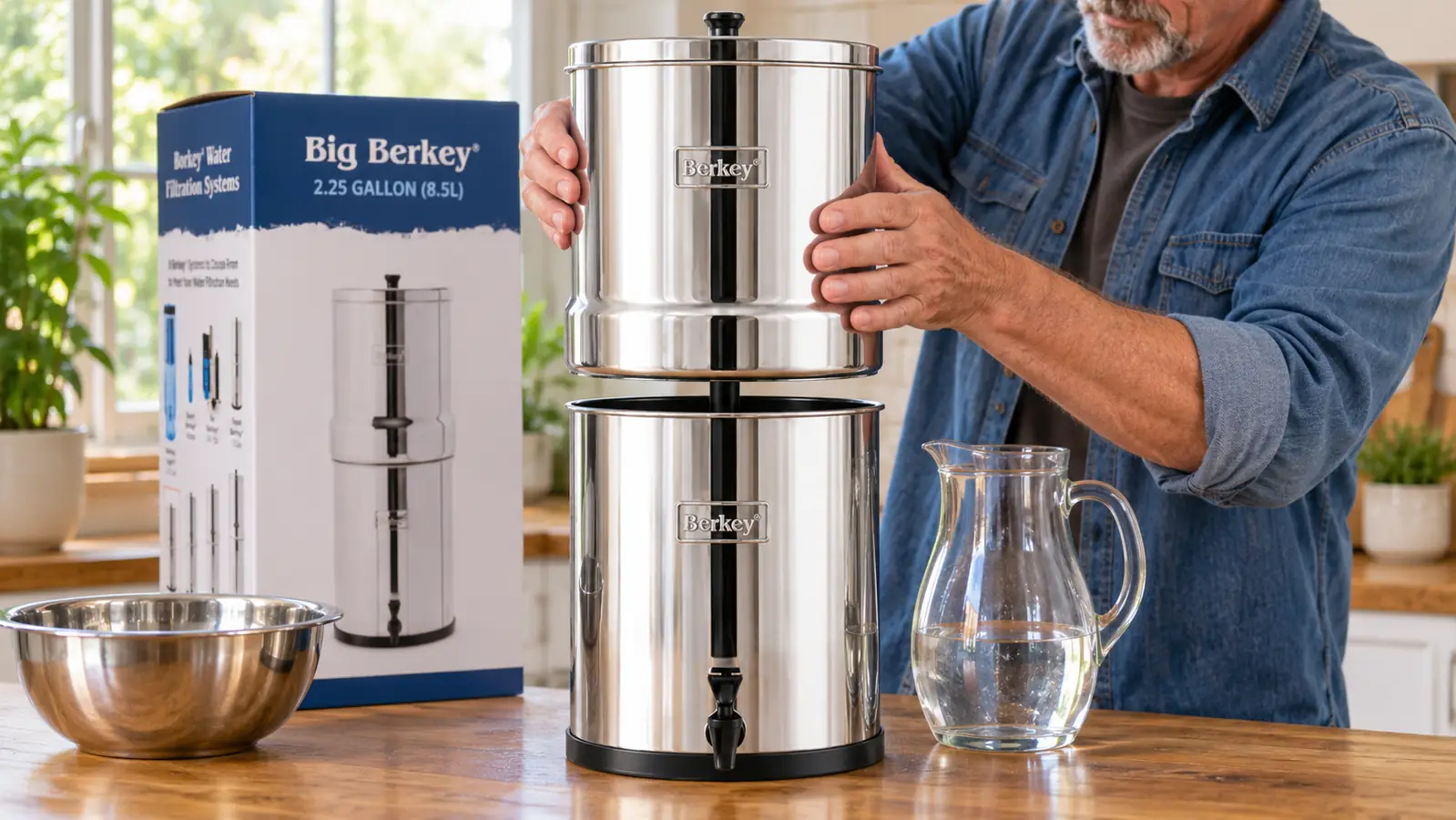
The BB9-2 elements are included, two of them, and they are the part doing the actual work. The purification method is Berkey's own proprietary filter media. Everything else on the unit is a container that holds those elements and lets gravity do the pushing. I like that division of labor because it tells me where to look when something eventually needs attention. One piece matters. The rest is a shell. On a machine with a dozen subsystems, you spend your evenings chasing which one is lying to you. Here there are only two candidates.
2.25 gallons is one honest day for two people
Eight and a half liters. Dana and I drink from it, cook from it, and fill the kettle from it, and a full unit gets us through a normal day with a little left over for a neighbor who stops by. It is not a whole-house system and it was never meant to be. What it is, is the right size to fill once in the morning before I head out to the power shed, which is the only kind of routine that survives contact with a real week. Capacity you have to think about is capacity you will eventually stop using.
The chambers are stainless steel, not plastic
Both chambers are stainless steel, and that matters to me for a boring reason. A cabin is hard on things. The south window pours sun on that counter all afternoon, the wood stove throws heat eight feet away, and the temperature swings thirty degrees between a January night and a January afternoon. I have watched cheap plastic go brittle in that exact environment and then crack at the worst possible moment. The Berkey does not care about any of it. I wipe it down, set it back, and stop thinking about it for another season.
It sits on the counter and asks for no plumbing
The unit is roughly 8.5 inches across and 19.25 inches tall assembled, and the installation type is countertop. That means no tapping the well line, no shutoff valve, no sweating copper in a cabin where the nearest supply house is forty minutes of dirt road away. I set it on the counter next to the window, filled the top chamber, and that was the entire install. Six years later it has not leaked, shifted, or needed a single fitting. If you are building a place out in stages the way I did, equipment that installs itself is worth more than equipment with more features.
Gravity is the power source, the countertop is the installation, and two Black Berkey elements are the only parts doing any real thinking. There is not much left to break.
It is rated for well water up to 1000 ppm TDS
Our water comes out of a drilled well and carries the minerals you would expect it to carry. The unit is rated for a maximum TDS level of 1000 ppm, and our number sits comfortably under that. If your well runs harder than that ceiling, this may not be your answer, and you should know it before you buy rather than after. That is the one spec on this list I would actually go measure at your own place first. But for a lot of rural wells, mine included, the ceiling is high enough that it never enters my thinking again.
An outage is a non-event
There is no display, no sensor, no mode to reset, and nothing that has to boot back up after the inverter trips. When the power goes at two in the morning because a branch came down across the array, the water sitting in the lower chamber is still there and still drinkable. I have had a few mornings where I got up, made coffee on the wood stove, and did not touch a single switch in the house. That is the test I actually care about, not the one on the brochure. A filter you can operate half asleep is a filter that stays in service.
It rides in the truck for a weekend at the creek
I camp a few times a season and I fish the creek more than that. The unit comes apart into its chambers, and 19.25 inches tall is not hard to fit in the bed of an older pickup with a topper on it. I bring it along when I am staying somewhere with a questionable water source, because there is no fuel to carry and no battery to charge before it works. Set it up on a picnic table, fill the top, and in a little while there is safe water for the coffee pot. That is a lot of peace of mind for one square foot of cargo space.
The footprint fits a small cabin
8.5 inches by 8.5 inches by 19.25 inches tall. In a 24 by 32 place with no pantry to spare and not one square foot of counter I can afford to waste, that is a genuine consideration rather than a footnote. It takes up less room than my coffee pot and cutting board together, and it lives against the wall in the corner where nothing else wants to be anyway. Small homes punish equipment that is bigger than its job. This one is not, and I notice that every time I wipe the counter down.
Two chambers, two filters, nothing else to go wrong
I spent thirty years as a millwright, and the first thing I look at on any machine is how many ways it can fail. This one has very few. Two stainless chambers, two Black Berkey elements, gravity doing the moving, and no electronics anywhere in the chain between the water and the glass. There is no control board to fry and no pump seal weeping at midnight. Simplicity is not the thing you brag about when you buy equipment. It is the thing that keeps working in year six, which is the only review that counts.
What I'd Skip
If you are outfitting a place right now, here is what I would leave on the shelf. I would skip anything that has to be plugged in to make drinking water, because that dependency is exactly what you moved out here to get away from. I would skip an undersized unit if two or more people live there, since a filter you have to refill four times a day is a filter you quietly stop using by March. And I would skip any setup I could not explain to Dana in one sentence, because equipment nobody understands is equipment nobody maintains. The Big Berkey passes all three of those tests at my place, and after six years I have not found a reason to put something else on that counter.
Six years, one filter, and it still runs on nothing but gravity
2.25 gallons, stainless steel chambers, two Black Berkey BB9-2 elements included. Fill it in the morning and stop thinking about it.
Amazon Check Today's Price on Amazon →