
For the first winter up here, drinking water came up the hill in the back of my truck. Two five-gallon jugs a week, more when the road iced over and I could not get out at all. The well was drilled, the pump worked, and the water tested fine. It also came out of the tap with a sulfur edge and enough iron in it that Dana would not drink it, and I could not blame her. So I hauled jugs like a man who had not thought the whole thing through. I had not.
The Big Berkey was the answer to that. It is a gravity-fed unit with a 2.25-gallon capacity, 8.5 inches across and 19.25 inches tall when assembled, and it sits on the kitchen counter and goes about its work with no pump, no draw on the solar array, and no connection to the plumbing. Two winters now, including a nine-day stretch when the well ran muddy. Here is what I have learned running one in a cabin that has to make its own power.
The Quick Verdict
Slow by design and completely indifferent to whether the inverter is on. Two winters on hard well water and I would buy it again, with one honest caveat about counter space.
Amazon Check Today's Price →The filter that kept working the week the well ran muddy
Gravity-fed, 2.25 gallons, two Black Berkey elements in the box, nothing to plug in and nothing to wire.
Amazon Check It on Amazon →How I've Used It
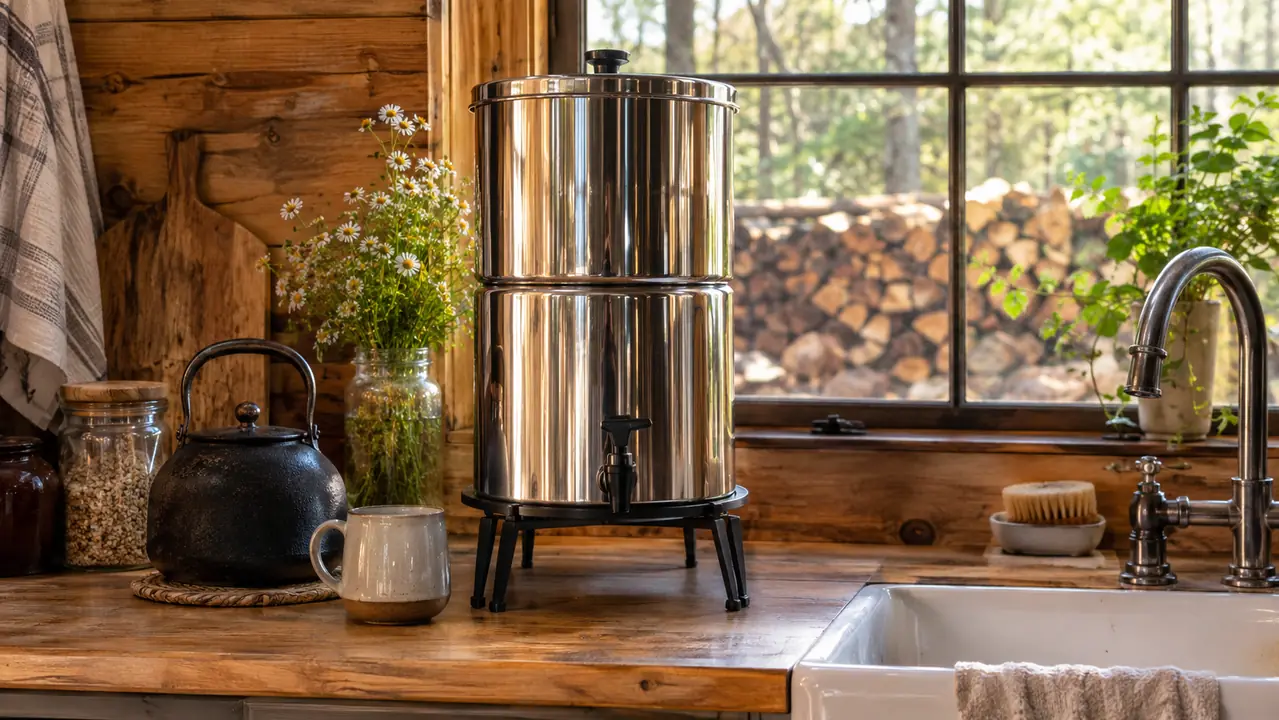
It sits to the left of the sink, under the window, on a slab of scrap oak I cut to fit so it does not walk around the counter. That spot cost me a shelf. The unit is 19.25 inches tall assembled and you need another six or eight inches of clear air above it to lift the upper chamber off, so measure twice before you decide where it lives. I moved the shelf up four inches and it has not moved since.
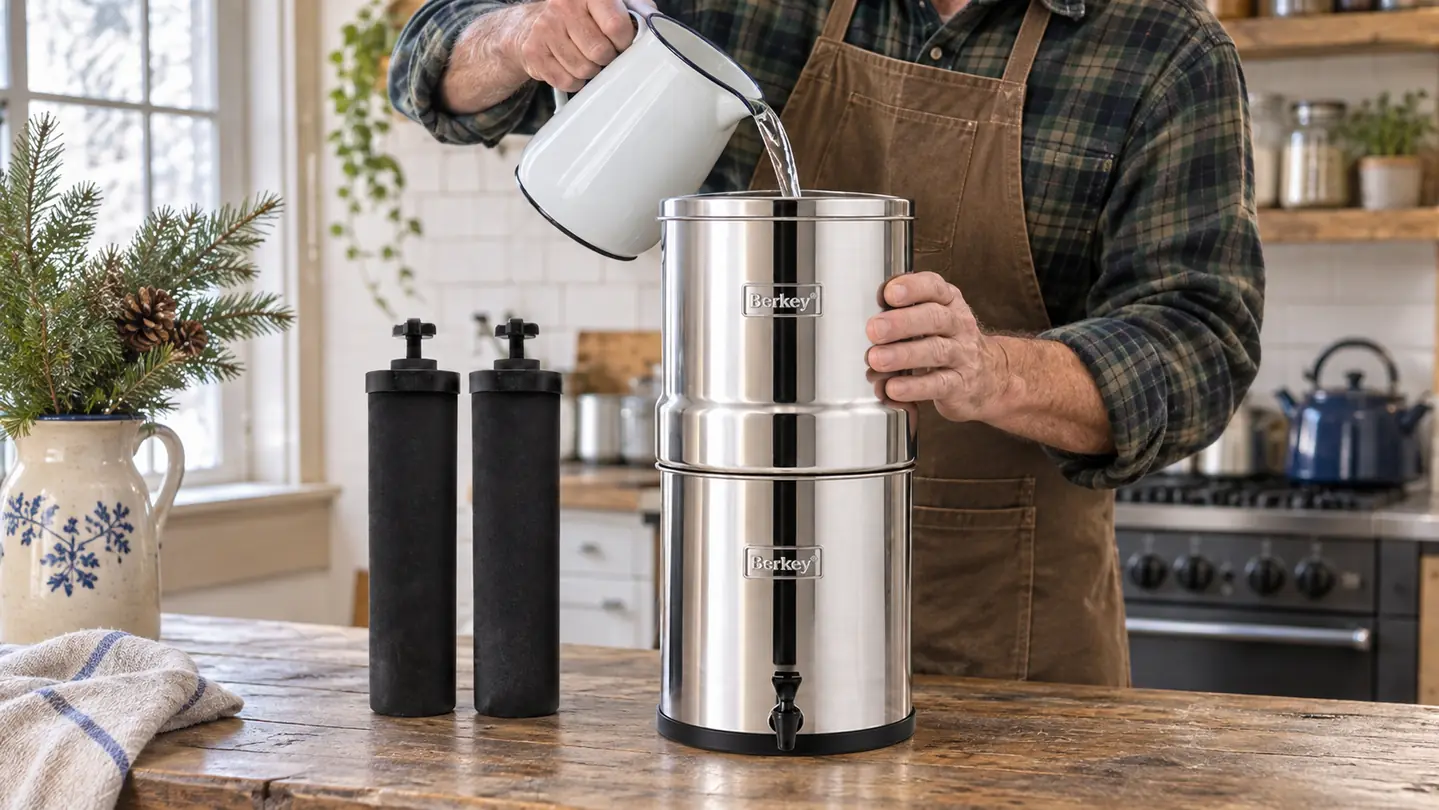
The routine is daily and it is simple. I fill the upper chamber from a two-quart pitcher, four or five trips from the tap, first thing in the morning and again after supper. Water seeps down through the two Black Berkey elements into the lower chamber and comes out the spigot. At the listed maximum flow rate of 0.03 gallons per minute, a full upper chamber takes somewhere around seventy-five minutes to pass through. That is the number that governs how you live with this thing, and I will come back to it.
Two people drinking and cooking will go through most of the 8.5 liters in a day. That is the honest size of it. If Dana has the kettle going and I am filling a thermos for the truck, I top it off twice. In the shoulder seasons, when it is often just me, once a day is plenty. The capacity is right for a household of two. It is thin for four.
I have never had it freeze, because it lives inside and the wood stove keeps the main room above freezing even on the nights the stove damps down. When we are away for a few days I empty it and leave the top chamber off, which takes about two minutes and saves me worrying about it the whole drive.
What the Two Black Berkey Filters Actually Do
Two BB9-2 Black Berkey elements come in the box. They hang in the upper chamber, the water works its way through the proprietary black filter media, and gravity does the rest. There is no cartridge housing to crack, no small O-ring to lose in the snow, and nothing electronic in the chain to fail at the wrong moment. In a cabin, that last part is worth more than it sounds.
What it is not is a softener. My well is hard and the Berkey does not change that. It does not pull the calcium out, and I still get a white ring on a glass if I leave it to dry on the counter overnight. What it does is take the sulfur edge off and catch the fine sediment that shows up after a heavy rain. The listing puts the supported water TDS ceiling at 1000 ppm, and that is a number worth checking against your own well test before you spend anything. If your water runs past that, this is not the tool for the job and no amount of wishing will make it one.
I am not going to hand you a list of everything it removes. The manufacturer publishes its own test results and you should read them yourself rather than take my word for it, because I am a millwright with a well and a jug, not a lab. What I can tell you is what changed in the glass. It stopped smelling like the inside of a garden hose. It stopped leaving grit in the bottom of the kettle. That is the whole of my evidence and it is enough for me.
The Flow Rate Is the Whole Story
0.03 gallons per minute. Say that out loud and it does not sound like much, because it is not. That works out to about a gallon every thirty-three minutes with clean elements and water that is not too cold, and a full upper chamber takes a bit over an hour to work its way down. This is not a tap. It is a reservoir with a slow leak, and you treat it accordingly.
Cold slows it. The well water comes in around the temperature of a springhouse, and cold water moves through the elements more slowly than water at room temperature. A February fill takes longer than a July fill. Not dramatically, but you notice when you are standing there holding an empty pitcher. The flow also tails off as the upper chamber empties, because there is less weight left pushing the water through. The last inch in the top takes longer than the first gallon.
This is the trade you are making, and it is worth understanding before you buy. A countertop pitcher is faster. A plumbed under-sink unit is faster still. Both of them want something from you: muscle, or water pressure, or electricity, or a cartridge you have to order on a schedule. Gravity wants none of it. It wants time, and in a cabin I have more of that than I have of the other three.
What that looks like in practice is planning ahead instead of waiting. I fill the top before bed and the bottom is ready by the time I want coffee. I fill it again while I am putting breakfast away. The only time the flow rate has annoyed me is when I forgot to fill it the night before and stood there watching a thin stream come out of the spigot while the kettle sat cold. That has happened twice in two winters, and both times it was my own fault.
Well Water, Sediment, and the Spring Melt
Spring is when a drilled well shows you what it is. The snow goes off the ground, the water table comes up, and for a week or two the water arrives with fines in it, a fine gray grit that settles in a glass and coats the bottom of the lower chamber. During that stretch I clean the lower chamber every couple of weeks instead of every couple of months. It is not a hardship. It is just a season, like mud on the truck.
I also put a sediment cartridge of my own on the line coming in from the well, upstream of the Berkey, and I change it when the melt starts. That is my choice and not a requirement of the unit. The Berkey will handle water with sediment in it. I would rather the sediment stop somewhere I can throw it away than settle in a chamber I have to scrub.
The second winter gave me the test I would not have asked for. A thaw and then a hard freeze in the same week turned the well muddy for nine days. I filled the upper chamber each morning, went out to work on the truck or split wood, and came back to clean water in the bottom. Nobody started the generator for it. Nobody boiled anything on the wood stove and then waited an hour for it to cool. When people ask me why I bother with gravity, that week is the answer I give them.

What I Compared It To Before Buying
I looked at three other things first. The cheapest was a countertop pitcher, which works and which I would still recommend to somebody in an apartment on city water, but the capacity is small and the cartridges are a recurring errand. The second was an under-sink reverse osmosis unit, which needs water pressure and power and sends a good deal of water down the drain, and with a well and a solar array I did not love any part of that math. The third was doing nothing and hauling jugs, which I had already tried for a winter.
What settled it for me was the parts count. No pump, no pressure tank, no electricity, no drain line. Two elements, two chambers, and a spigot. In a cabin, every system you add is a system you have to maintain in the cold with a headlamp on. I will take the one with fewer pieces every time, even when it is the slower one.
Living With It: Space, Cleaning, and the Small Annoyances
The footprint is honest. 8.5 inches across will fit almost anywhere, and it does not need to be beside the sink as long as you are willing to carry a pitcher. The height is where people get caught out. 19.25 inches assembled, plus clearance to lift the top chamber off, and now you are looking at a spot under a window or at the end of a run of counter rather than tucked under a cabinet.
Cleaning is a twice-a-year job for me, plus the extra round in spring. Empty the lower chamber, lift off the top, pull the two elements, scrub them, rinse everything, put it back together. Maybe forty minutes with a cup of coffee in the middle of it. None of it is difficult. It is just a job you have to remember, and nothing on the unit is going to remind you. There is no light and no gauge on it. You learn to read it instead: when the flow drops off more than the season explains, it is time to clean.
The other small annoyance is filling. Four or five trips with a two-quart pitcher, twice a day, is the cost of not plumbing it in. I have thought about running a line over from the tap. I have not done it, because in February it is one more thing that can freeze, and the pitcher has never once let me down in six years of living out here.
What I Liked
- No power draw and no plumbing. It keeps working when the inverter is off and the pump is down.
- 2.25 gallons is enough for two people to drink and cook for a day without a refill.
- Two Black Berkey elements come in the box, so you are not buying a second filter to get started.
- 8.5 inches across fits a cabin counter, and there is nothing to wire or plumb.
- Nothing to program and nothing to reset. Fill it and walk away.
Where It Falls Short
- 0.03 gallons per minute is genuinely slow. You plan around it, you do not stand and wait.
- Filling the upper chamber is a daily chore, and it is four or five trips with a pitcher.
- It needs 19.25 inches of height plus room to lift the top chamber, which is more than it sounds.
- Nothing on the unit tells you the elements are dirty. You read the flow and taste the water.
- It does not soften hard water, and my well is hard.
Nine days of muddy well water and nobody had to start the generator for it. That is the whole argument for gravity in one sentence.
Who This Is For
This is for a household of one or two on their own water. A drilled well, a spring, a cistern, a rain system with a screen ahead of it. Somebody who wants drinking water that does not care whether the power is on, and who is willing to spend a couple of minutes a day on it. It suits a cabin, a camp, a small homestead, a place where the lights go out and come back and nothing in the kitchen notices. The people I know who get along best with a Berkey are the ones who already keep a routine around the wood stove and the generator and do not mind adding one more small habit to the list.
Who Should Skip It
Skip it if there are four or more of you drinking water all day, because you will be filling it constantly and you will start to resent it. Skip it if you want to turn a handle and get a full glass, because gravity will not give you that. Skip it if your well runs past the TDS ceiling the listing states, or if you are on treated city water and what you really want is a cold drink. And skip it if you know in your bones you will not clean it. A neglected filter is worse than a jug, and it costs more.
Two winters, one muddy well, and the same pair of elements
If you are on your own water and you want the simplest thing that works, this is the one I would put back on the counter tomorrow.
Amazon See the Big Berkey on Amazon →