
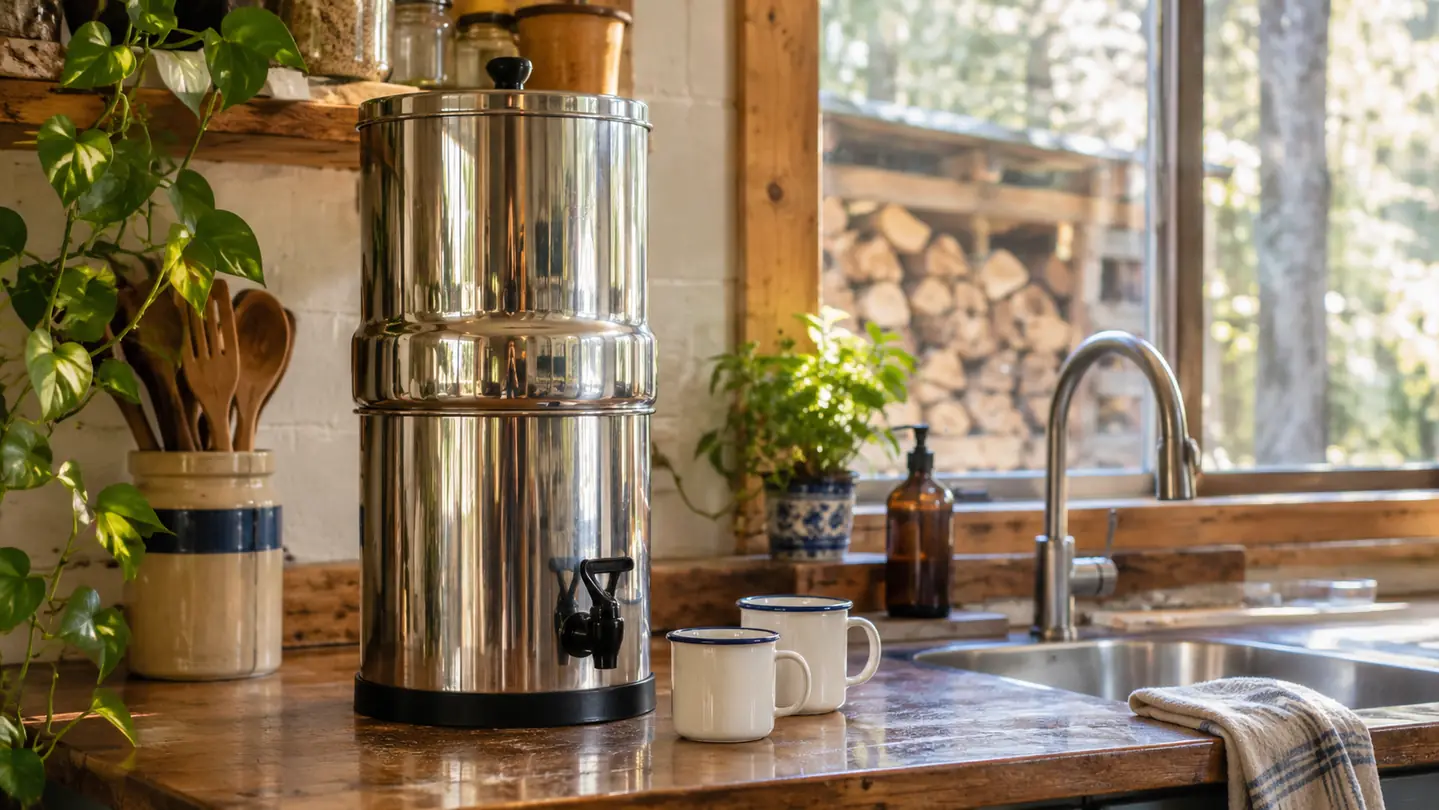
Short answer: if your drinking water comes from a drilled well, a cistern, a spring, or stored jugs, the Big Berkey is the better tool for the job. If your water is already treated and you mainly want cold water in the fridge, a pitcher filter is simpler and easier to live with. I am Caleb Rourke. Dana and I have been off the grid for six years in a 24 by 32 foot cabin I finished on 14 wooded acres an hour outside Syracuse. Our water comes from a drilled well. I have hauled enough five-gallon jugs up the hill to know the difference between a filter that carries a household and one that fills a glass.
People ask me which one to buy as if there is one right answer. There is not. There is the water you have, the counter space you can give up, and the amount of fuss you will tolerate at seven in the morning. A pitcher filter and a gravity filter like the Berkey solve different problems. One is a convenience item you keep cold. The other is a small water station that sits on the counter and asks nothing from the power shed. Here is the honest split, including where the pitcher wins.
| Big Berkey | Brita pitcher | |
|---|---|---|
| Capacity | 2.25 gallons, 8.5 liters, enough for a day of drinking and cooking for two | A few cups to a couple quarts, refilled several times a day |
| Filtration | Two Black Berkey BB9-2 elements with proprietary media | A replaceable carbon cartridge |
| Power | Gravity, no electricity | Gravity, no electricity |
| Setup | Assemble chambers, prime and install two elements, run a few batches | Rinse cartridge, fill, wait |
| Portability | Countertop unit, 19.25 inches tall and 8.5 inches across, not something you move full | Carry it to the sink or fridge with one hand |
| Footprint | 8.5 by 8.5 inches on the counter, 19.25 inches tall | Small enough for a fridge door in most cases |
| Water source | Rated for water up to 1000 ppm TDS, useful on a drilled well | Best on water that is already treated and clear |
| Durability | Stainless steel chambers | Plastic body and cartridge |
| Daily rhythm | Fill once, draw all day, maximum flow rate 0.03 gallons per minute | Fill often, drink cold from the fridge |
| Best for | A household depending on its own well or stored water | One or two people with reliable treated water |
Where Big Berkey Wins
The first win is capacity. The Big Berkey holds 2.25 gallons, which is 8.5 liters. For Dana and me, that is a full day of drinking water plus the water that goes into coffee, soup, and a pot of beans. A pitcher filter holds a fraction of that, so you are filling it several times a day and listening to it trickle while you wait. The Berkey has a maximum flow rate of 0.03 gallons per minute. That sounds slow because it is slow. You fill the top chamber, walk away, and come back to a full lower chamber. The trade is simple: you stop babysitting a small reservoir all day.
Second, it is built for water that has not been treated by a municipal plant. The spec sheet rates it for water up to 1000 ppm total dissolved solids. That does not mean it will turn mud into spring water, and it is not a pass to skip a lab test. It does mean the unit is designed around a real well, not a city tap. The two Black Berkey BB9-2 elements are the filtration core. The chambers are stainless steel. There is no pump, no power cord, and no control board. It works when the power shed is quiet and when the solar array is buried under snow.
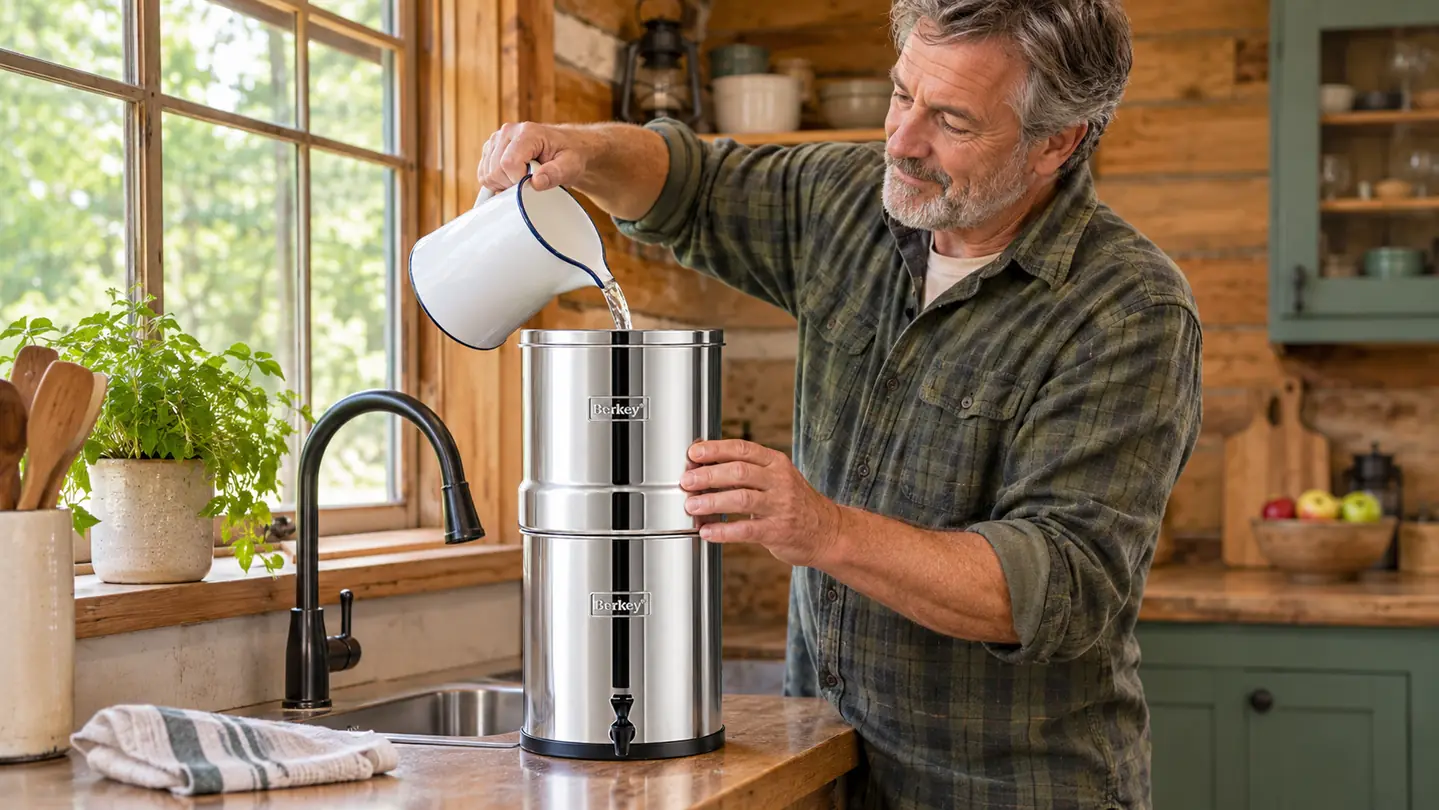
Where a Pitcher Filter Wins
A pitcher wins on setup and on daily use. You rinse the cartridge, fill the reservoir, and put it in the fridge. There is no assembly, no priming, and no two chambers to line up on the counter. If you have ever come home tired and just wanted a glass of cold water, that matters. A pitcher is also easy to move. You can carry it to the sink with one hand, set it on the table, or take it to a rental kitchen when you move. The Big Berkey is 19.25 inches tall and 8.5 inches across. It owns its counter space. You do not tuck it into a cupboard and forget it.
Second, a pitcher asks less of you when the water is already good. If your water is clear, treated, and low in sediment, a carbon cartridge pitcher is enough to improve taste and keep a cold supply in the fridge. It is also easier to replace. You pull the old cartridge, rinse the new one, and you are done. There is no element to handle and no chamber to dry. A pitcher is the low-commitment choice, and for some households that is the right choice. It is not a lesser choice just because it is smaller.
What the Specifications Tell You
Specs are not the whole story, but they keep you honest. The Big Berkey is listed at 2.25 gallons, 8.5 liters, with a maximum flow rate of 0.03 gallons per minute. It measures 8.5 inches by 8.5 inches by 19.25 inches. It is a countertop unit with stainless steel chambers, two BB9-2 elements, and a gravity power source. Those numbers tell you two things. It fits on a normal counter. It is not fast. If you need a glass right now, you will wait. If you need a day of water, you will not.
The TDS rating is the number I would pay the most attention to. A maximum of 1000 ppm is a real limit. It is not a challenge. If your well is at 1100 ppm, do not buy this and hope. If your well is at 300 ppm and the water is clear, the Berkey has room to work. A pitcher does not publish a number like that in the same way. It is built for treated water, and it is honest about being a small convenience filter. Match the tool to the test, not to the picture on the box.
The Daily Reality in a Cabin Kitchen
On a normal Tuesday I fill the Berkey after breakfast. I pour from a jug or from the tap at the sink, depending on how the well is running. By lunch the lower chamber has enough for two people. By evening I top it off again. The unit sits on the counter between the flour jar and the dish rack. It is not invisible, but it is not in the way. The stainless chambers wipe clean. The only thing I have to remember is to keep the top chamber from running dry and pulling air.
If the well kicks up sediment after a heavy rain, the Berkey is the tool I want. A pitcher would clog and slow to a crawl, and I would be changing cartridges before the ground dried out. The Berkey has more room to work with and a rating that accounts for water with higher dissolved solids. That said, a filter is not a fix for a bad well. If your water tests high for bacteria or nitrates, deal with that at the source. A countertop filter is a final step, not a license to ignore a lab report.
Maintenance is the other daily reality. The Berkey has two elements and two chambers. The pitcher has one cartridge and one reservoir. Both are simple. Neither one is hard to keep up with. The difference is that the Berkey rewards a little planning. You fill it before bed and you have water in the morning. The pitcher rewards a little habit. You fill it after every pour and you keep it cold. If you hate planning, the pitcher wins. If you hate running out, the Berkey wins.
A pitcher is a convenience item. The Big Berkey is a small water station. Pick the one that matches the job, not the one with the nicer label.
If your water comes from your own well, put the Berkey on the counter and stop hauling jugs
The Big Berkey holds 2.25 gallons, runs on gravity, and uses two Black Berkey BB9-2 elements. It is the unit I trust for daily drinking and cooking water in a cabin that makes its own power.
Amazon Check Today's Price on Amazon →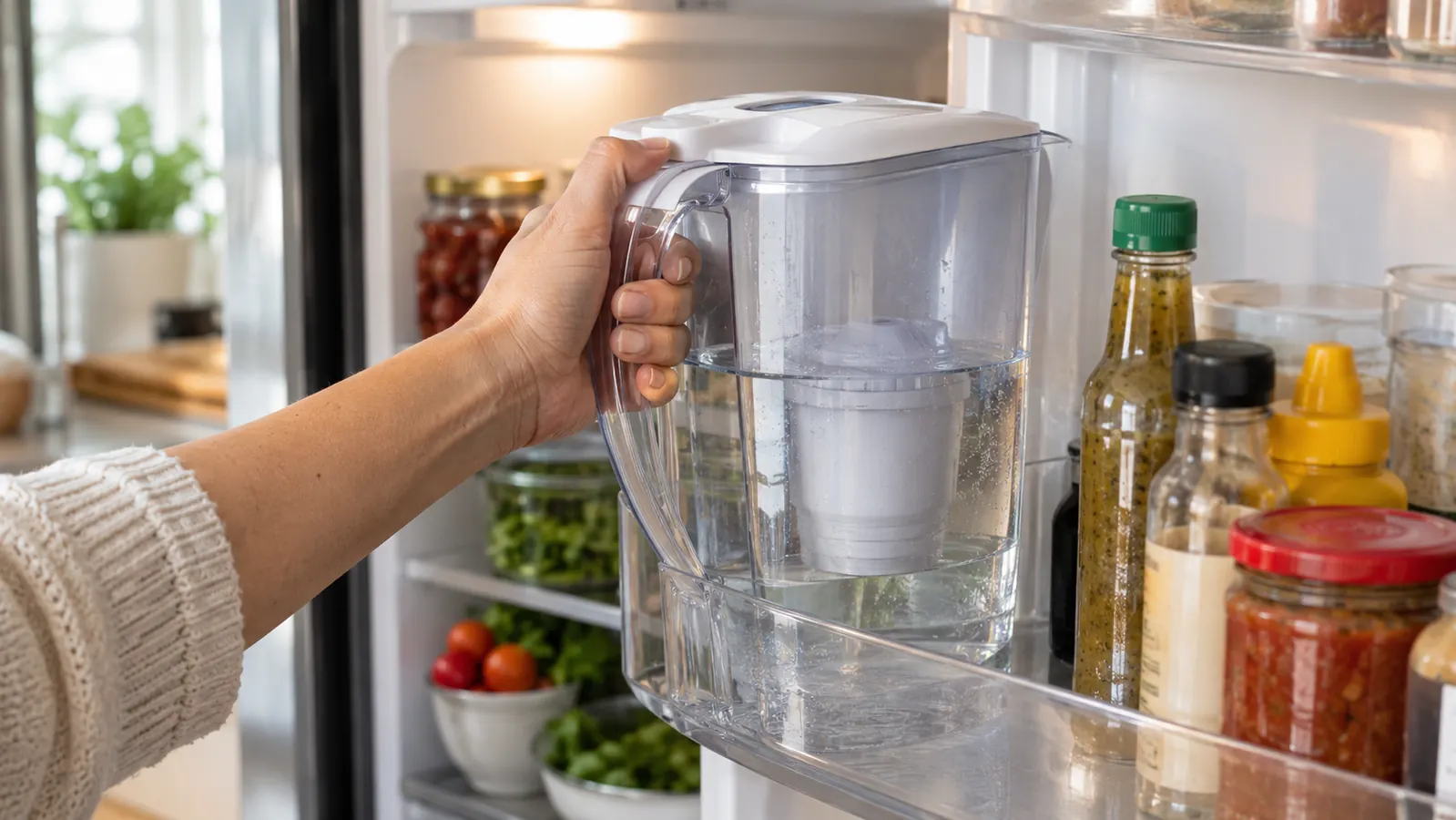
Who Should Buy Which
Buy the Big Berkey if your water comes from a drilled well, a spring, a cistern, or stored containers you fill yourself. Buy it if two people or more draw drinking and cooking water from the same spot every day. Buy it if you have 8.5 inches of counter width and 19.25 inches of height to give up. Buy it if you want stainless steel chambers, gravity operation, and a system that does not care whether the power is on. Buy it if you are willing to fill the top chamber and walk away. That is the whole bargain. You trade a little time for a lot of capacity and independence.
Buy a pitcher filter if your water is already treated and clear. Buy it if you live alone or with one other person and you mainly want cold water in the fridge. Buy it if you rent, move often, or have a kitchen the size of a closet. Buy it if you want to spend five minutes on setup and never think about a chamber again. Buy it if the water is good and the job is convenience. That is not a small thing. A pitcher that you actually use beats a bigger filter that you resent filling.
A Note on Water Testing
Test your water before you buy either one. A filter is only as good as the water going into it. A basic lab test will tell you hardness, bacteria, nitrates, and total dissolved solids. The Big Berkey is rated up to 1000 ppm TDS. If your number is above that, the rating itself tells you to look at a different approach. If your number is low and the water is clear, a pitcher may be all you need. Do not guess from taste alone. Good-tasting water can still carry things you cannot taste.
Fix the source first if the test shows a real problem. A gravity filter is not a substitute for sealing a wellhead, repairing a cracked casing, or dealing with surface water getting into the supply. A pitcher is not either. I am grateful for clean water, and I do not take a lab report for granted. Six years in, I still test once a year and I still keep a jug of treated water in the pantry for the days when the well pump or the weather has other plans. A filter is part of a system. It is not the whole system.
What I Would Tell a Neighbor
If a neighbor walked over and asked me which one to buy, I would ask three questions. How many people are drinking from it? Where does the water come from? How much counter space will your wife give up? If the answer is two people, a drilled well, and a spare foot of counter, I would point at the Berkey. If the answer is one person, town water, and a fridge door, I would point at the pitcher. The answer follows the water, not the brand.
I would also tell them not to buy either one as a status item. A filter is a tool. The Berkey is a good tool for a household on its own water. The pitcher is a good tool for cold water in a kitchen with treated water. Neither one will fix a bad well, and neither one will make you a different person. They just make the water you already have easier to use. That is enough.
The right filter is the one that fits your water, your counter, and your morning
If that is a gravity system with real capacity, the Big Berkey is the one I would put in my own cabin. If it is a pitcher in the fridge, buy a good one and keep it full. Either way, test the water and size the tool to the job.
Amazon Check Today's Price on Amazon →