

Six years ago the power shed behind my cabin held four deep cycle batteries, a charge controller, and a spiral notebook where I logged voltage every morning like a nervous accountant. That bank weighed well over 300 pounds and it hated the cold. When I finally replaced it with something I could pick up in one hand, the whole rhythm of this place changed. The Jackery Explorer 1000 v2 is the one I settled on, and after running it through two ice storms, a hot August, and one very long November, I know what it does well and where it stops.
I am not going to pretend a battery in a case replaces a real off-grid system. It does not, and anyone who tells you otherwise is selling something. What it does is cover the gap between the loads a cabin actually has after dark and the loads a full system is built to carry. Here are ten reasons it earns its space in my shed, written for the person sizing this decision right now.
The Unit That Earns Its Space in My Shed
1,024 watt hours, 23.4 pounds, and a foldable handle. It covers my evenings, takes a charge from the panels I already own, and refills in about 50 minutes.
Amazon Check Today's Price on Amazon →It Puts 1,024 Watt Hours in One Hand
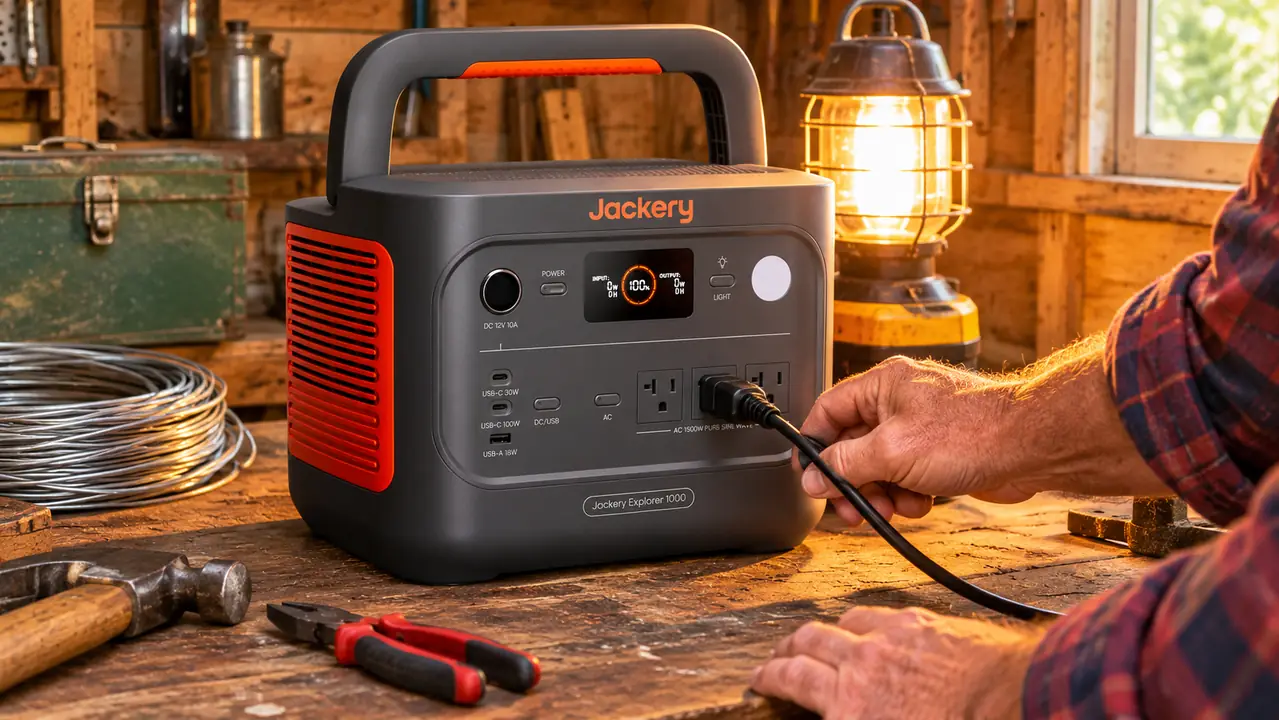
The old bank took two of us and a hand truck. The Jackery Explorer 1000 v2 has a foldable handle and weighs 23.4 pounds, so I carry it from the shed to the cabin the way I carry a toolbox. That sounds small until you are doing it in the dark in February with one hand on the rail. Capacity is 1,024 watt hours, which in practice is a full evening of lights, a laptop, the radio, and three phones charging with something left over.
Fifty Minutes From Empty to Full Resets a Bad Day
The number that changed how I plan is the charge time. Empty to full runs about 50 minutes on a wall outlet. In a cabin, downtime is the enemy. When I drain the station during a stretch of gray weather, I do not lose a day to it. I plug it in, eat lunch, and it comes back whole. That one figure is why I stopped keeping a spare bank in the shed and stopped rationing lights on Wednesday nights.
It Charges From the Panels I Already Own
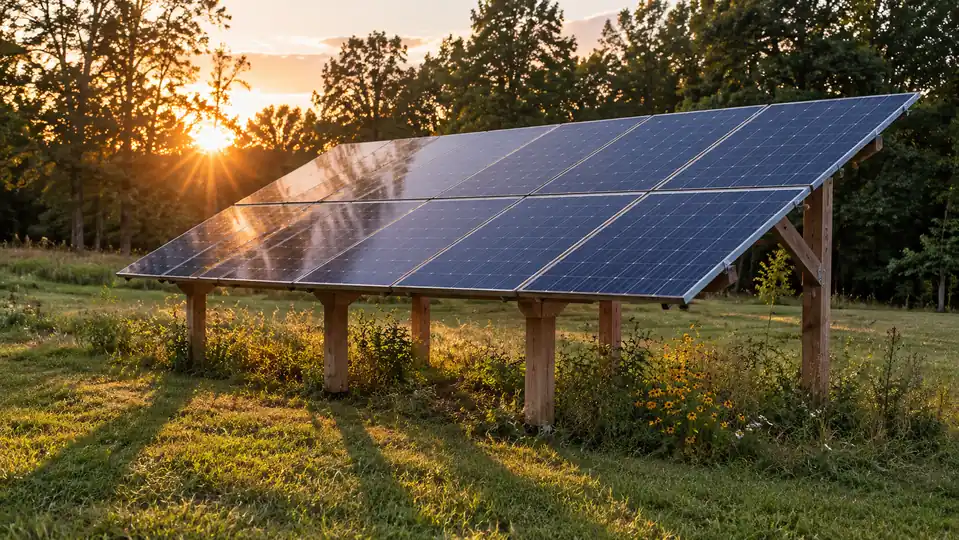
I already had a small ground mount array, and the last thing I wanted was a station that demanded its own dedicated panels. This one takes a solar charge, so the panels I bought years ago still earn their keep. On a clear day I set it out in the morning and it is topped up by mid afternoon. On a gray day it is not, and that is fine, because the wall outlet is always there as a fallback.
LiFePO4 Means I Stopped Babysitting a Battery Bank
The chemistry in the case is LiFePO4, and that is the reason my voltage notebook lives in a drawer now. The old lead bank wanted to be kept full, wanted equalizing, and sulked through a cold snap at half charge. I do none of that anymore. I check the level, I use it, I charge it when it needs it. Six years out here taught me the equipment I keep is the equipment that asks the least of me in February.
Pure Sine Wave AC at 1,500 Watts Runs the Fussy Loads
Two of the outlets are pure sine wave AC rated at 1,500 watts. That matters for anything with a motor or a circuit board inside it. The small fridge, the box fan, the shop light over the bench, the charger for my drill batteries. Rough power makes some of that gear hum or run warm. This does not. I have run a fan all night and let the fridge cycle through an evening without a complaint from either one.
I ran the numbers on the next size up and on a second battery, and both were answering a question my cabin does not ask.
Seven Outlets End the Family Charging Argument
Seven outlets total, and I have used every one of them on a single Saturday. Two USB-C, one USB-A, one DC car port, and two pure sine wave AC ports. Dana charges a tablet, I charge a phone and a headlamp, the radio stays plugged in, and there is still a free port when a neighbor walks over with a dead flashlight. Port count is not a glamorous thing to talk about. It is the reason the unit gets used every day.
A 10 Millisecond Switchover Keeps the Freezer Alive
The Jackery has a 10 millisecond switchover, and that is the spec I did not expect to care about. It sits between my main inverter and the sensitive gear, which is the small chest freezer and the little box that keeps my internet working. When I shut the inverter down to change a fuse or clean a terminal, those loads never blink. Ten milliseconds is faster than the compressor can notice. Before this, every maintenance job meant unplugging things and hoping.
It Is Silent, Which Matters at Two in the Morning
No pull cord, no exhaust, no fuel can, and no reason to walk it out to the yard before starting it. I have run it inside the cabin on a January night with the door shut and nothing in the room smelled any different afterward. My hearing is not what it was at 30, but the loudest thing in that room at 2 a.m. is the wood stove settling. After twenty years around engines at the mill, the quiet took some getting used to.
It Rides in the Truck for Creek Days and Weekend Builds
It weighs a little over 23 pounds, so it goes in the truck bed next to the tackle box when I fish the creek. At the tailgate it runs a light and charges a phone after dark. Then it comes back to the shed and takes a charge from the array. One battery doing two jobs is worth more than a second battery doing one. If you are building out a place on a budget, that overlap matters more than any line on the spec sheet.
The App Answers the Walk Question From the Kitchen Table
It has app control, and I will be honest about how much I use it. Less than I expected. What I do use it for is one question: do I need to carry it in, or is it still at 70 percent? I can look from the table instead of pulling on boots. That is not a feature anyone brags about. It is the kind of thing that makes a tool easy to live with, and easy to live with is what actually gets used out here.
What I'd Skip
If you are standing where I stood six years ago, here is what I would leave on the shelf. I would skip the next size up. A bigger station buys capacity you will not touch unless you are running a microwave and a coffee maker at the same time, and you pay for it in the one thing that makes this unit useful, which is that you can pick it up with one hand. I would skip a second battery for the same reason. I would also skip a transfer switch for the whole panel. I have watched folks burn an entire season wiring a panel for a battery that can only carry three circuits.
Here is the plain version of the limits. This is not a whole cabin system. It will not run a 240 volt well pump, it will not run a water heater, and a hard cold snap will trim what the battery gives you. That is not a flaw in the unit so much as a mismatch of jobs. Size it for the loads you actually have after dark, keep the heavy lifting on your main system, and it will serve you for years. I am grateful for the Jackery, plainly, and I would buy it again.
Match the Battery to Your Evenings, Not the Whole Cabin
Every reason on this list comes back to the same idea: cover the loads you actually have after dark and leave the heavy work to your main system.
Amazon Check Today's Price on Amazon →