
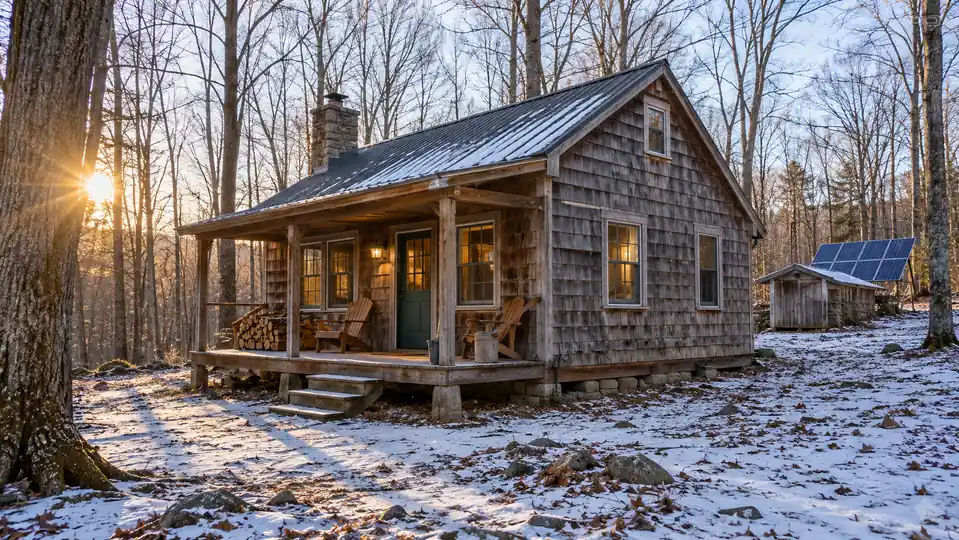
The short answer first, because I know why you clicked. The Jackery Explorer 1000 v2 covers almost everything a cabin actually needs backed up, and a gas generator covers the rest. I own both, and after six years off the grid on fourteen wooded acres an hour outside Syracuse, I can tell you they have never once been asked to do the same job.
I bought the generator first, because that is what everybody buys first. A 2,200-watt inverter unit in the Honda EU2200i class, and it carried the well pump, the fridge and the shop lights through four winters without complaint. The Jackery came later, mostly for camping and for running a drill where there was no outlet. Then a funny thing happened. Within a month the generator was under a tarp and the power station was on the bench by the door, and that is the whole reason I am writing this down.
Here is the honest shape of it before we get into the weeds. If your worry is a two-day ice storm, or an inverter that trips at two in the morning, and you want the furnace blower, the fridge and the modem to keep running without putting on boots, the Jackery does that. If your worry is a five-day January outage where the well pump cycles forty times and the saw needs to run, the generator does that, and no 1,024Wh battery is going to. The rest of this is where the line falls, and what I would spend my own money on if I were starting over.
| Jackery Explorer 1000 v2 | Inverter generator (Honda EU2200i class) | |
|---|---|---|
| Weight and moving it | 23.4 pounds with a foldable handle, one hand from the shed to the kitchen | Close to fifty pounds dry, plus a fuel can in the other hand |
| Where it can run | Indoors, in the power shed, beside the fridge. No exhaust at all | Outside only, cord through a window, exhaust pointed away from the house |
| Noise | A cooling fan you forget is running | Conversation stopping. Anyone within a quarter mile knows |
| Runtime in a long outage | 1,024Wh, then it needs a wall outlet or the sun | Refuel and keep going as long as the gas holds out |
| Hard starting loads | 1,500 watts continuous, and honest about its ceiling | Surge and fuel behind it for a well pump or a compressor |
| Upfront cost | More to buy, then almost nothing to run | Cheaper to buy, then gas, oil, stabilizer and spark plugs |
| Maintenance | None. Plug it in now and then | Oil changes, stale gas, a carburetor that sulks if you skip a season |
| Coming back on | 10ms seamless UPS. The light does not blink | Walk outside, choke, pull, listen, wait |
| Recharging with no fuel | Takes a charge from a panel when the sun shows up | Dead in the water without gasoline |
| Best for | Outages measured in hours, electronics, indoor use, camping | Multi-day outages and running heavy tools |
Read that table honestly and you will notice it does not have a loser. It has two machines built for two different lengths of trouble. What follows is how I landed on keeping both, and which one I would buy first if the budget only stretched to one.
Where the Jackery Explorer 1000 v2 Wins
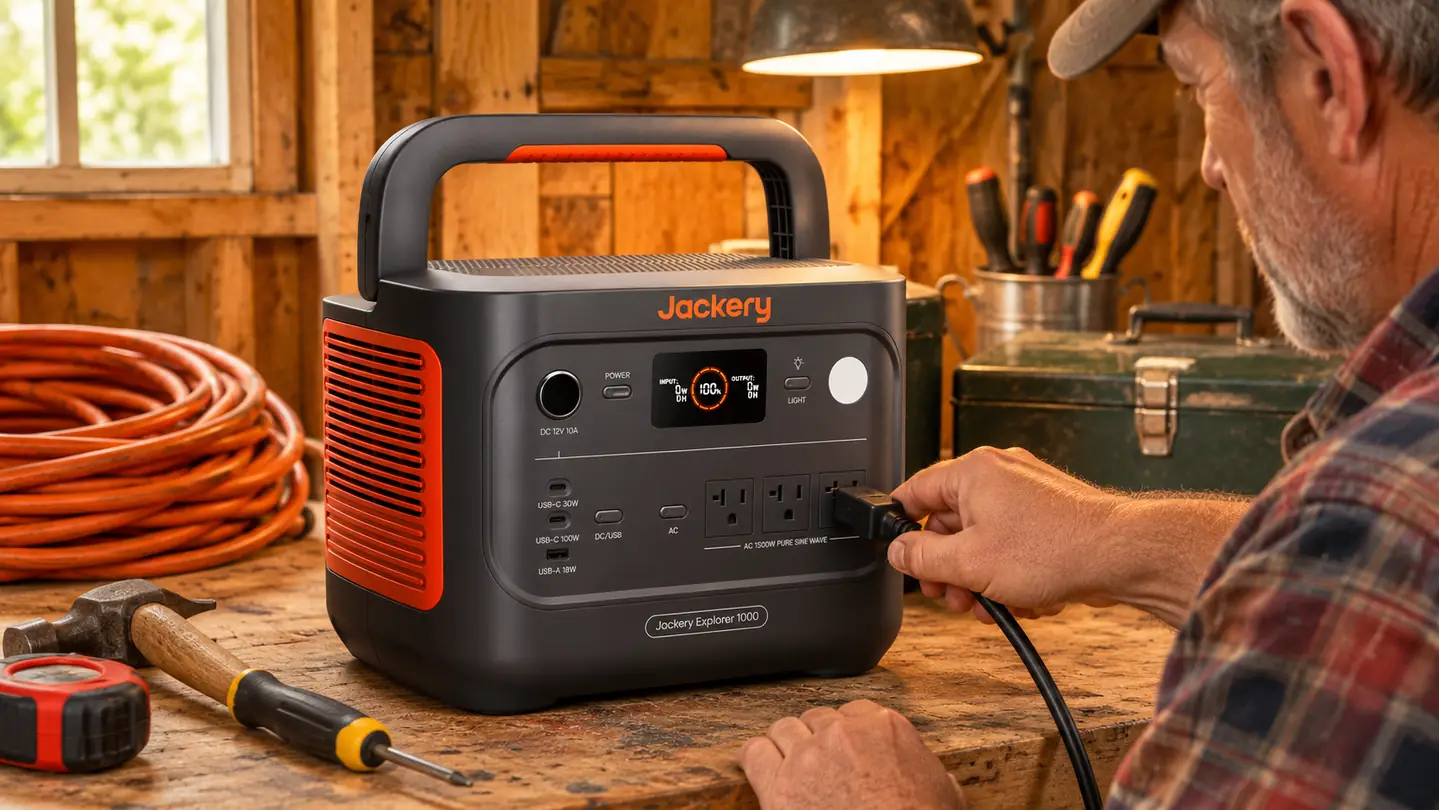
The first win is the one that changes how you live with it: it does not have to sit outside. No exhaust, no carbon monoxide, no cord run through a cracked window with a towel stuffed around it. In February that matters more than anything on a spec sheet. Mine lives on the bench in the power shed, and the fridge and the modem stay plugged into it year round, so when something fails at two in the morning I am not standing in the snow in my long johns pulling a recoil cord and hoping.
The second is that it comes back on instantly. The Explorer 1000 v2 runs a 10ms seamless UPS for home backup, which in plain English means the light does not even blink. My inverter let go last March during a wind storm and the only reason I knew was that the clock on the stove needed resetting. With the generator I get a walk outside, a choke, a pull, and thirty seconds of listening to it hunt before it settles down. I have done both, and I know which one I want at three in the morning.
The third is the boring arithmetic of moving it. Twenty three and a half pounds with a foldable handle, which is one hand and no grunting, and it fits under the truck seat on the way to the lake. Two pure sine wave AC ports, two USB C ports, one USB A port and a DC car port, so the laptop, the phones, the radio and the drill battery all get a place to plug in. Pure sine wave matters if you are charging tools or feeding a modern fridge control board. It also goes from empty to full in about fifty minutes on a wall outlet, which is faster than I can get the generator out, fueled and started. And it is a LiFePO4 battery, which is the chemistry you want in a machine that sits for months and then gets asked to work.
Where the Gas Generator Wins
I am not going to pretend a battery is the whole answer, because it is not, and anyone who tells you it is has not spent three days in the rain. A 1,024Wh battery is a bucket. You can pour it out fast or slow, but when it is empty it is empty, and a solar panel under a foot of snow makes nothing at all. The generator makes power as long as there is gas in the can and a station open to refill it. That is not a small thing when the road is a sheet of ice and the forecast has four more days of grey in it.
The second win is hard starting loads. A well pump coming on against a cold pressure tank, a chest freezer pulling hard to get back down to temperature, an air compressor, a circular saw. The Explorer delivers 1,500 watts and it is honest about where that stops. The generator has the surge behind it and the fuel to keep surging. If your plan for the afternoon is cutting plywood for a new woodshed, you want the generator running outside and you want ear protection while you do it.
The third is the shape of the two bills. The generator is cheaper to buy. Then you buy gasoline, oil, stabilizer, a spare plug, and you change the oil every season whether you ran it or not. Stale gas will gum a carburetor faster than anything else in your shed, and a generator that will not start during an outage is a very heavy paperweight. The Jackery costs more up front and then asks for almost nothing but an outlet. Over six years those two lines cross, though I would not buy either one on that arithmetic alone. Buy the one that does your job.
If your outages are measured in hours, not days, this is the one that earns the shelf
The Explorer 1000 v2 sits on my bench plugged in, stays topped up, and takes over in 10ms without me getting out of the chair. 1,024Wh, 1,500 watts, twenty three and a half pounds, and a full charge in about fifty minutes.
Amazon Check Today's Price on Amazon →What the Explorer Will Not Do
I want to be plain about the limits, because I have read enough cheerful write-ups to last me. This unit will not run my well pump. It will not run a space heater all night, or a table saw through an afternoon of trim work, or the welder when a bracket cracks in February. It will not carry a five-day outage on its own unless I am careful and the sun cooperates. Anyone who tells you a 1,024Wh battery replaces a generator has never owned one.
It also does not love the cold, and neither does any battery. Mine lives in the shed, and a unit that has been sitting at twenty degrees overnight does not give you everything the label suggests until it warms up. I bring it into the cabin when I know weather is coming, and I keep it topped up rather than drained, because a full battery is a battery you can use. That is not a flaw in the machine. It is just how you have to think about it.
And there is the honest matter of noise versus silence cutting both ways. The Explorer is quiet enough that I forget it is running, which also means I forget it is running down. The generator is loud enough that I never forget, and I can hear it change pitch when a load kicks on. Both of those are useful in their own way. The difference is that one of them tells you what it is doing and the other one just quietly does it until it stops.
The Night the Inverter Let Go
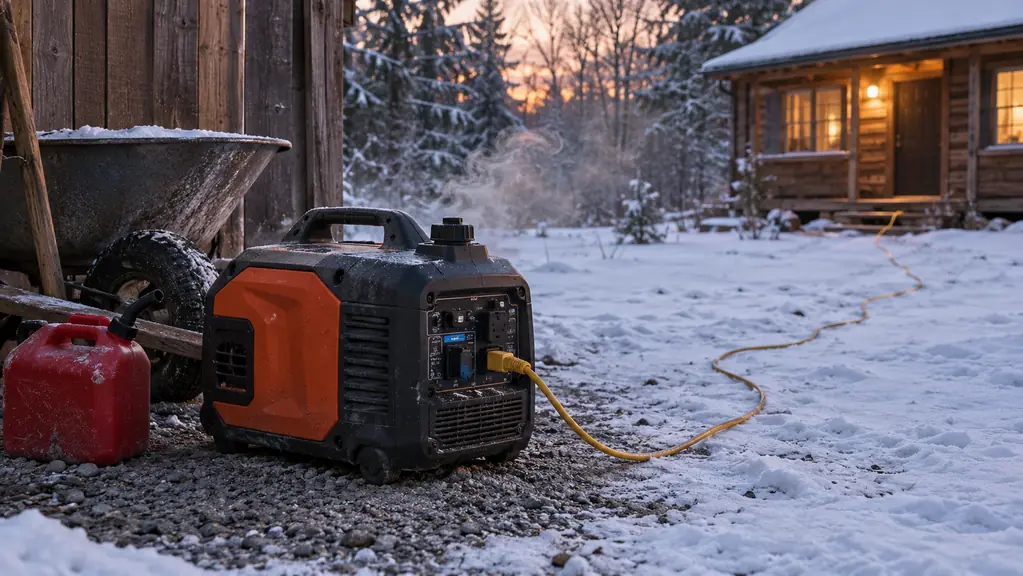
Two winters back I lost my inverter at about ten at night. Wind came through hard enough to take a couple of limbs off the maples behind the shed, and one of them found the conduit. Dana was already asleep. I had a headlamp, a meter and no idea how long the repair would take, and the temperature was sliding toward single digits.
The Explorer ran the fridge, the modem and the furnace blower for the rest of that night and most of the next day. Not the well pump. I did not ask it for the well pump, and it did not pretend it could. When the battery got down to about a quarter I carried it to the truck, drove to the diner in town, and charged it while I ate eggs and read the paper. Fifty minutes later it was full and I drove home. That is not a story about a wonderful battery. It is a story about a machine small enough that I could pick it up and solve the problem over breakfast.
The generator would have handled the same night, and it would have handled three more just like it if I had enough gas on hand. But it would have meant a cord through the window, a machine idling forty feet from the house at all hours, and a trip for fuel anyway once the cans ran dry. Both tools work. One of them works without me getting dressed. I am grateful for that in a plain way, the way you are grateful for a good coat.
The Explorer ran the fridge, the modem and the furnace blower all night and most of the next day. I did not ask it for the well pump, and it did not pretend it could.
Who Should Buy Which
Buy the Jackery Explorer 1000 v2 if your outages run in hours rather than days, and if the things you actually miss are the small ones: the fridge, the modem, a lamp, the furnace blower, a charged phone, a drill on a job with no outlet in sight. Buy it if you want to be indoors when the power comes back, and if you like the idea of charging from a panel instead of standing in line for gasoline with a can in each hand. Buy it if you are setting up a cabin and you want one machine that covers the first day and a half of almost anything.
Buy the generator if you are planning for a week, if you have a well pump or a compressor that needs real surge, if you are building something and running tools all afternoon, or if the sun in your part of the country disappears for four days at a stretch in January. And if you can manage it, buy both. They are not competitors. The generator is the long haul. The Jackery is the two in the morning.
The one I would replace first if it walked off the bench
Six years off the grid and the Explorer 1000 v2 is the piece of equipment I use most and think about least. 1,024Wh, 1,500 watts, twenty three and a half pounds, a 10ms UPS, and a full charge in about fifty minutes.
Amazon Check Today's Price on Amazon →