
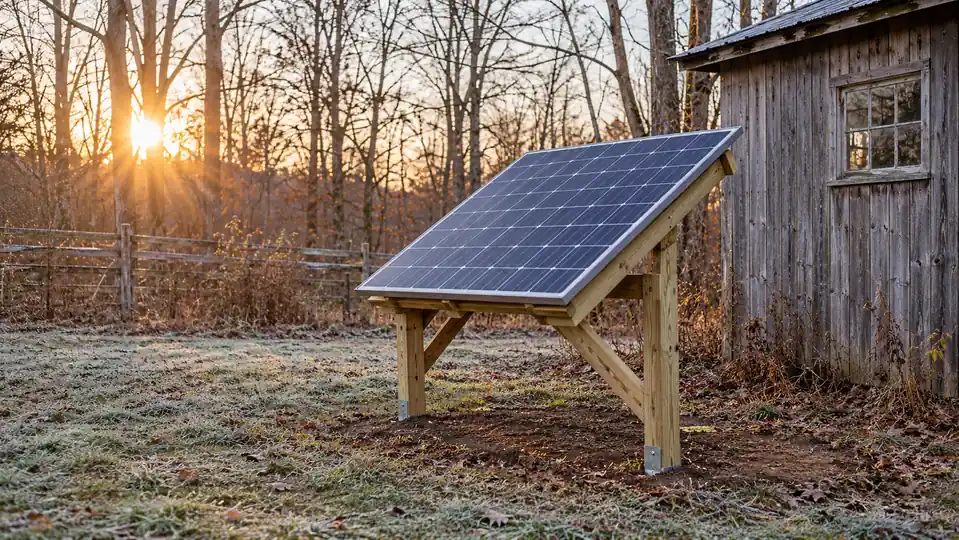
The number I watch hardest every November is not the temperature. It is how much charge is left in the bank at three in the afternoon. By the first week of the month the sun comes through the hemlocks low and flat, and whatever the panels put in that day has to carry Dana and me until morning. A year ago this month I bolted the Renogy 200W Solar Panel Kit onto the ground mount behind the power shed to help with exactly that stretch. Twelve months later I have a fair amount to say about it, including the parts I would do differently if I were starting over today.
Short version first. It has done the job a 200 watt kit is supposed to do, and the charge controller that came with it has been better than I expected. The long version is below, season by season, with the weeks it fell short.
The Quick Verdict
A year outdoors in New York weather with no failures and no rust on the frame. The 30A PWM controller is the half of this kit that earns its keep. Buy it as part of a small system, not as a standalone answer.
Amazon Check Today's Price →One year outdoors, one ice storm, zero failures
This is the exact kit on my ground mount, the 200 watt panel with the 30A Wanderer controller. Check what ships in the box today before you plan your mount.
Amazon Check Today's Price on Amazon →How I've Used It
My system is small and I have kept it small on purpose. The cabin is 24 by 32, finished by my own hands over a long stretch of weekends. It runs on a battery bank that carries lights, a chest fridge, the well pump and my tools, and it heats with a wood stove. A 200 watt kit was never going to carry that by itself. The Renogy panel sits behind the power shed next to an older panel and adds to what the bank sees each day. That is how most folks will use a kit this size, as one part of a system rather than the whole of it.
I built the mount from pressure treated 4x4s with a fixed tilt facing south. I set the angle for the low December sun and left it alone, because I would rather lose a little June output than climb up there in February with a wrench. The panel frame is aluminum and it is bolted down at four points. After a year of frost heave and one ice storm it has not moved a fraction.
That mount took me most of a Saturday in late October. I dug four holes about two feet deep, set the posts in gravel and tamped them by hand a few inches at a time, then checked the whole thing with a four foot level before I hung anything on it. The frame sits roughly three feet off the ground, high enough that the grass under it does not rot the wood and low enough that I can reach the panel face with a broom in February. I ran a bead of caulk around each lag bolt, which is a habit left over from my millwright years and probably more than a panel this size needs.
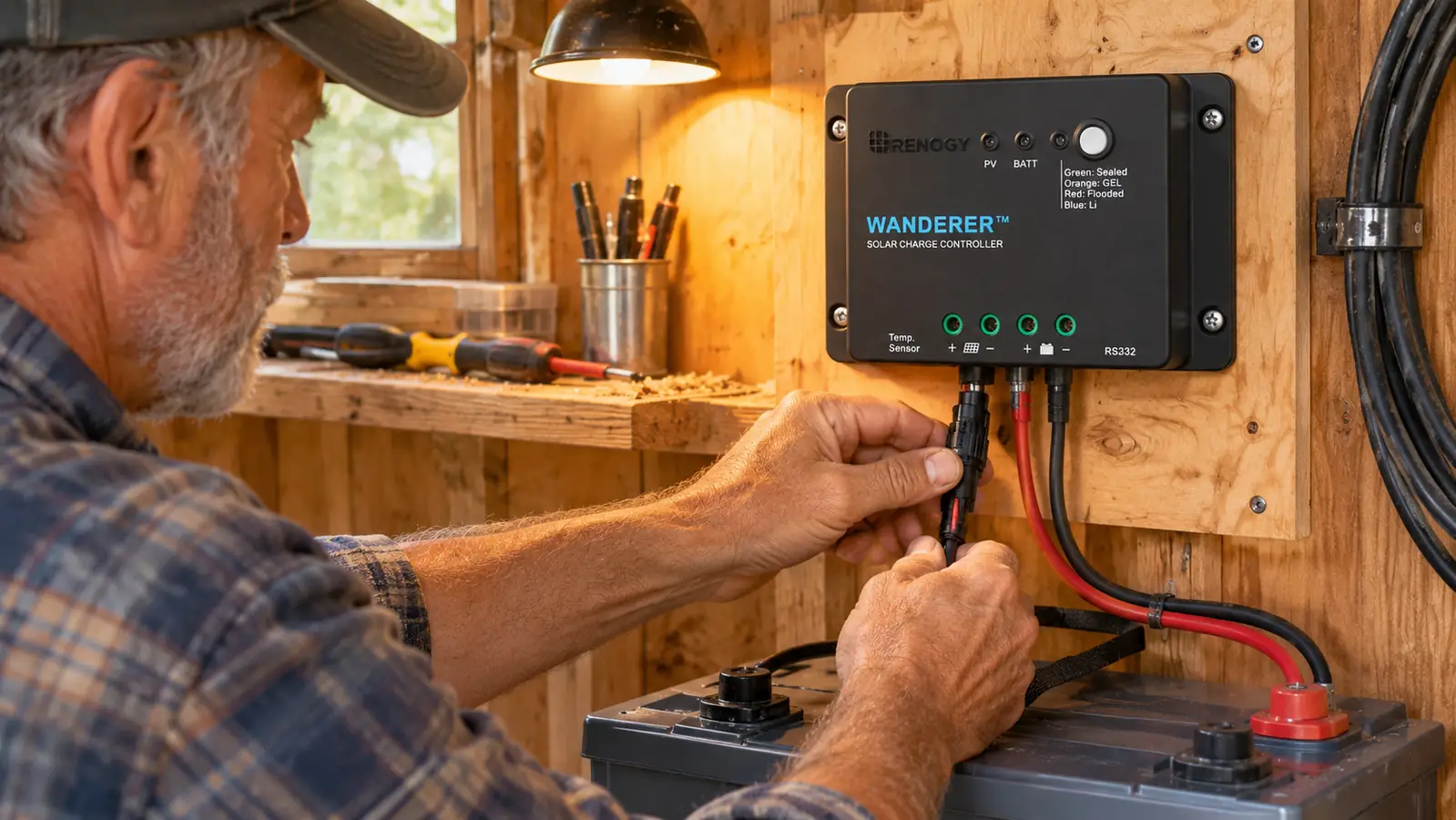
The run from the panel to the controller is about fifteen feet. I used what came in the box on the panel side and heavier cable for the run to the battery bank, and I put a fuse in that run because I like my shed the way it is. The controller is mounted on a plywood board next to the bank where I can put a hand on it. Morning check, three o'clock check, and on the short days a decision about whether the generator comes out. That is the whole routine.
In twelve months I have run the generator fewer times than the year before. That is the only number I really care about, more than watts or amps. Some of that is the panel, some of it is the controller doing its job without me thinking about it, and some of it is me finally learning to turn the lights off when I leave a room.
What Comes in the Box, and What Doesn't
What arrived was the 200 watt monocrystalline panel, the 30A PWM charge controller, and a cable to join them. The panel is rated at 200 watts max and 22 percent efficiency at 12 volts nominal. The controller is the Wanderer, 30 amp, pulse width modulation, with four stage charging: bulk, boost, float and equalization. It carries a five year material and workmanship warranty, which is longer than I expected for a kit this size.
Plan on supplying the rest yourself. The box is the panel, the controller and the cable between the two. The mount, the fuse, and the cable run out to your battery bank are yours to figure out. Knowing that going in, it still cost me an afternoon at the hardware store and a second trip back for the right lugs. If you are putting this on a roof, you are building the rack. If you are putting it on a ground mount like mine, you are building that too.
A Year of Output, Season by Season
Renogy rates the kit at an average of about 1000 watt hours a day, based on five hours of good sun. That is a fair number for a fixed mount in a place that actually gets five hours. My clearing gets close to that in June and something nearer one and a half hours in December, and the hemlocks on the west side take their cut in the afternoon no matter what the panel is rated.
Summer was generous. From May through August the kit did what the rating suggests and then a little more on the cool clear days, and the bank was usually full by early afternoon. If your load is lights, a fridge and a laptop, 200 watts in a northern summer is real power and not a trickle.
Fall was the honest month. September still produced well. October fell off a cliff the week the sun started dropping behind the ridge before two in the afternoon. November came down to whatever the panel could grab between ten and two. By December and January I had stopped counting watt hours and started counting whether the bank held through the night. Most weeks it did, and that was because the kit was adding to the older panel rather than carrying everything alone.
Take one day as the example, the ninth of December. Clear sky, sun up a little after seven, gone by twenty past four. I checked the bank at eight in the morning and again at three in the afternoon and the difference was small enough that I wrote the generator into the plan for that night. The rest of that week ran the same and then a stretch of gray followed it. That is not a fault in the kit. That is latitude, and no panel in this price range argues with it.
Spring saved the year. March is cold and bright up here, the snow throws light back up at the panel face, and the array started paying again before the ground thawed. By April I had quit thinking about the generator, which is my own definition of a good power system.
The Charge Controller Is the Quiet Half of the Kit
Most people buying a 200 watt kit are buying it for the panel. After a year I would tell you the controller is the half that earns its keep. The 30A Wanderer handles the four charging stages on its own, bulk when the bank is low, boost and float as it fills, equalization when it wants it. I did not have to set that up and I have not had to babysit it. It does the work while I am out splitting wood or down at the creek with a rod.
It also protects the system. The listing calls out short circuit protection and a set of built in protections for the whole setup, and I tested that by accident last March. A connection worked loose in a wind storm and the controller shut the array down instead of letting something cook. I found it the next morning, tightened it up, and it came back like nothing had happened. I would rather learn that lesson on a loose lug than on a battery bank.
The 30 amp rating gives more headroom than a 200 watt panel needs at 12 volts. I like that. It means the controller is not pinned at its limit on a cold bright day when the panel overproduces, and it means that if I add a second panel later I do not have to replace the controller in the same weekend. For a system I plan to keep running for another decade, that counts.
What I do now is simple. Before I light the stove I walk out to the shed, put a hand on the controller and check the bank myself. If the bank is low and the sun is already on the panel face, I know within a few minutes whether the day is a charging day or a generator day. That one small habit has saved me more generator hours than any piece of gear I have bought. The Wanderer runs its four stages whether I am standing there or not, but the standing there is what keeps me from guessing.
What Winter and Wind Did to It
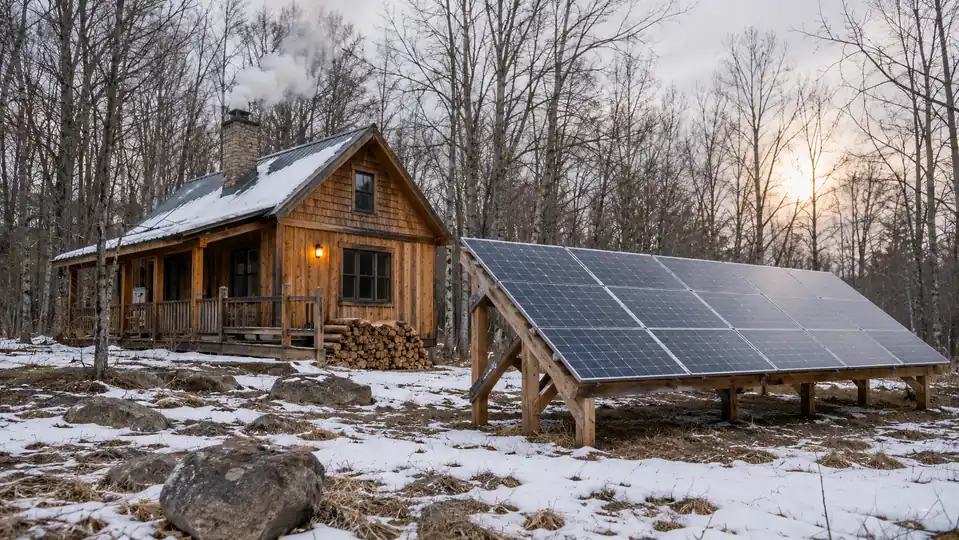
We had one ice storm in February that put a red oak across the driveway and a quarter inch of ice on everything standing. I went out expecting to find the panel on the ground. It was not. The ice slid off once the sun hit the face, the aluminum frame was fine, and the mount had not shifted. I have had lesser gear fail in better weather than that, and I took a certain quiet satisfaction in it. I said a word of thanks and went back in for coffee.
Snow is the bigger nuisance. A fixed mount at my tilt sheds most of it but not all, and there were four or five mornings I went out with a broom. Use a soft broom and do it in the cold before the sun softens the snow into ice. A shovel against a panel is a bad idea, and I have seen the results of that on a neighbor's roof.
In April I walked the whole mount with a wrench and checked every bolt on it. Two of them took a quarter turn and the rest were exactly where I left them in October. That is the kind of thing you only learn by going out and putting a hand on it, and it is why I would tell anyone with a ground mount to put a date on the calendar in spring and again in fall. Ten minutes in April is cheaper than a panel on the ground in July.
Where It Falls Short
Two honest complaints. First, this is a shoulder season tool in this climate. From April to October it carries lights and a fridge without a second thought. From November to February it is a supplement. Anyone who tells you a 200 watt kit runs a full time cabin through a New York winter is either selling something or lives somewhere a good deal sunnier.
Second, it is PWM and not MPPT, and it is a 12 volt nominal system. That is the right match for a 200 watt array on a short cable run. If you are planning a bigger array, moving to a higher voltage bank, or pushing cable a long way, this is the wrong starting point and no setting will fix it. Buy the gear that matches the system you are actually building, not the one in the catalog photo.
What I Liked
- Aluminum framed panel that came through a year of New York ice and wind without shifting or rusting
- 30A PWM Wanderer controller with four stage charging and short circuit protection
- Panel, controller and the connecting cable arrive together
- 30 amp controller leaves headroom for a second panel later
- Five year material and workmanship warranty
- Produced close to the rated 1000 watt hours a day from May through August
Where It Falls Short
- No mount, no fuse and no battery cable in the box
- PWM rather than MPPT
- Output drops hard from November through February in the Northeast
- Fixed tilt costs you some summer production unless you adjust the angle
- 200 watts supplements an existing bank, it does not carry a full time cabin alone
From May through August the kit did what the rating says and then some. From November through February it was a helper, not a hero.
Who This Is For
This is for the person with a small system already in place who wants more headroom in the shoulder months. If you have a 12 volt bank, a shed or a cabin, and a load that is lights, a fridge, a pump and a few tools, the Renogy kit slots in without a redesign. It is also a sane first panel for someone building out a ground mount who wants to learn the wiring on something manageable before spending serious money on a larger array. The four stage charging means it will treat your battery right while you learn.
Who Should Skip It
Skip it if you are trying to run a full time off grid house on 200 watts, because you will be disappointed by January. Skip it if you have already moved to a 24 or 48 volt bank, since this controller is built for 12 volts. Skip it if your only sun in the deep of winter is a couple of hours and you have no generator to fall back on. And skip it if you want a kit that includes the mount and the battery cable, because this one does not.
A year of New York weather later, it is still bolted to that mount
If your short days look like mine, this is the kit I would start with. Check the current listing for what ships in the box, then build a mount that faces south and leave it alone.
Amazon Check Today's Price on Amazon →