
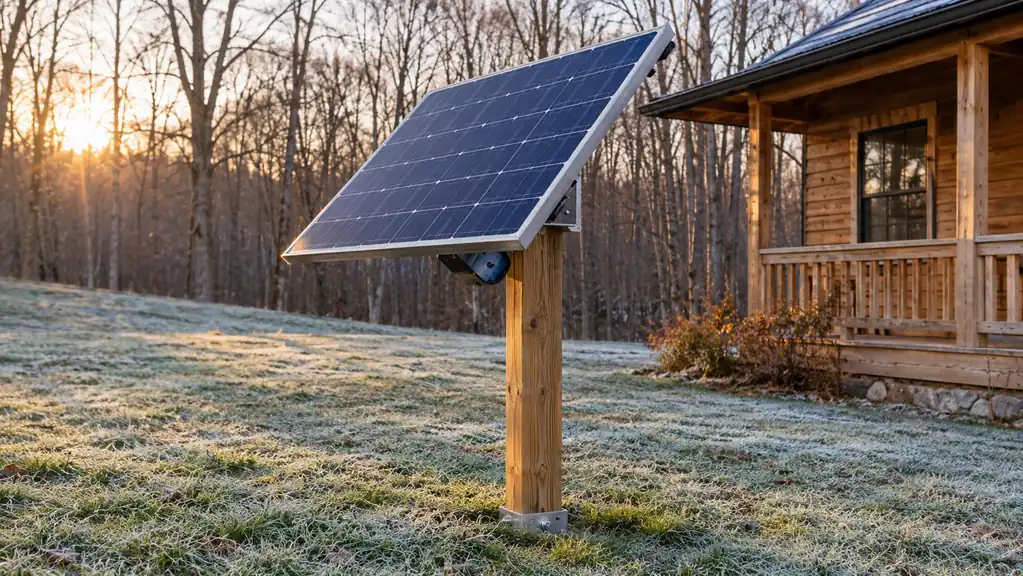
The short answer first, because that is what I would want if I were the one reading: if the panels are going to live in one place, buy the Renogy 200W Solar Kit. If they need to ride in the truck and come out at a different campsite every weekend, buy a folding panel and stop worrying about it. I have run both on my place in upstate New York, and the reason the answer splits has nothing to do with quality. It has to do with whether the panel has a home.
I finished this cabin six years ago. It is 24 by 32 foot, on 14 wooded acres about an hour outside Syracuse, and it runs off a battery bank in a shed I built behind the woodpile. The main array is on a ground mount I welded myself. A 200W Renogy kit feeds the smaller bank that runs the well pump controls and the shed lights. A borrowed 200W folding suitcase panel spent most of one summer here, mostly because I wanted to find out whether I had wasted a Saturday building a mount. I had not.
| Renogy 200W Kit | 200W Folding Panel | |
|---|---|---|
| Stays put in wind | Bolted to a post and framed, it does not move until you move it | Light enough to carry, light enough to tip. I stake the legs and still watch the sky |
| Moves with you | Not built to travel. Once it is mounted, it is mounted | Folds into a case about the size of a guitar case and rides behind the truck seat |
| Charge controller | 30A Wanderer PWM controller in the box, 4-stage charging, short circuit protection | Usually none. You supply one or plug into a power station |
| Aiming at a low winter sun | Fixed once mounted. You set the angle when you build the frame and live with it | Legs let you tip it toward the sun in a few seconds, as often as you like |
| First setup | A morning with a post hole digger, a level, and a frame you supply | Unfold, plug in, done in five minutes |
| Adding capacity later | Step up to a bigger controller and add panels to the same array | You buy another complete folding panel |
| Working around trees | One branch across a cell and output drops, same as any panel | You can walk the panel around the branch all afternoon |
| Warranty | 5-year material and workmanship warranty | Typically a year or less on the units I have looked at |
| Best for | A cabin, shed, or pump house that stays put | Camping, a job site, a boat, a place you visit twice a month |
How I Compared Them
I ran both panels against the same battery bank on the same days and wrote down what the controller showed at dusk. No lab, no calibrated meter, no spreadsheet with three decimal places. A notebook, a shunt on the negative cable, and the habit of checking before I go in for supper. I started on April 12 and kept at it through the following March, because a week in spring tells you almost nothing about a panel. What I cared about was not the best day, since any panel makes power in July. I cared about the ordinary days, high cloud and a low sun, because that is most of the year here.
The other half of the comparison has nothing to do with watts. It is the twenty minutes of fiddling every time a portable panel comes out of its case, and the fact that a panel bolted to a post never has to be carried, aimed, staked, or remembered. Multiply twenty minutes by every decent day for six years and it starts to weigh more than the number printed on the box. I tried to beat that first. In May I left the folding panel set out on a pair of sawhorses behind the shed for two weeks, thinking I would skip the setup and just walk out and plug in. It worked right up until a gust on the nineteenth flipped it face down in the gravel and dinged the corner of the frame. That was the end of shortcuts. Anything that lives outside here has to be fastened to something.
I also ran the comparison in February, which is the month that tells the truth. Low sun, short days, panels half buried in snow by nine in the morning. Both of them underperformed. The kit underperformed less, because I could walk out with a broom and clear it without unbolting anything, and because a fixed south angle is close to right in winter anyway. The folding panel did better in the afternoon, when I could tip it nearly vertical to catch the low light. That is the whole trade in one February day.
One ground rule before we go further. Both of these are 12 volt systems that charge a battery. Neither one turns a cabin into a grid-connected house. At 200 watts you are topping up a bank, running lights, a fan, a laptop, a well pump control. If you want a refrigerator and a microwave running at the same time, you need more panels than either of these, and you probably know that already.
Where the Renogy Kit Wins
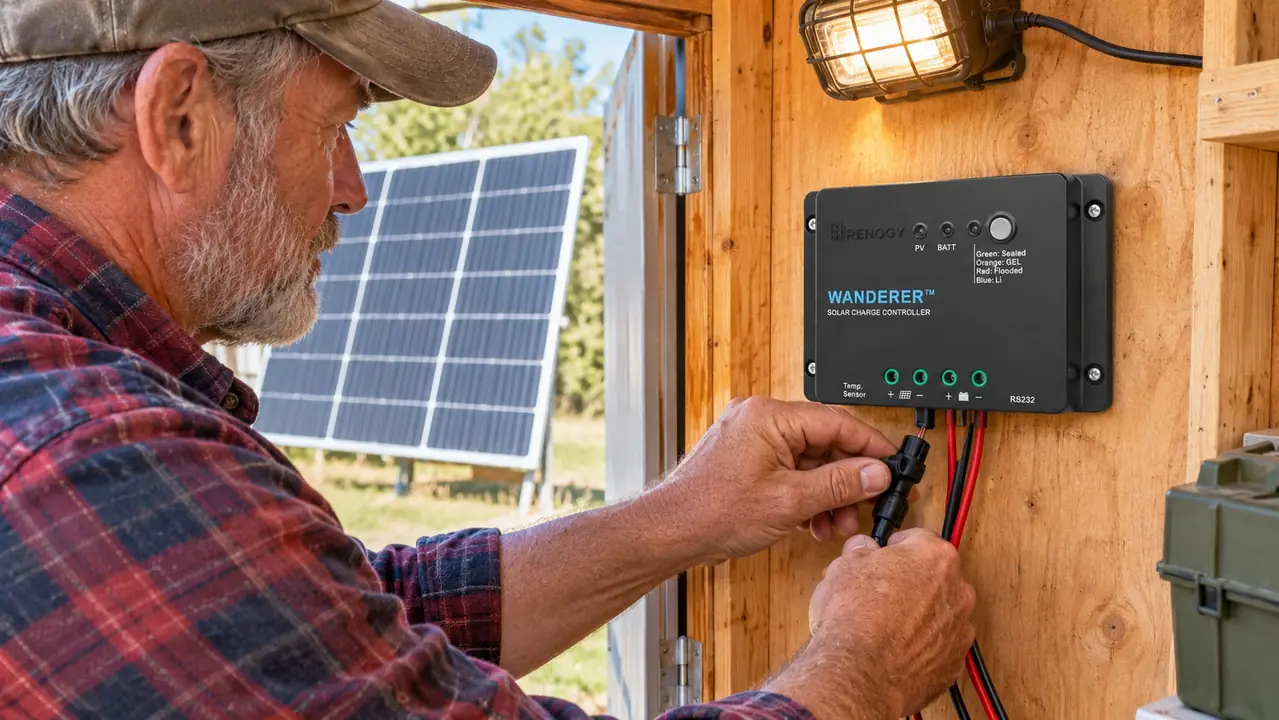
The controller comes in the box. That reads like a small thing until you have priced one separately and then stood in a cold shed at nine at night squinting at a wiring diagram. The 30A Wanderer PWM controller is included, it does 4-stage charging (bulk, boost, float and equalization), and it carries short circuit protection. That last part earns its keep if you are the sort of man who has ever set a wrench down across a battery terminal. I am that sort of man.
The panels are monocrystalline at 22 percent efficiency, and Renogy rates the kit at an average of 1,000 watt-hours a day on five hours of sun. My honest number in April, with a fixed angle and hardwoods to the south, runs 700 to 800. In June it beats the rating. In January my best clear day was a little over 400, and a gray one in the middle of the month did not break a hundred. That is not a complaint. Every panel maker quotes a good day, and the sane way to read any of those figures is as a ceiling rather than a promise.
The larger win is that it stays where you put it. I sank a treated 4x4 thirty inches into gravel, cut a frame from angle iron, and set the face about 40 degrees toward true south. That panel has not moved since. Wind comes down this valley hard enough to peel shingles, and the gale we got the second week of November took a run of shed roof and never touched the panel. A bolted panel does not care. A panel resting on its own legs does, and you will find yourself watching the weather instead of the battery.
It also grows with you. The 30A controller has room left on it. Two hundred watts at 12 volts pulls under 17 amps, so there is headroom for another panel or two before the controller becomes the limit, and when I wanted more I added panels to the same frame rather than replacing the whole thing. Renogy backs the hardware with a 5-year material and workmanship warranty, which is longer than I expected at this end of the market and longer than most of what I have bought for this place.
There is one more thing, and it is not on the spec sheet. A bolted panel is a fixed part of the property. It is on the insurance list, it is in the mental map of the place, and nobody walks off with it. A folding panel in a case is a thing that can be carried away, and I have heard of exactly that happening at a trailhead. Not often. Once is enough.
Both panels made about the same on a clear April afternoon. The kit made power on the gray ones too, for the simple reason that it was already out there and pointed the right way.
Where the Folding Panel Wins
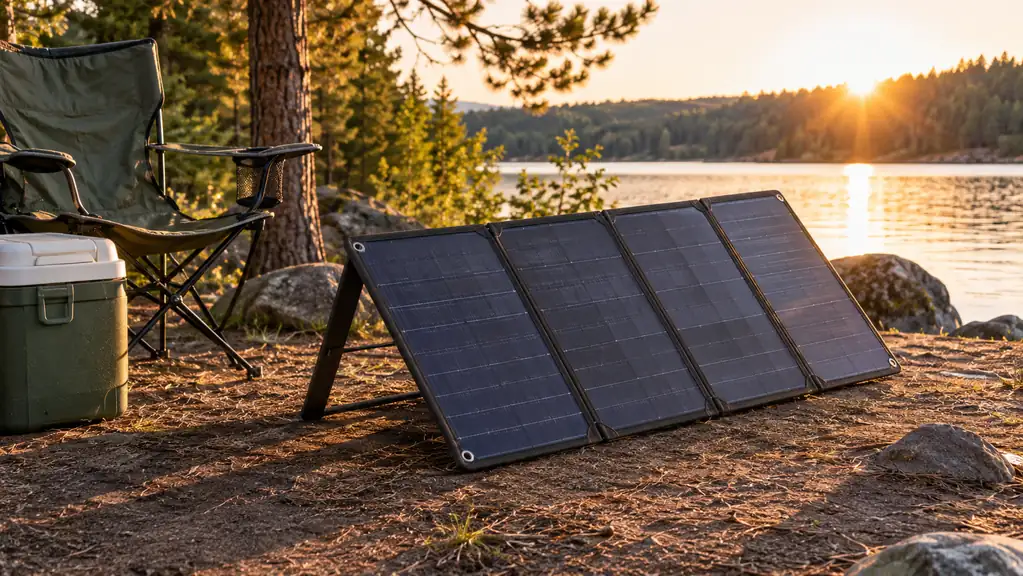
It travels, and that is not a small thing. The one I borrowed folded into a case about the size of a guitar case and rode behind the seat of the truck for a month without complaining. I carried it down to the creek in one hand. Try that with a framed 200 watt panel and you will need a second person and a good reason.
It aims. The folding unit has legs that let you tip it toward the sun in a few seconds, and over one day I moved it three or four times. On the eighth of July I set it up on the gravel bar while I fished and moved it four times between eight in the morning and four in the afternoon, tracking the sun around a big hemlock. The battery kept climbing all day. Left in one spot at one angle it would have been in that tree's shadow by two. On my fixed mount I set the angle in November and live with it until March. If your spot has trees to the south, being able to walk the panel around a branch is worth real watt-hours, more than the difference between one brand and another. That is why the tree row in the table above is a tie. Neither design fixes shade. Only moving the panel does, and only one of these can be moved on a whim.
It also has no install. No post hole, no frame, no level, no waiting for a dry Saturday. Unfold it, plug it in, done. For a renter, a camper, or a man who is not sure yet where his permanent array ought to go, that is the whole argument in one sentence. The catch is that most folding panels ship without a controller, so you buy one anyway, and then you are back to the same wiring job you were trying to avoid.
If the panel has a permanent home, this is the one to bolt down
The Renogy 200W kit arrives with the panels, the 30A Wanderer charge controller and the cable. One Saturday with a post hole digger and you are done. 1,546 ratings, 4.6 average.
Amazon Check Today's Price on Amazon →What I Liked
- Charge controller is included, so there is no separate shopping trip
- Bolts down and stays put through valley wind
- Monocrystalline panels at 22 percent efficiency
- 5-year material and workmanship warranty
- Straightforward to expand when you want more headroom
Where It Falls Short
- Needs a post hole and a frame you supply yourself
- Fixed angle unless you build an adjustable mount
- Not something you pack for a weekend at the lake
- A PWM controller is right for a small bank, not a big one
Who Should Buy Which
Buy the Renogy kit if the panels have a place to live. A cabin, a shed, a pump house, a hunting camp, a travel trailer that stays parked more than it rolls. If your routine involves walking out to the same spot every morning and glancing at a controller, you want hardware that is already bolted down and already aimed. My test is simple. Stand in the yard and pick the spot you would still be happy with in ten years. If you can pick it today, buy the kit. If you cannot, you are not ready for a mount, and you should not build one you will end up moving. You will spend one morning on the install and then forget about it for years, which is the highest compliment I can pay a piece of equipment.
Buy a folding panel if the power needs to move. Camping, a job site, a boat, a borrowed cabin, a winter place you visit twice a month. Or if you genuinely do not know yet where the permanent array should go. Take the folding panel through one full season, watch where the sun actually lands in December, and then build the mount in the right spot. That is not a wasted purchase. That is a survey you can carry in one hand.
The thing that still gets me after six years is walking out to the shed on a clear morning and hearing the controller ticking away, making power out of nothing but daylight. I am grateful for it in a plain way, and I do not take a sunny day for granted the way I did when the lines still came to the house. Whichever of these two you pick, get it out in the sun and pointed the right way. Half the people who tell you solar does not work have a panel leaning against a wall in the shade.
One morning with a post hole digger, then years of quiet
If you have already picked the spot, the Renogy 200W kit is the shortest path from an empty shed to a battery that is actually charged.
Amazon See Today's Price on Amazon →