

The first winter I ran power in the cabin, I built the array out of pieces. A panel from one seller, a controller from another, wire from the hardware store in town, and a fuse block I guessed at. It worked. It also took me three weekends and one cooked controller to get there, and I am still a little sore about it.
A few years later a neighbor asked me to help him set up power in his own shed. He had already bought the Renogy 200W 12V kit instead of going my route. We had it making power in an afternoon, and most of that afternoon was spent building the mount. That contrast is the whole article. Here are ten reasons a matched kit beats piecing parts together, from a man who has done both, in a power shed about forty feet from his back door.
The box I would rather carry out to the shed
200 watts of panel, the 30A Wanderer controller and the connecting cable, matched before they ship. Look at the listing yourself and check today's price before you decide.
Amazon Check Today's Price on Amazon →The controller already matches the panel, so you skip the guessing
The Renogy 200W panel and the 30A Wanderer controller arrive knowing about each other. The panel is rated 200 watts at 12 volts nominal. The controller is rated for 30 amps. Nobody has to sit at the kitchen table with two spec sheets working out whether one will cook the other. That exact check is where my first build went wrong, and a replacement controller cost me more than the afternoon I thought I was saving.
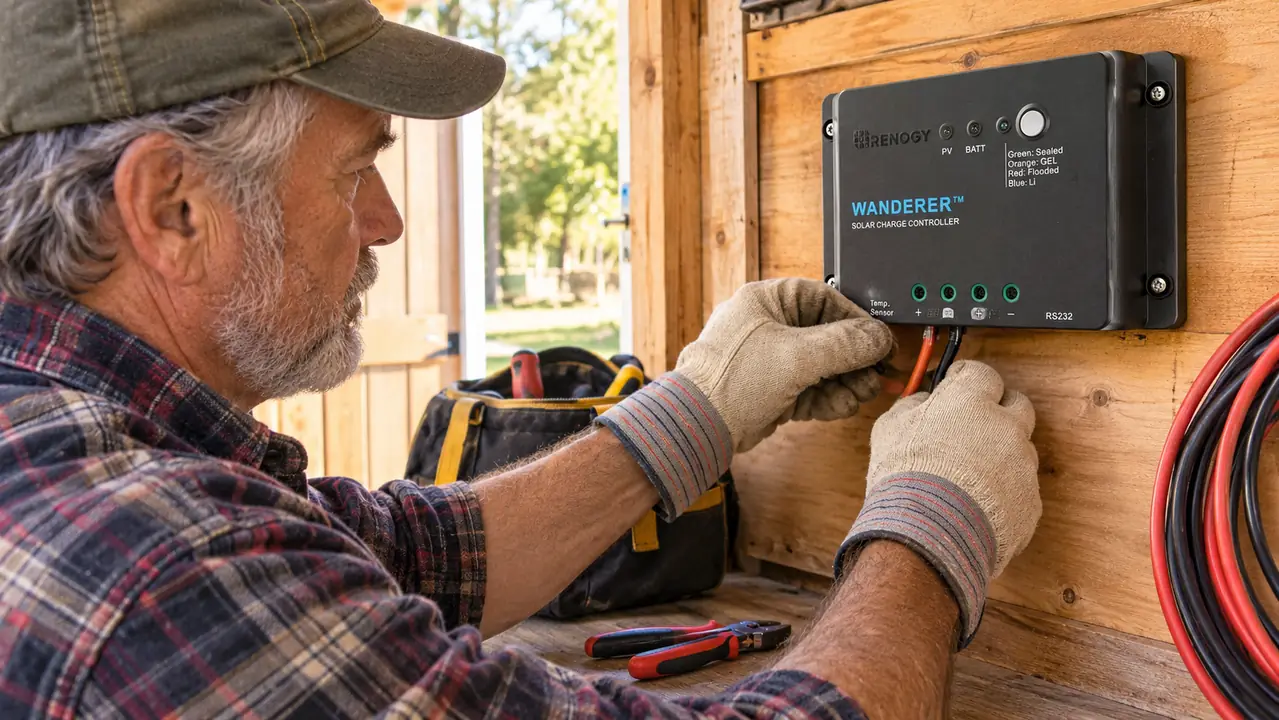
The connecting cable comes with it, so there is no third order
In the box you get the panel, the controller and the cable that joins them. You still need a battery and something to hold the panel up, and I will not pretend otherwise. What you do not need is a third order placed a week late, or a drive into town for a connector that turns out to be the wrong one, which happened to me twice on the first build.
Four-stage charging looks after the battery you already own
The Wanderer controller runs four charging stages: bulk, boost, float and equalization. In plain terms, it pushes hard while the battery is low, eases off as the battery fills, holds a steady float, and equalizes on a schedule. A bargain controller that only knows on and off will still put a charge in. It just does not look after the battery, and the battery bank is the part of a solar system that hurts worst to replace.
The protections are built in, and a shed sits unwatched
Short circuit protection is built into the controller, along with the rest of its safeguards. That matters more than it sounds when the gear lives in a shed forty feet from the house, in February, with nobody walking past it. I have had a loose connection arc on me in a cold shed. I would rather the controller deal with that than find out about it at spring thaw.
There is an honest output number to plan around
Renogy publishes a real figure: about 1000 watt hours a day, based on five hours of good sun. Upstate New York does not hand me five hours of sun in December and I will not pretend it does. But an honest average lets me size the battery bank instead of hoping and guessing. Panel efficiency is listed at 22 percent, which is respectable for a monocrystalline panel this size.
An aluminum frame takes an upstate winter without fuss
The panel frame is aluminum. My ground mount sits at the edge of a treeline where weather comes across the open field, and it takes ice, sleet and the odd fallen branch. Aluminum does not rust, and it is light enough that one man can move a panel without calling for help. Small thing in year one. It is not a small thing in year four.
One warranty covers the kit instead of three arguments
Five years on materials and workmanship, on the kit rather than on one component of it. With a homemade system, the panel seller points at the controller, the controller seller points at your wiring, and you are in the middle holding a multimeter and losing an evening. That runaround is a real cost. It just never shows up on a receipt where you can see it.
You learn one system instead of four
One manual. One wiring diagram that matches what is actually sitting on the bench in front of you. My first array came with four sets of paperwork and three different conventions for labeling positive and negative, and I burned an entire evening reconciling them on a legal pad. That evening is gone. I am not getting it back, and I did not learn anything worth knowing from it.
You can grow the array later without starting over
A second panel of the same voltage can be added down the road without throwing out the first one, and staying inside the same Renogy line keeps the paperwork simple. The 30A controller is the ceiling here, so look up what it will take before you buy more panels, and expect to move to a bigger controller if you go much past this. But the kit does not become scrap the day you want more power. It grows with the property.
When the lights go dim, there is one place to look
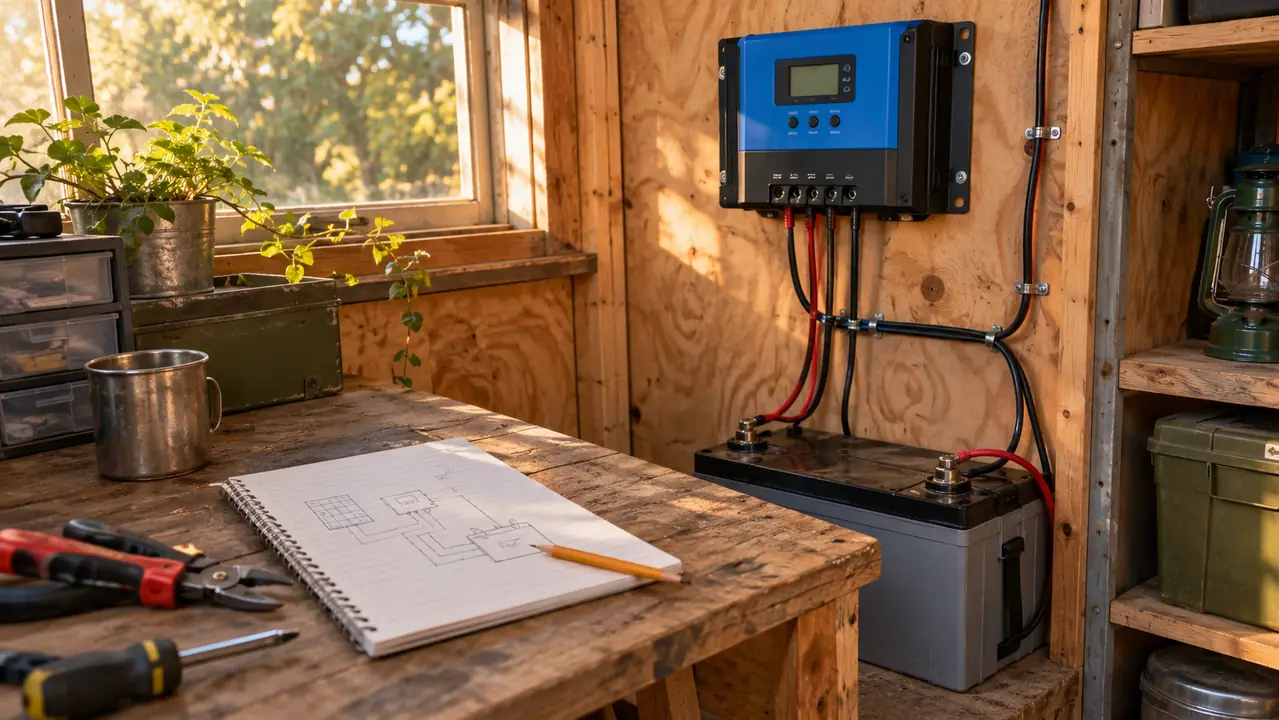
Panel, controller, cable, battery. Four things, in that order, and rarely anything else. I have walked two neighbors through this over the phone and both times we had the problem cornered inside an hour, because there was nothing to rule out first. With a homemade system you start by figuring out which vendor's part is lying to you. That is the worst hour of the whole job.
What I'd Skip
Skip the urge to buy a bigger panel than the controller is rated to handle. Skip adding a second panel in year one, before you have watched one full winter and know what your short December days actually give you. And skip the cut-rate controller that comes with no paperwork, because the savings go out the window the first time a battery fails early. The kit is not a whole-house system and I would not sell it as one. At 200 watts it keeps a battery bank topped up, runs the lights in my power shed, and charges my tool batteries, and it does that quietly for months. It will not run a heater and it will not run a microwave without an inverter sized for the load. Know what you are buying before you carry the box out back.
My homemade array worked. It also cost me three weekends and one controller. The Renogy kit took an afternoon.
One afternoon now beats three weekends later
Panel, controller and cable in one box, matched before it ships. Read the listing, check the current price, and see whether it fits the shed you have in mind.
Amazon See the Renogy 200W Kit on Amazon →