

Dana and I have run this place off a small solar array on a ground mount for six years now, and every November the same question comes through the door. Should the next lantern be rechargeable, or should a man just keep a shelf of D cells and the old battery lantern that has hung by the power shed since we finished the walls. I have run both. The Lepro 1000LM rechargeable lantern is the one I reach for now, and the D-cell lantern still hangs on its nail, because there are nights when a battery you can swap in the dark beats a battery you have to remember to charge.
Here is the short answer. If your lantern lives inside the cabin and you have any way at all to put 5 volts into it, even from the truck on a cloudy week, the Lepro is the better tool for the job. It is brighter, it spreads light instead of pooling it, and the four light modes let you dim it down to something that will not wake the house at two in the morning. If your lantern lives in a truck box or a canvas bag and might sit untouched for eight months, a battery lantern is still the safer bet. Alkalines do not self-discharge on a shelf. That is the whole argument, and the rest of this is the reasoning behind it.
| Lepro Rechargeable Lantern | D-Cell Battery Lantern | |
|---|---|---|
| Light output | 1000 lumen through a 360 degree beam angle from 46 LEDs | Varies by model, and dims as the cells wear down |
| Power source | Built-in 4400mAh lithium polymer battery, recharges at 5 volts | Disposable D cells, swapped out by hand |
| Rated runtime | Up to 12 hours | Entirely dependent on what cells are in it |
| Light modes | Four | Usually one, occasionally two |
| Hanging options | A hook on top and a second hook at the base | A wire bail handle over the body |
| Wet weather | Listed as waterproof | Varies widely from model to model |
| Sitting in a drawer for a year | Self-discharges and needs a top-up before you trust it | Still lights when you pick it up |
| A cold night with no warning | The battery sags in real cold, so it rides inside your coat | Sags too, but spare cells fit in a pocket |
| Long-term repair | Sealed housing, one year warranty | Contacts can be cleaned, cells are standard |
| Best for | Cabin shelf, power shed, nightly use | Truck box, pack, emergency drawer |
How I Compared Them
No meters, no lab coat, no spreadsheet with three decimal places. I put both lights through a full winter in the cabin and a fall of truck duty, and I judged them on the things a person actually notices. How much of the room gets lit. How far the light throws when I am walking out to the woodpile at dusk. Whether I can hang it somewhere useful without hunting for a nail. What happens at eleven at night on the third day of an outage, when nobody wants to be the one asking whether the lantern still has anything left in it. Those are the questions that matter up here. Every other question is a catalog question.
The Lepro is the newer tool of the two, so most of my testing was simply living with it. It sat on the kitchen table, hung from a rafter hook over the table, and spent a stretch in the power shed where I keep the charge controller and the hand tools. The battery lantern lived where it always lives, on a nail by the shed door, and came out for the nights I did not want to think about charging anything. I ran them side by side on the same evenings, which is the only fair way to judge a light. A lantern tested on a sunny afternoon tells you almost nothing.
The battery lantern is the older style most people picture. A plastic body, a bulb behind a lens, and a set of D cells you load through a door in the base. It throws a round pool of light, and that pool gets smaller and yellower as the evening goes on and the cells sag. It has never once failed me. It has also never lit the far corner of the room, and I have owned it long enough to have cleaned the spring contacts twice with a pocket knife and a rag, which is the kind of maintenance a sealed light simply does not ask for.
One more thing worth saying before the list. I am not against disposable batteries and I am not against chargers. But a cabin runs on systems, and the question with any system is what it asks of you on a bad day. A shelf of D cells asks you to remember to buy them. A rechargeable lantern asks you to remember to charge it. Both of those are memory problems, and the fix for a memory problem is a routine, not a better battery.
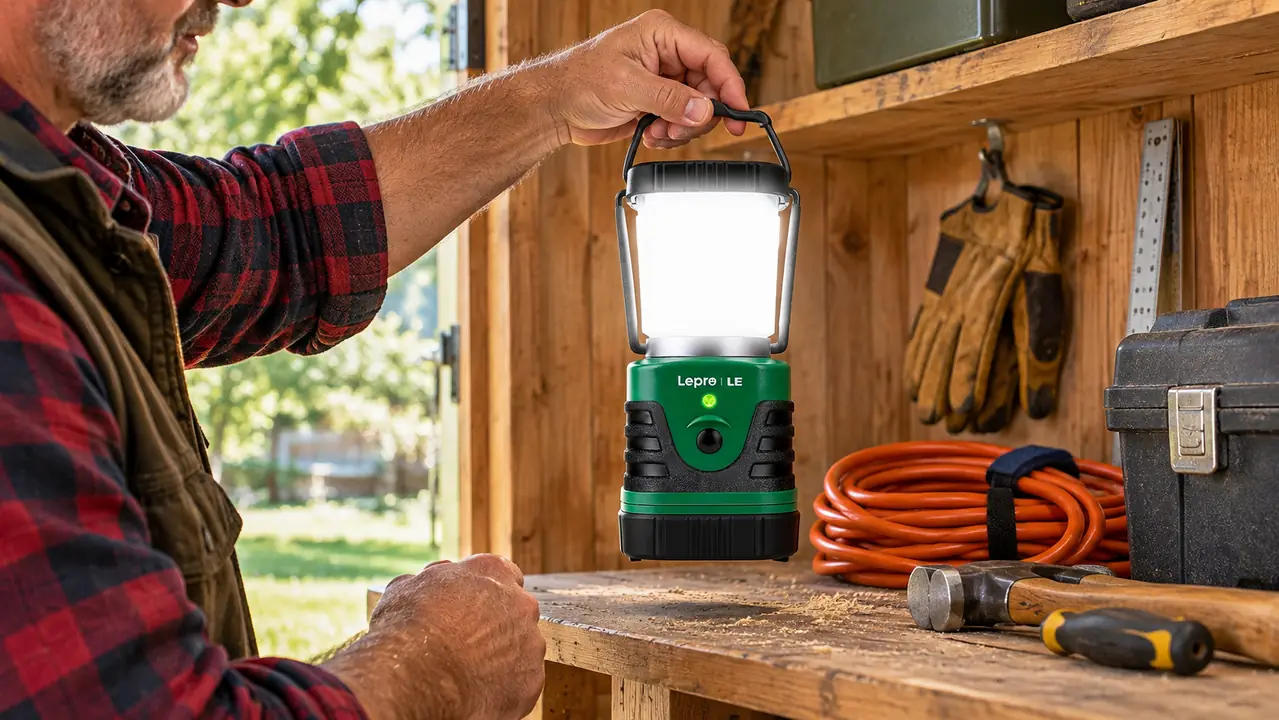
Where Lepro Wins
The light itself is the first thing, and it is not close. The Lepro puts out 1000 lumen through a 360 degree beam angle, spread across 46 LEDs at 10 watts, and the difference between that and a pooled beam is the difference between lighting a room and lighting a spot on a table. Sat on the table it lights the table, which is what a tabletop mount is for. Hung from the rafter it lights the loft and the floor under it at the same time. There is a hook on the top of the unit and a second hook at the base, and that second hook is the one I use most, because hanging a light inverted from a beam gets it out where the ceiling would otherwise eat half of it. In a room this size, that matters more than the lumen number does.
The second thing is the power, and this is the part that changed how the cabin works. There is a 4400mAh lithium polymer battery built in, charged at 5 volts, rated to run up to 12 hours, and it comes included with the light. That means the lantern has a fuel source I can refill from my own array instead of a fuel source I have to drive into town for. Four light modes means I am not stuck choosing between a room light and a night light. The housing is listed as waterproof, the body is plastic with a brushed finish, and the whole thing carries a one year warranty. None of that is exciting. All of it is exactly what I want in a tool that hangs in a shed for years.
Where the Battery Lantern Wins
Storage. That is the one everybody forgets until the night it matters. A rechargeable light with a lithium battery loses charge sitting on a shelf. Not fast, but it does, and a lantern that was full in September can be a dull orange glow in February when you finally reach for it. The battery lantern has no such problem. It hangs on its nail for a year, you pick it up, and it lights, because the cells inside it were never asked to hold a charge in the first place. For a light that is pure insurance, something you keep for the night you need it and not for the nights you do not, that is a genuine advantage and I will not pretend otherwise.
Cold and repair are the other two. In real cold, every battery I have ever carried gets tired, the Lepro's included, so the answer in January is to keep it inside your coat on the walk out to the shed. A battery lantern has the same trouble, but when it fades you can pull the cells, warm them in a pocket, and drop in spares. When the contacts corrode you can clean them with a knife. When the lens cracks the light still works. There is no charger to find, no cord to lose, and nothing to remember. The Lepro is a sealed unit with a one year warranty, and when the battery inside it eventually stops taking a charge, that is the end of that light.
If It Lives Inside the Cabin, This Is the One I Would Hang
1000 lumen through a 360 degree beam, four modes, and a built-in 4400mAh battery that tops up at 5 volts off your own power. The hook at the base lets it hang inverted over a table.
Amazon Check Today's Price on Amazon →
The Runtime Question
Twelve hours is the rating, and ratings come off a test bench, not off my kitchen table. What I can tell you is how it behaves in the cabin. Dinner to bedtime here is about five hours in December, and the lantern does that on one charge with room to spare, as long as I am not running it on the brightest setting all evening. The four modes are the whole reason that works. Bright for the walk out to the power shed, because a stumble on ice in the dark is how men my age end up in a sling. Dim for the table while we eat. Something in the middle for reading. I pick the mode the way I pick a gear, which is a thing you cannot do with a lantern that only has an on switch.
The battery lantern works the same math from the other direction. Fresh cells give you a decent evening, and then they do not. There is no gauge on it and no warning, so the light just gets weaker until somebody finally says something about it. I have watched a room dim by degrees over four hours and not one person in it noticed until the lantern was useless. The Lepro at least lets me choose deliberately, so I know what I asked for and roughly what it will cost me in runtime. That is not a small thing when the grid is a memory and the nearest hardware store is twenty minutes of bad road away.
What I do now is simple. The lantern gets topped up every Sunday along with the headlamps, whether it needs it or not, because a habit beats a calculation every time. It takes 5 volts off the same small charger I use for everything else, and it lives on the shelf by the door where I can find it with my hand instead of my eyes. If the array has been buried under snow for a week, the truck can do it. That is the entire charging system, and it has not let me down yet.
The 360 degree beam is the part I did not expect to care about. Hung from the hook at the base, the light went into the corners instead of onto the table, and that changed how the room felt at night.
Cold Nights and Dead Batteries
January is the honest test. I have walked out to the power shed at ten below with the Lepro in my hand, and it does what every battery does in that weather, which is act tired until it warms up. Bring it back inside and it recovers. Leave it out all night and you will be disappointed in it. So I do not leave it out. It comes in with me, the same as the headlamp and the radio, and the spare set of cells in my coat pocket is there for the battery lantern on the nights I do not want to think about any of it.
None of that is a knock on the rechargeable light. It is just what a battery is, and a man who expects otherwise is going to spend a lot of evenings grumbling at a piece of plastic. The point is that a lantern is only as good as the routine around it. The routine for the Lepro is to charge it and keep it warm. The routine for the battery lantern is to keep cells on hand and hope the ones inside it have not leaked. Both routines are simple. One asks more of you in the moment and less of you over a year, and the other is the reverse. Pick the one that matches how you actually live, not the one that sounds better on paper.
Who Should Buy Which
Buy the Lepro if the lantern lives indoors, if you have solar, a generator, a truck, or any regular source of 5 volts, and if you use a light most evenings rather than twice a season. It is the better light for the actual job of lighting a room, and the built-in 4400mAh battery means you are not feeding it off a shelf of disposables. It also suits a wall tent, a camp setup, or a barn where you want light without running a cord out there. The hook at the base is worth more than it sounds like it is, especially if your ceiling is low and your table is long.
Buy the battery lantern if the light is emergency kit that might sit for a season or two without anybody touching it, if it lives in a truck box or a pack, or if you want something you can fix with a screwdriver and a pack of cells. Buy it if you are the sort of person who will not remember to charge anything in February. Be honest with yourself about that, because I have met plenty of men who bought a rechargeable light and then met it again in the spring with a dead battery and a bad attitude. There is no shame in it. There is just a better tool for that habit, and it costs less in frustration to admit it up front.
The Lantern That Earns Its Shelf Space Before Thanksgiving
1000 lumen, a 360 degree beam, four modes, and a 4400mAh battery that recharges at 5 volts from your own power. It hangs from either end and it does not need a drawer full of D cells.
Amazon Check Today's Price on Amazon →