
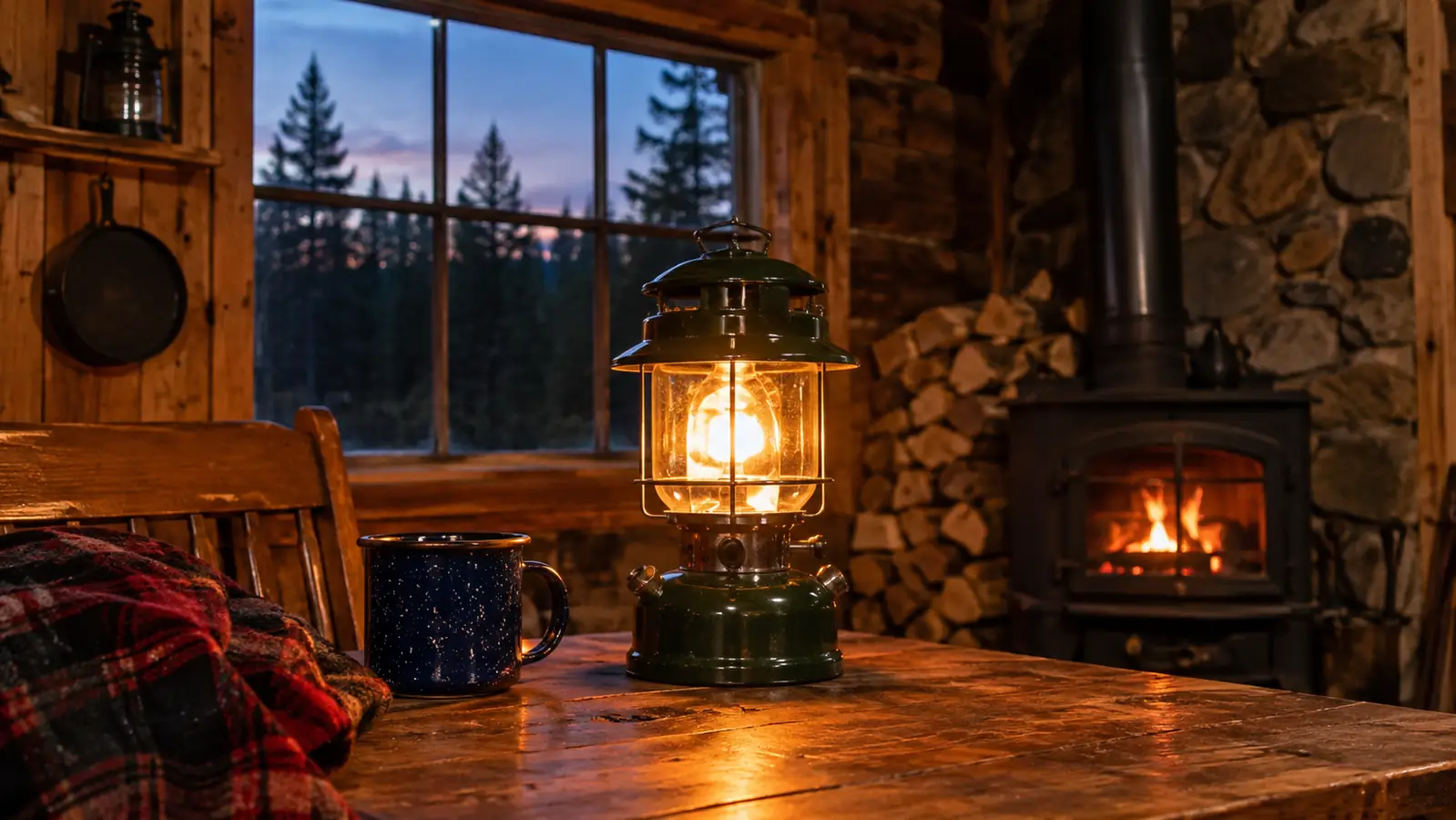
The power goes out here more than people expect. Six years off the grid on fourteen wooded acres an hour outside Syracuse, and a stretch of gray January days will still pull the bank in the power shed down far enough that I start turning things off. What I needed was not another flashlight. I needed something I could set on the table, hang from a rafter, and forget about for twelve hours. Something that did not ask me to think about it.
The Lepro 1000LM LED Camping Lantern is what I landed on. It is rechargeable, it carries a 4400mAh battery, it has four modes and 1000 lumens, and there is a hook on the top and another at the base. Thirty-three thousand people have reviewed it and it sits at 4.6 stars, which is more than I usually put stock in, but the spec sheet matched what I was after. I have run it for months now: two outages, a long stretch of cabin evenings, and one cold weekend camped by the creek when the light went before the fish did. Here is what I found.
The Quick Verdict
The light I reach for first. 1000 lumens, a rated 12 hours on the 4400mAh battery, and two hooks that let it live wherever I need it that evening. It is a lantern, not a spotlight, and that suits a cabin fine.
Amazon Check Today's Price →The lantern that hangs from a rafter and runs all evening
1000 lumens, a 4400mAh rechargeable battery, four modes, and hooks on both ends. Rated up to 12 hours of play time, with a one year warranty behind it.
Amazon Check Today's Price on Amazon →How I've Used It
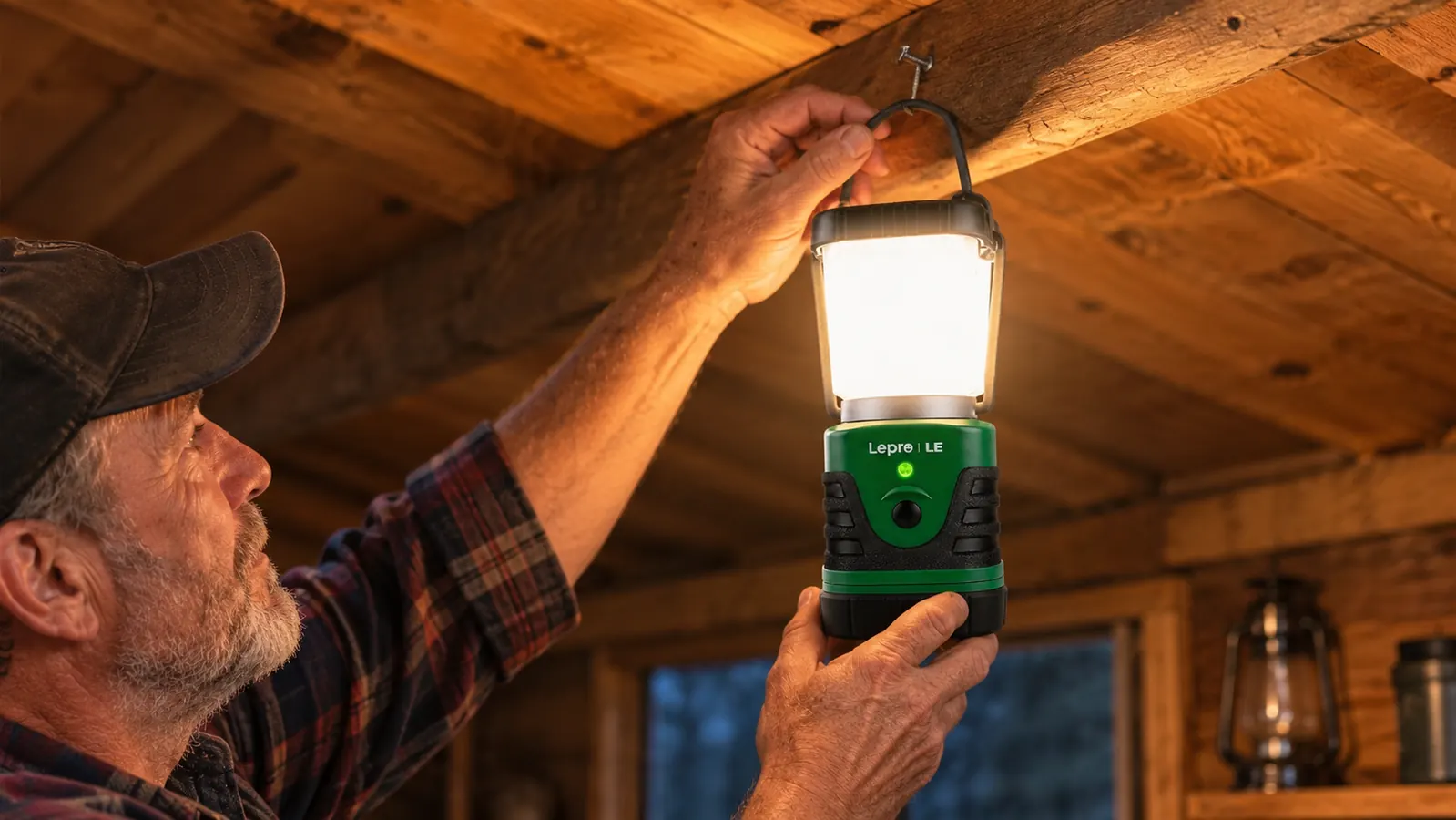
The first place it went was a nail above the kitchen table, and that is where it has stayed. The top hook drops over the nail and the lantern hangs about a foot below the beam, which puts the light above eye level and out of the way of everything else. Dana reads there in the evening. I clean fish there when the weather turns. Neither of us has knocked it off the nail yet, which is more than I can say for the propane fixture it replaced.
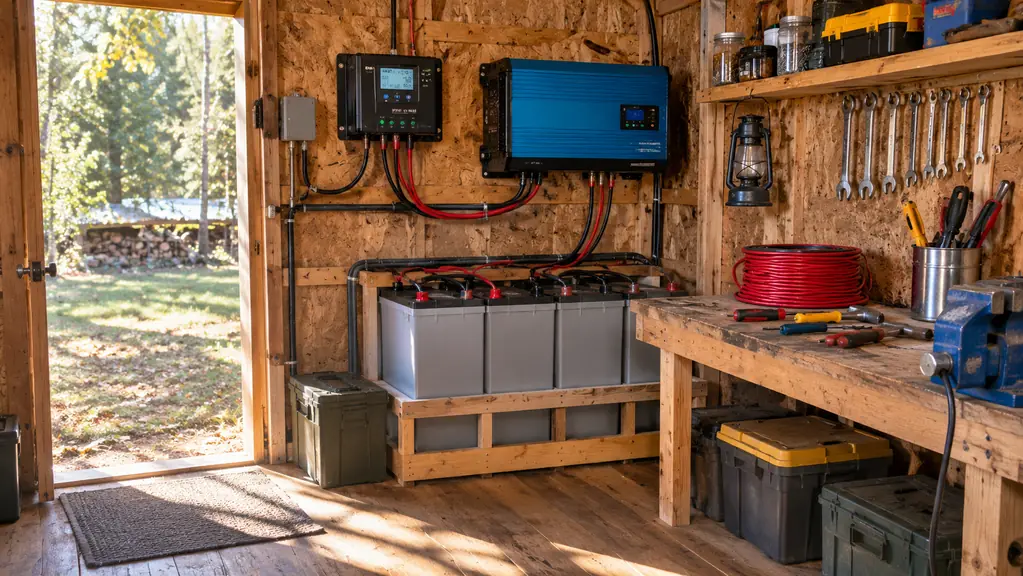
The second place is the power shed, a ten by twelve box with a charge controller, an inverter, a bank of batteries and a workbench. It is dark in a way the cabin is not. On the full setting the lantern lights the whole shed, and I have changed a fuse, tightened a lug, and traced a bad ground by that light without holding a flashlight in my teeth. If you have ever done that kind of work with a light in your mouth, you know what a small mercy it is to set one down instead.
There was a stretch in February when an ice storm took the line down and the whole hill went dark. We are off the grid, so it did not change much for us, but the neighbors came up for coffee and the lantern hung over the table the entire evening. Nobody asked where the light was coming from. That is the test, I think.
It has been on the porch in the rain, in the truck bed on the way to the lake, and hanging from the ridge pole of a tent. I have not been gentle with it. It got knocked off the porch rail once and landed on the boards, and it kept working without so much as a flicker.
What 1000 Lumens Looks Like in a 24 by 32 Cabin
A number on a box does not tell you much. What 1000 lumens means in practice, in a cabin this size, is that hanging from the center beam it lights the kitchen, the table, and most of the sitting area at the same time. It is bright enough that I do not want it at that setting while I am eating. It is also bright enough that I found a gap in the roof framing at ten at night with it.
The 360 degree beam angle is the part that matters more than the lumen count. Forty-six LEDs arranged around the body send light out in every direction instead of throwing a cone at one wall the way a handheld does. Set it on the table and the whole room comes up, not just the spot in front of it. That is the difference between a lantern and a torch, and it is the reason this one lives on a nail instead of in a drawer.
There is a loft at the back where we sleep. The lantern does not light it from the table, and it does not have to. I carry it up the ladder, hang it on a nail at the top, and read for an hour on the low setting before I turn in. Easy to carry in one hand on a ladder matters more than any spec when you are fifty-two and it is ten at night.
The Battery, the 12 Hour Rating, and What I Actually Got
Lepro rates this at up to twelve hours of play time off the 4400mAh battery. That is a range and not a promise, and it depends entirely on the mode you are in. On the low setting I have gotten three evenings out of a single charge, maybe four hours a night, and there was still light in it at the end. On the full 1000 lumen setting, plan on something much closer to the rated figure. I did not sit there with a stopwatch, but the gap between the modes is real and you will feel it.
Charging is simple. It takes 5 volts, so it tops up off a small adapter on the bench in the power shed on days when the sun is out and the bank is healthy. I plug it in during the morning and it is full by dark. That is the whole routine. In six years off the grid, the gear that lasts is the gear that does not ask much of you, and this asks for one small adapter and an afternoon.
On a bad week, when the bank is low and I am not running the inverter for anything I do not need, the lantern still charges. Five volts off a small adapter is not much of a load. That matters to me more than the lumen count does, because a light that only works after three sunny days is not much use in February.
Three evenings on one charge at the low setting, and a whole shed lit on the high one. Two hooks, four modes, and I have not gone hunting through a flashlight drawer since it came through the door.
Four Modes, and the One I Live In
There are four modes. I spend about ninety-five percent of my time in the dimmest one, which is enough to read by, enough to eat by, and easy on the eyes after dark. The full setting is for the shed, for the porch when something is moving out by the treeline, and for the first ten minutes of an outage while I am at the panel working out what tripped.
Four is not a hardship, but I would be lying if I said I used them all. What I care about is that the low mode is genuinely low and not just slightly less bright than the top one. Plenty of lights get this wrong. They hand you four settings that all feel like the same setting with a different label.
The Hooks, the Water, and the Small Things
The two hooks are the design choice I appreciate most. The top hook is the obvious one: it hangs from a nail, a rafter, a tent loop, a branch over the picnic table. The hook at the base is the one people miss, and it lets you hang the lantern inverted from something above it, which is how I light the workbench without the body throwing a shadow across what my hands are doing. Small thing. It changes how useful the light is.
The manufacturer lists it as waterproof and I have no reason to argue with that. It sat out on the porch rail through two rainstorms and worked fine both times. The body is plastic with a brushed finish, so it is easy to carry from room to room in one hand and it does not mind being set down hard. There is a one year warranty behind it, which is a normal length and about what I expect from a light in this range.
We took it to the lake in October, and it hung from a branch over the table while we ate and stayed there until we turned in. That is what I want out of a camping light. Not a beam I have to aim, just enough light over the whole site that nobody trips on a cooler or steps on a rod in the grass.
Where It Falls Short
The honest limitation is that this is a lantern and not a spotlight. The 360 degree beam is exactly right inside a cabin and exactly wrong when I need to see two hundred feet down the driveway at something making noise in the brush. For that I still carry a handheld with a reflector. The Lepro lights the space around you. It does not reach out and touch anything.
The second limitation is the battery arithmetic. Run it on full every evening and you will be charging it every day. That is true of every light in this class, but twelve hours is a ceiling and not a floor, and it is worth knowing before you buy it expecting a week of full brightness.
Third, if you are expecting a metal body with some heft, this is plastic and it feels like plastic. It has held up fine for me, including the drop off the porch rail, but I would rather tell you that now than have you find out on your own. A warranty covers defects. It does not cover your expectations.
What I Liked
- 1000 lumens on full with a 360 degree beam that lights a room instead of a wall
- Rated up to 12 hours, and the low mode ran three evenings for me on one charge
- A hook on the top and another at the base, so it hangs or sits wherever you need it
- Rechargeable 4400mAh battery that tops up at 5 volts off a small adapter
- 46 LEDs in a plastic body with a brushed finish and a one year warranty
Where It Falls Short
- Full brightness pulls the battery down close to the 12 hour rating, so plan your charging
- 360 degrees of light is not a beam and will not reach down a driveway
- Plastic body, not metal
- Four modes, and I only ever use two of them
Who This Is For
If you keep a cabin, a camp, a barn, or a shop that loses power a few times a year, this is the light I would put in your hand. It is also the right pick for anyone setting a place up to run on its own power, because it charges at 5 volts and asks nothing of your system. I wrote about why a rechargeable lantern earns a spot in a cabin in the first place, and the Lepro is most of the reason that piece exists.
Campers will get their money out of it too. It hangs in a tent, it lights a picnic table, and it does not eat a package of batteries every weekend. I put it against a plain battery model in a side by side piece, and the short version is that a season of not buying batteries covered the difference.
Mostly, though, it is for the person who is tired of the flashlight drawer. The one where half the lights are dead and the other half are dim and you are standing in the dark sorting through them. One light on a nail, charged, done. That is worth more than it sounds.
Who Should Skip It
Skip it if what you actually need is a thrower. If the job is scanning a woodline, checking a gate at the far end of a field, or lighting a driveway from the porch, buy a focused handheld and keep this as the second light. Skip it too if you want a light you never think about charging at all, because that is a different tool with a different set of tradeoffs.
And skip it if plastic is a dealbreaker for you. I have had no trouble with it, but I would not want to talk you into something you will resent every time you pick it up.
One light, one charge, and the dark stops being a problem
The Lepro 1000LM LED Camping Lantern: 1000 lumens, a 4400mAh rechargeable battery, four modes, and hooks on both ends. Rated up to 12 hours. It has lived on a nail above my table for months now.
Amazon Check Today's Price on Amazon →