
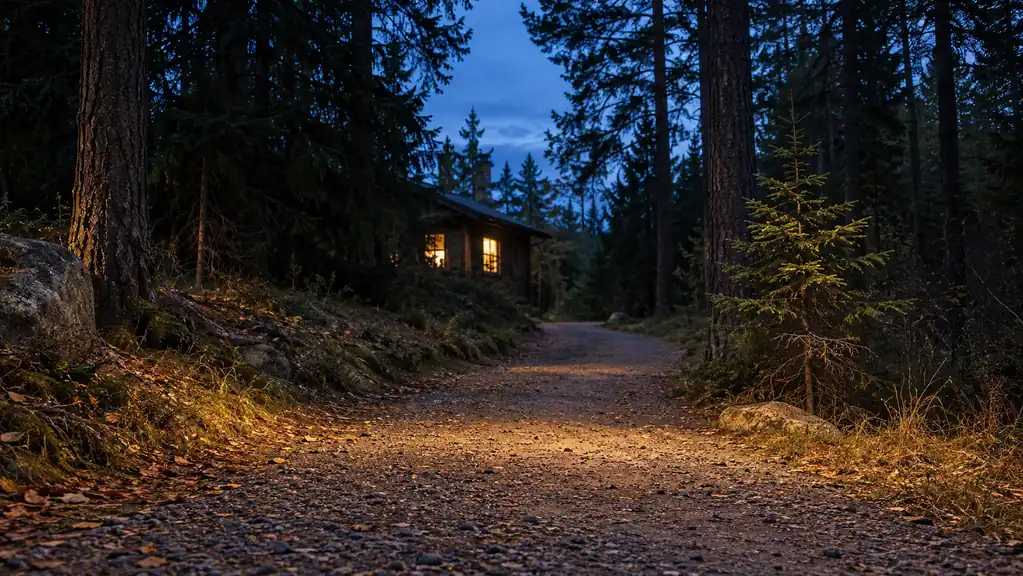
Honest reviews are hard to find on a lantern with 33,728 ratings and a 4.6 star average, so here is mine. My name is Caleb Rourke. Dana and I live off the grid in a 24 by 32 foot cabin I finished myself on 14 wooded acres in the hills about an hour outside Syracuse. Six years now, no meter, no utility bill. Everything in this place runs off a small solar array on a ground mount and a battery bank in a shed out back that I call the power shed. That life changes how you think about a light. A light is not a decoration out here. It is a load, and every load comes out of the same battery. I bought the Lepro 1000LM rechargeable lantern to light the gravel path between the cabin and the power shed after dark. Two winters later it does that, plus four other jobs I did not plan on. What follows is what I actually found, including the parts the listing does not dwell on.
The short version first. The Lepro is a plastic lantern with a brushed finish, 46 LEDs behind a 360 degree diffuser, 1000 lumens at full output, a 4400mAh lithium polymer battery built in, four light modes, a hook on the top and a second hook at the base, a water resistance rating that handles weather, a one year warranty, and an advertised runtime of up to 12 hours. It charges from 5 volts. None of that is hype and none of that is the whole story. The gap between a spec sheet and a February night in the hills is where most reviews stop, and it is where this one starts.
The Quick Verdict
A hard working 1000 lumen lantern that hangs almost anywhere and charges off 5 volts. The 12 hour runtime is a low mode figure, and the plastic body is a cabin tool, not a summit tool.
Amazon Check Today's Price →The light I grab before I open the power shed door
1000 lumens, a 360 degree beam, 4400mAh, four modes, and a hook at both ends so it hangs off anything within reach. Current price and stock sit on the Amazon listing.
Amazon Check Today's Price on Amazon →What Nobody Tells You About a 1000 Lumen Lantern
A thousand lumens sounds like a marketing number until you stand in a room with it. In a 24 by 32 foot cabin at full output it is genuinely bright. It washes the whole main room and you can read from the far chair without leaning in. The surprise is the direction. Because the 46 LEDs run all the way around the body, the light goes sideways and upward as much as down, so the ceiling and the walls get lit and the room fills evenly instead of throwing one hard cone on the floor. For a cabin that is exactly the right behavior. For working on a vehicle it is less right, because the light comes at you from every angle and bounces straight back off the fenders into your eyes.
The second thing nobody tells you is that 1000 lumens and 12 hours do not live in the same sentence. The listing says up to 12 hours. It also says 1000 lumens. Both are true, just not at the same time. Full output pulls that 4400mAh battery down much faster, which is simple physics and not a knock on Lepro. If you buy this expecting a full night of 1000 lumen light you will be disappointed, and you will blame the lantern for a promise you made to yourself. Buy it knowing the bright setting is for the ten minutes you actually need it and the long setting is for the four hours you do not.
How I've Used It
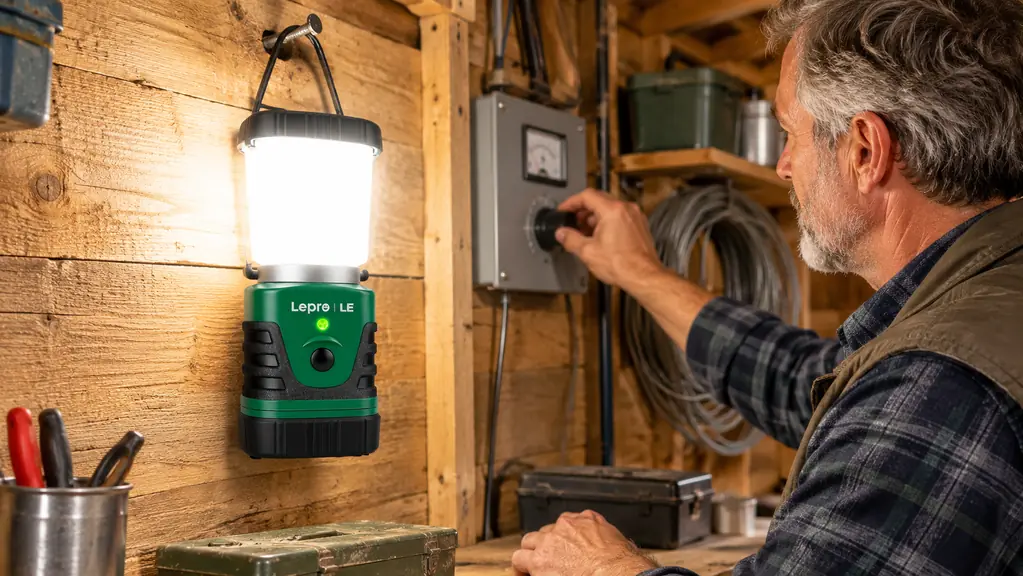
The first job is the walk to the power shed. Gravel path, about forty yards, trees tight on both sides, no porch light. I carry the lantern by the base and it lights the ground and the trunks together, which sounds small until you have walked that same path with a phone in your hand and taken a branch across the face. At the shed I hang it off a nail by the top hook and it lights the whole interior while I read the charge controller and check the water lines before the cold sets in. The shed is 8 by 10 feet with a metal roof and one small window, and before the lantern I lit it with a headlamp strapped over a wool hat. That strap slid up all winter and the beam pointed at the ceiling every time I tilted my head back to read the controller display. I moved the nail to eye level the week the lantern arrived and I have not worn the headlamp in that shed since. The 360 degree beam means the panel face and the terminal strip are both lit at once, which is the part I did not expect. With a headlamp I was forever turning my head to move the light. Here I just look where I want to look.
The second job found me. The cabin heats with a wood stove and the firebox is deep, and a headlamp is useless when your arm is in past the elbow and your head is turned sideways. The lantern hangs off the stove door handle by the top hook and lights the entire firebox. The same trick works on the truck: hook it on the raised hood latch and you can see the whole engine bay, at the cost of some glare coming back off the sheet metal.
A thousand lumens and twelve hours are both true. They are just not true at the same time.
The third job is the table after supper. Dana reads and I do paperwork and the lantern sits on the table facing up. This is where the 360 degree beam earns its keep, because nothing casts a hard shadow and nobody has to move their chair out of the dark. The fourth job is the one I did not see coming, which is the outhouse at four in the morning in February. It hangs upside down from the hook at the base and lights that little room wall to wall. I have made that trip a couple hundred times now and I have not once had to hold a light in my teeth.
The Charging Side Nobody Mentions
It charges from 5 volts, which in a normal house means any adapter rolling around in a kitchen drawer. Here it means the small inverter in the power shed or the one in the truck, and that changes the arithmetic. Filling a 4400mAh battery from a 5 volt source is not a heavy load, but it is a load, and in December my array is making a fraction of what it makes in June. So I charge during the day when the panels are already carrying the cabin, not at night off the bank. That one habit is what makes this lantern fit an off grid system instead of quietly fighting it.
The other thing worth saying is that charging is not instant. A 4400mAh battery takes hours to fill, so this is not a lantern you top up five minutes before you need it. I plug the Lepro in on Sunday morning while the array is producing, and it sits there until I remember it. That routine costs me nothing, it matches how I already check the bank voltage, and it is the reason I have not been caught dark in two winters. The first month I owned it I did the opposite. I ran it flat and plugged it in at nine at night, off the bank, then wondered why the bank looked tired the next morning. It took one cloudy week in January to work out that I was moving power from a big battery into a small one at the worst possible hour. Now the charger lives in a coffee can on the shelf beside the inverter, and Sunday morning is the day, because it is already the day I check the water lines and sweep the chimney.
Runtime, Measured Against Real Evenings
I did not run a lab test and I am not going to pretend I did. What I can tell you is how it has gone in this cabin. A winter evening here is four to five hours of light before we turn in. On the low end of the four modes the lantern makes it through that easily and comes back the next night with something left in it. On full output it does not. Full brightness is a burst setting in practice, ten or fifteen minutes while you are doing the thing that needs it, and then you drop back down and the battery recovers its manners.
A fair example was the second week of February this year, when the truck sat with a dead cell and I was out at it after supper with the hood up and the thermometer around nine degrees. I ran the lantern on full for about twenty minutes to get the clamp off, then dropped it to the low setting and hung it on the latch while I cleaned the terminals. It ran another hour and a half at that setting and was still going when I quit for the night. That is the pattern in one evening: full output is a tool you use in bursts, and the low setting is what actually carries the night.
The rated 12 hours is a number I believe for the dimmest mode on a fresh battery in a warm room. Cold is the variable the listing does not discuss. Lithium polymer loses capacity when it is cold, so a lantern left in an unheated truck overnight in February will not give you the same run as one that slept near the stove. I bring mine inside. It is the same reason I bring the drill batteries inside, and if you have ever run a cordless tool outdoors in January you already know exactly what I mean.

The Four Modes, the Body, and the Hooks
Four modes is more than I use. In practice I want two: enough to see by, and enough to work by. The others get cycled through when I hand the lantern to somebody else, and that is fine. What I appreciate is that moving between them takes nothing to learn. There is no menu, nothing to configure, and it does not want a phone or an app to do its job. A guest picks it up and has light in about four seconds, which is more than I can say for half the gear in my shed.
The body is plastic with a brushed finish and I want to be straight with you about that. Plastic is why the thing weighs what it weighs and why it hangs off a stove door handle without bending anything. Plastic is also why I would not take it up a rock face. Mine has been dropped on the cabin floor and on the gravel path and it shrugged both off. I would not expect it to shrug off a tailgate onto a stone driveway. It is water resistant and rated for weather, and it has sat out on the porch rail in the rain more than once with no complaint, but I would not float it down the creek to see what happens.
The hooks are the part I would miss most. One on top, one at the base. Between the two of them there is almost nothing in this place I cannot hang it from: the stove door, a nail, the ridge pole of a wall tent, the hood latch on the truck, the hook beside the outhouse door. The one at the base matters more than it sounds, because hanging it upside down drops the light lower and spreads it wider across a floor, which is what I want in the outhouse and in a truck footwell. The top hook is the one for overhead work. I have hung it off a bent nail on the porch post and off the handle of the water spigot, and neither was a mount I planned. That is the test I care about. A light that needs a bracket built before you can use it stays in the shed, and this one almost never does.
What I Liked
- 1000 lumens at full output fills a 24 by 32 foot room evenly, with no hard shadows
- 360 degree beam lights the ceiling and walls, not just the floor
- Hooks at the top and at the base, so it hangs from almost anything
- 4400mAh battery charges from 5 volts, which suits a small solar setup
- Four modes with nothing to configure and no app involved
- Water resistant enough to sit out on a porch rail in the rain
Where It Falls Short
- The 12 hour rating is a low mode figure; full brightness is far shorter
- Charging a 4400mAh battery takes hours, not minutes
- Cold weather cuts runtime and the listing never mentions it
- Plastic body will not survive a hard drop onto rock or concrete
- The 360 beam glares off metal when you work on a vehicle
Who This Is For
This is for the person who needs light where there is no switch on the wall. Cabin owners, campers who drive to a site or sleep in a wall tent, anyone running a barn or a shed off a battery, anyone who has sat through a three day outage and gotten tired of candles on the kitchen table. It suits an off grid setup because it charges from 5 volts and because it hangs instead of demanding a flat surface. If you heat with wood and you have ever tried to see into a firebox wearing a headlamp, this earns its spot on the stove door handle. It is also a fine lantern for somebody who does not want to learn a device, which at my age I count as a feature.
Who Should Skip It
Skip it if you need a light that lives in a pocket. This is a lantern, not a flashlight, and it wants to be hung or set down. Skip it if you are packing for a serious backcountry trip where every ounce gets argued over, because a plastic body and a 4400mAh battery are weight you would rather spend on a shelter or a sleeping bag. Skip it if you need a light that runs all night at full brightness, because this one does not and no honest lantern this size will. And skip it if your gear regularly meets rock, concrete or a tailgate, because the body is plastic and I would not bet your money on it there.
What I will say after two winters is that I am grateful for a shed full of batteries and a light that hangs where I need it. That is a small thing to be grateful for and I am not going to dress it up. But when the wind comes down the hill in January and the path goes black, I reach for the same lantern every time, and it has not let me down yet.
Two winters by the power shed door and still the light I reach for
1000 lumens, a 360 degree beam, 4400mAh, four modes, hooks at both ends, and a one year warranty. If your place has no switch on the wall, this is a sensible one to start with.
Amazon Check Today's Price on Amazon →