
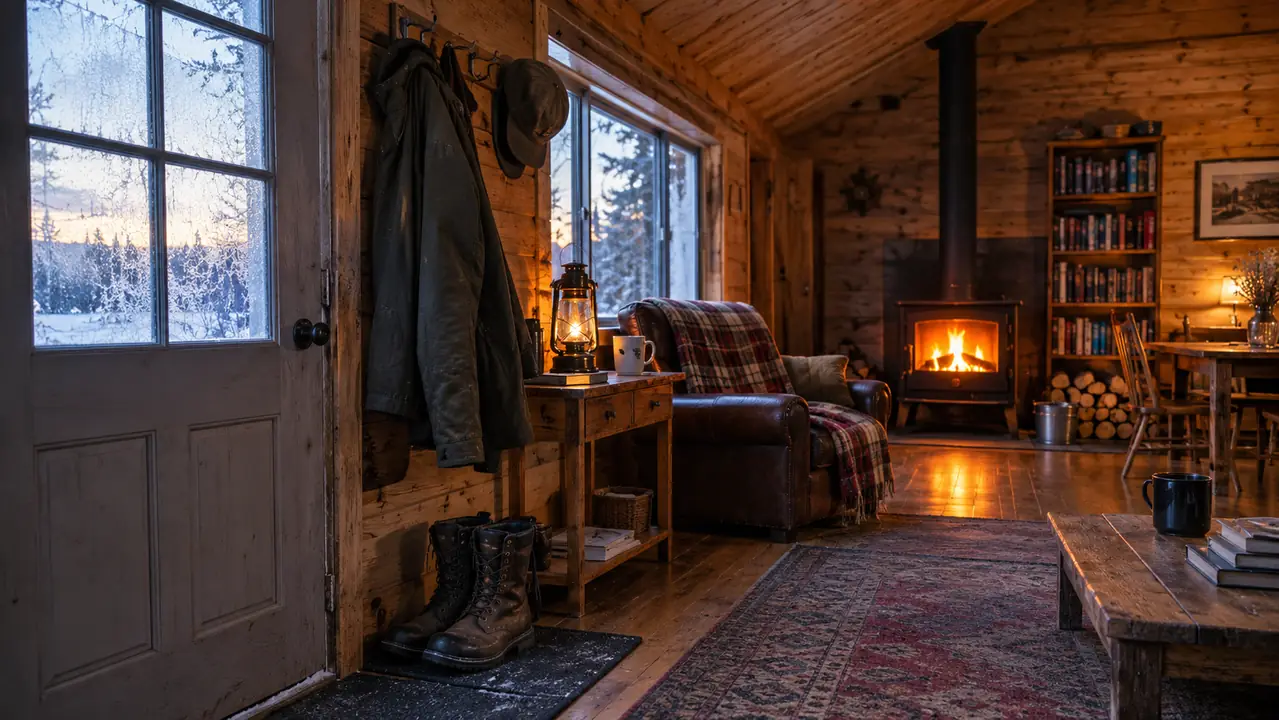
Five forty in the morning, six below zero outside, and the cabin was sitting at 52 degrees. The stove at the far end of the room was hot enough to tick, and I was standing three feet from it with my hands out, warming them like a man at a campfire. That is the part of wood heat nobody explains before you build. The stove makes plenty of it, and then a good share goes up the pipe while the floor by the bed stays cold. In a 24 by 32 foot cabin with one stove and an open plan, moving the heat is half the job. So the third winter here I set a VODA wood stove fan on the top plate to see whether it could do that moving without a cord.
Some background if you are new here. I am Caleb Rourke. Dana and I live on 14 wooded acres about an hour outside Syracuse, off the grid six years now, in a cabin I finished myself. Solar on a ground mount, a drilled well, and a power shed I built from spare lumber and stubbornness. Every load in this place has to justify what it draws. A corded fan running six hours a night off the battery bank in January is a poor trade, which is why a fan that runs on stove heat and nothing else got my attention in the first place.
The Quick Verdict
A heat powered fan that quietly does what it claims. It will not heat a room by itself, but it gets heat off the stove top and into the room instead of up the flue, and it draws nothing from the battery bank.
Amazon Check Today's Price →Move Stove Heat Into the Room Without Touching Your Battery Bank
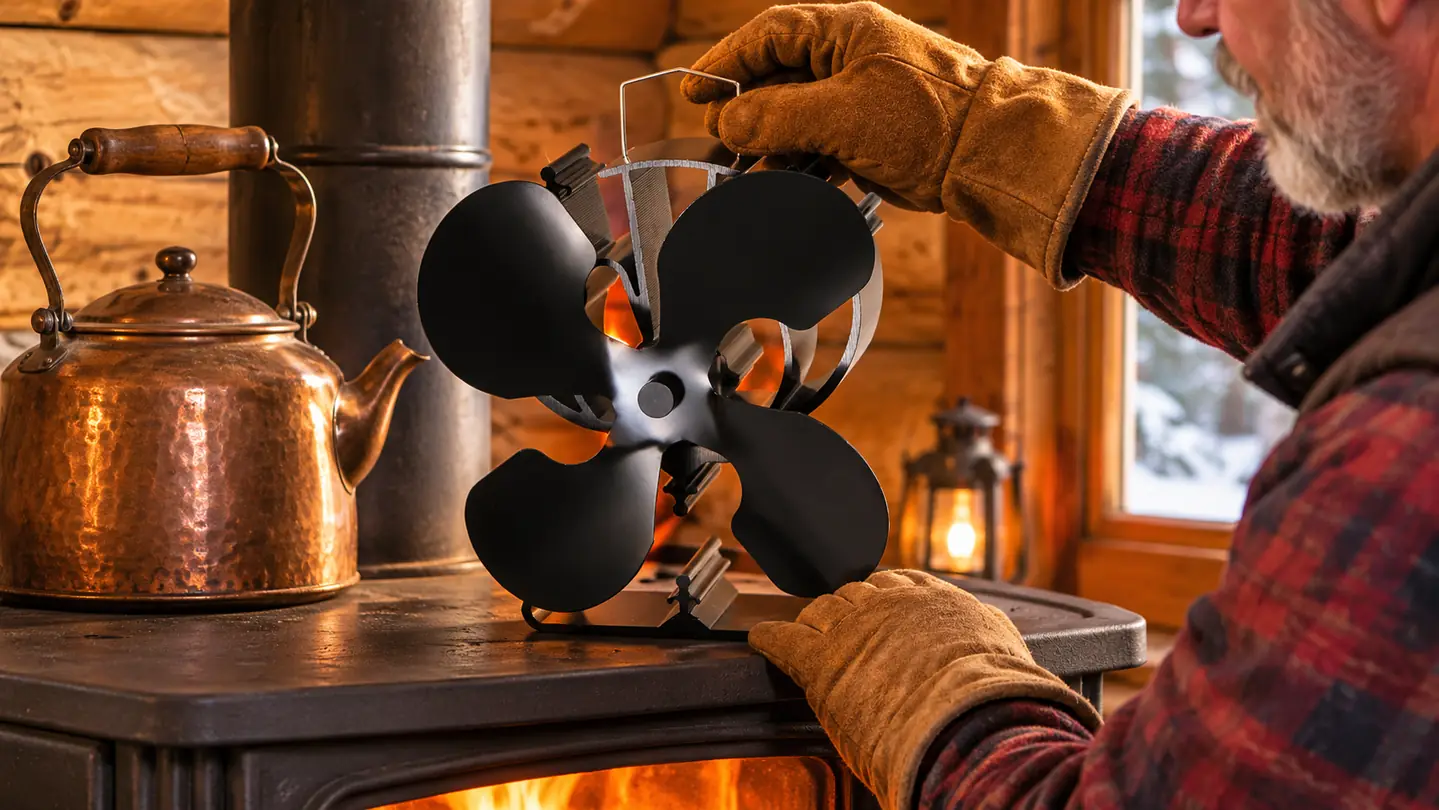
Four aluminum blades, no cord, no batteries. The VODA fan spins up on its own as the stove comes to temperature and settles when the fire does. Rated at 25 decibels, so it will not keep you awake twelve feet away.
Amazon Check Today's Price on Amazon →How I've Used It
The fan has sat on the same stove top from the first week of October to the middle of April for three winters now. This past season was the first one I kept notes. I keep it back from the door, off to one side of the stovepipe, on clean bare steel. The unit measures 4.72 inches deep and 8.27 inches wide and tall and weighs 600 grams, a bit over a pound, so it takes less top plate than the kettle does and I never had to rearrange anything to fit it.
My routine has not changed. I load the stove around 5:30 in the morning and again near 8 at night, and on the cold stretches a smaller load in the afternoon. The fan does not need me for any part of that. It starts turning once the steel under it is properly hot, picks up speed as the fire builds, and slows back down as the stove cools. There is no switch to remember and nothing to plug in. That sounds like a small thing until you have stood in a cold room at five in the morning deciding whether to fuss with one more gadget.
What I can tell you for certain is what the thermometer on the far bookshelf did. Before the fan, that shelf would sit in the low sixties on a night when the stove top was running hot. With the fan turning, it read three to five degrees warmer inside the first hour of a good fire, and the difference held through the evening. Three to five degrees does not sound like much on paper. In a cabin in February it is the difference between a sweater and a sweater plus a blanket.
What the Fan Actually Does, and Why There Is No Cord
The VODA fan is the simplest machine in this cabin. It makes its own power from the heat of the stove top, which is the whole reason there is no cord, no battery pack and no wall adapter anywhere on it. Nothing to charge, nothing to switch off. Hot steel underneath, cooler air above, and the fan turns that difference into motion. When the fire goes out, it stops. When the fire comes back, it starts again. In six years off the grid I have learned to be suspicious of gadgets that promise this kind of thing. This one delivers it in the most boring way possible, which is exactly what I want in a heating appliance.
It has four aluminum blades and a rated speed of 240 rpm. That is slower than it sounds, and the point is not a blast of air. The point is a steady column of warm air pushed out from the top of the stove and along toward the rest of the room. A corded box fan moves more air, no argument. But a box fan also stirs cold air up off the floor, pulls battery power all evening, and sounds like a box fan. The four wide blades on this thing push a soft, broad column instead of a narrow jet, and a broad column is what you want in a long, narrow room.
It also changed how the stove itself runs. With the fan turning, the top plate reads a little cooler than it did before, because heat is leaving the steel instead of stacking up in it. The firebox does not care. The room does. I burn about the same wood I always did, and the back half of the cabin is now livable instead of merely survivable. That is the trade I was after, and it is the reason the fan has stayed on the stove.
Noise, Placement, and the Small Annoyances
The rating is 25 decibels and I would call that honest. What you hear is a soft whir and a faint tick from the blades, nothing like a motor. I sleep about twelve feet from the stove with the bedroom door open and it has never woken me. On a still night it is quieter than the ticking of the stovepipe, and when the fire is low you will not hear it at all.
Placement matters more than anything else about it. It needs a flat, clean spot on the stove top. Ash grit under the base will make it sit uneven and you will hear it. I wipe the steel with a rag every couple of days and brush the leading edge of the blades once a week during the burn season, because fine ash does settle on them and a dusty blade is a slow blade. When the stove is hot you lift it with a glove, not your fingers, and you set it down somewhere it cannot roll. At 600 grams it is easy to move and just as easy to knock over if you are careless.
The one behavior worth knowing is the cool-down. As the fire dies, the fan slows and then stops, and it stops well before the stove is cold. That is how it works, not a fault. It means the last hour or two of a burn gets no help from it. If you want heat moved at ten at night, you need wood in the stove at nine. The fan will not rescue a fire that is already going out.
Where It Comes Up Short
Cold start mornings. This is the honest limitation and no fan of this type gets around it. Until the stove top is genuinely hot, the VODA fan is a paperweight. The first twenty minutes of a burn are mine, hands and all. Once the steel comes up, the fan takes over. If you were hoping for something that helps from the first match, this is not that thing, and you should know it before you order.
It pushes air, it does not heat air. What it does is take heat you already made and put it where you want it. In a wide open room with the stove in the middle, you will notice less difference than I did, because my stove sits at one end of a long room and the far end was the problem. And if the bedroom door is shut, it will not push heat through a closed door. I leave mine open. On the coldest nights I also run a small ceiling fan on low to stir what the stove fan delivers, and the two together work better than either one alone.
It is also a small appliance sitting on a hot surface. It will not survive being stepped on, dropped onto a concrete floor, or used as a shelf for a hot kettle. Mine has been knocked off once in three winters and it still runs true, but I would not make a habit of that. Treat it like a tool, not a toy, and it will keep turning.
What I'd Check Before You Buy One
First, look at your stove top. You need a flat area roughly 5 inches deep and 9 inches wide, clear of the flue collar and away from the door swing, that gets hot and stays hot. Measure it before you order. My top plate is generous, so this was never a question for me, but I have seen cast stoves where every inch is spoken for by a kettle and a trivet. Second, think about where the cold actually is. Put the fan between the stove and the cold end of the room, not on the side that is already warm. It is a directional tool. Aimed at the far bedroom wall, mine earns its place. Aimed at the recliner three feet away, it would be a novelty.
Third, be honest about how you burn. If you load the stove twice a day and let it burn down in between, the fan will run maybe eight hours of a twenty four hour day. If you keep a fire going steady, it will run most of the time and the difference in comfort is much larger. That is the whole calculation, and it is worth doing before you spend anything. I am grateful for a cabin that stays warm on wood I cut myself, and grateful again for a tool that squeezes a little more comfort out of the same stack of splits.
What I Liked
- Runs on stove heat alone, so it draws nothing from the solar battery bank
- Starts and stops on its own as the fire comes up and dies down
- Four wide aluminum blades push a broad column of warm air down a long room
- Rated at 25 decibels, quiet enough to sleep twelve feet away
- 600 grams with a small footprint, so it fits a crowded stove top and lifts off for cleaning
- Simple enough that there is nothing to program and nothing to break
Where It Falls Short
- Useless until the stove top is properly hot, so cold starts are still hands-on
- Gentle airflow, not a room fan. It will not push heat through a closed door
- Needs a flat, clean patch of steel and weekly dusting of the blades
- Stops well before the stove is cold, so the tail end of a burn gets no help
- Small enough to knock over if you are careless around a hot stove
It does not make heat. It takes heat you already paid for in firewood and gets it into the room instead of up the pipe, and it does it without pulling a single amp from the battery bank.
Who This Is For
This is for the person heating a cabin, a shop, a camp or a small house with a wood stove and living with one cold end of the room. It is for anyone off the grid, or on a shallow battery bank, who does not want another load running all evening. It is for the household that keeps a fire going most of the day, because that is when a heat powered fan earns its keep. If you are handy, patient and already splitting your own wood, this fits right into the way you already live, and you will not have to think about it after the first week.
Who Should Skip It
Skip it if your stove sits in the middle of an open room and the heat already spreads on its own. Skip it if you light a fire in the evening and let it die by ten, because you will get a couple of useful hours and not much else. Skip it if you want a fan you switch on and point, or if you are not willing to keep the blades clean. And skip it if you are expecting it to stand in for insulation, a proper stove install or a ceiling fan. It is one small tool doing one job well. The cabin still has to be built right, and no gadget on the stove top changes that.
One Small Fan, No Cord, and a Warmer Far End of the Cabin
Three winters on my stove top and it still turns true. If your stove heats one end of the room and you want the other end, this is the least fussy fix I know that does not touch the battery bank.
Amazon Check Today's Price on Amazon →