
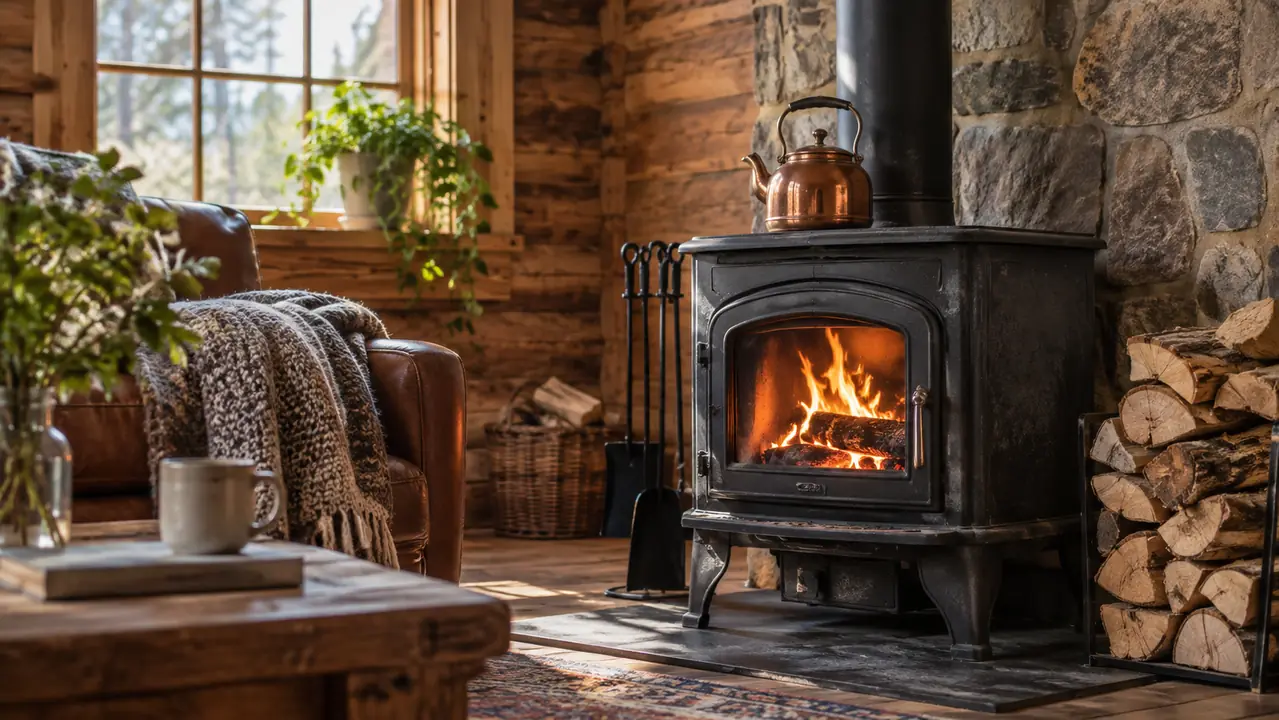
If your wood stove is your main heat and your power comes from a battery bank, put the VODA heat-powered fan on the stove first. I run one in my cabin. It starts when the stove top gets hot, pulls nothing from the solar array, and moves enough air to take the cold edge off the far room. An electric stove fan moves more air on demand and does not care how hot the stove top is, but it needs an outlet, a cord, and watts you may not have to spare. That is the short answer.
I am Caleb Rourke. I am 52, a retired millwright, and I live with my wife Dana on 14 wooded acres about an hour outside Syracuse. Our cabin is 24 by 32 feet, finished by my own hands, and we have been off the grid for six years. The wood stove is the heart of the place from October through April. The solar array sits on a ground mount, the well is drilled, and the power shed is where I keep the batteries and the charge controller. I have run the VODA fan on the stove for a few seasons. I borrowed an electric stove fan from a neighbor for a stretch this winter so I could compare them side by side instead of guessing. I am grateful for both, but they are not the same tool.
How I Ran the Comparison
I did not set up a lab. I started the comparison in the second week of November, right after the first hard frost, and kept it going through the end of January. I put a magnetic thermometer on the stove top and kept a notebook by the woodbox. I wrote down the stove top temperature when each fan started moving air, the temperature at the far wall an hour later, and the outside temperature at the start of the evening. I ran four evenings with the VODA and four with the electric fan, rotating them so the wood was the same mix of ash and hard maple both times. I did not use instruments worth more than the fans themselves. I just wrote down what happened and what the room felt like an hour in.
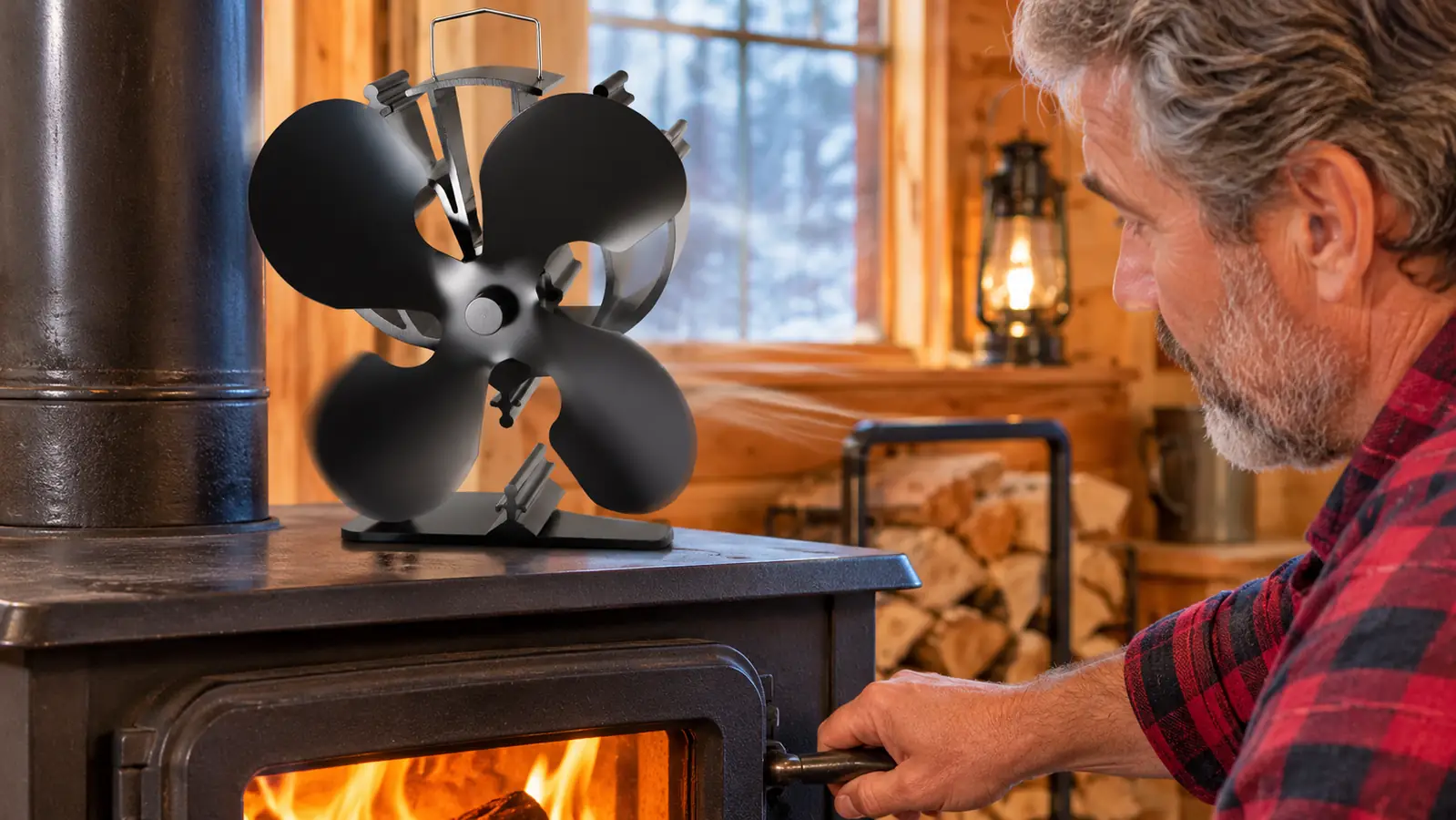
The electric fan was a common plug-in type, a twelve inch model with three speeds and a metal cage. It sat on the hearth about three feet from the stove, angled toward the far room. The VODA is the heat-powered unit with four blades, an aluminum body, and a rating of 25 db. It weighs 600 g and measures 4.72 inches deep by 8.27 inches wide by 8.27 inches high. Those numbers come from the listing, and they match what I see on the stove top. The first difference shows up before the stove is even hot. The electric fan will run the moment you switch it on. That sounds small until you have a cold room and a fresh load of wood. It can move air while the stove is coming up. The VODA cannot. It sits still until the stove top warms the base, then the blades start. Once they do, the fan runs at 240 rpm and stays with the heat. When the fire dies down, it slows and stops on its own. I never have to remember to turn it off, and I never find it running in an empty room.
| VODA Heat-Powered Fan | Electric Stove Fan | |
|---|---|---|
| Power source | Stove top heat, no cord, no batteries | Wall outlet or battery bank through an inverter |
| Startup | Starts when the stove top reaches temperature | Starts as soon as you flip the switch |
| Cold room help | No help until the stove is hot | Moves air during warm-up |
| Airflow control | Speed follows the stove heat | Switch or dial on the unit |
| Noise | Rated 25 db, a soft whir in the room | Motor and blade noise, varies by model |
| Footprint | 4.72 inches deep by 8.27 inches wide by 8.27 inches high, 600 g | Needs a cord run and outlet space |
| Power draw | None from the wall | Draws from the battery bank or the grid |
| Off-grid fit | Built for a stove and a power shed | Best where power is steady |
| Best for | Daily wood heat in an off-grid cabin | A shop or room with steady power and a cold corner |
| Maintenance | Dust the blades and hub, no cord to manage | Keep the cord, switch and motor clear |
Where VODA Wins
The VODA wins on independence. That is the whole reason I tried it. Our power shed is not a utility closet. It is a small building with a charge controller and a battery bank that I watch like a hawk in December. Every plug-in load is a decision. A fan that runs on stove heat is not a decision. It takes heat off the stove top and puts it into the room without a cord. The listing says it uses the heat from the stove and needs no batteries or electricity. That matches what I see. I do not run a cord across the hearth, I do not add a load to the inverter, and I do not think about it when the sun has been down for three days.
I noticed that most on a night in early December, when the outside temperature dropped to nine degrees and the sun had not shown itself in two days. The battery bank was sitting lower than I like. I had already shut off the small inverter in the loft and unplugged the clock radio Dana keeps on the shelf. Adding a fan to that evening would have been one more line on the list I keep taped inside the power shed door. The VODA just ran. No cord, no load, no entry in my head about what the array would do tomorrow. That is the whole case for it, and it is not a small one when you live where we live.
It also wins on quiet and on the long stretch of a cold evening. The rating is 25 db, and in our cabin it is a soft whir under the sound of the fire. The four blades move a wide sheet of air instead of a narrow blast. I can feel it at the far end of the room when the stove is rolling, and it does not make the place feel like a wind tunnel. The aluminum body has held up. I dust the blades when I clean the stove pipe, and that is about it. There is no cord to trip over, no batteries to change, and nothing to plug into the inverter. That matters more to me every year.
Where the Electric Fan Wins
The electric fan wins on timing and control. It moves air now. If I come in from the truck with wet boots and the stove is just catching, the electric fan can push the first warmth off the stove top before the VODA has even thought about starting. That matters in a shop or a camp that you heat in bursts. It also lets you point the air where you want it and change the speed when the room is too warm or too cold. The VODA cannot do that. Its speed follows the stove, not my mood.
The morning I appreciated the electric fan was a Sunday in late November. I had been out to the truck in the rain, came back in soaked through, and the stove was down to a bed of coals. I threw in kindling and two splits and flipped the switch on the borrowed fan. It pushed the first warm air across the room in about ten minutes, and I could feel it on my hands while I was still standing there dripping. The VODA would have sat still for another twenty or thirty minutes, waiting for the base to warm. That is not a knock on it. It is just how a heat-powered fan works, and on a wet morning you notice the difference.
The electric fan also wins if your stove is not the only heat source or if you want air moving in summer. It does not care whether the stove is lit. It can run in July to pull cool air through a window, and it can run in a room where the stove is cold. That flexibility is real. The catch is that it needs a reliable outlet or a battery bank with enough headroom. In our cabin, that is a real cost, not a small one. A fan that runs all evening on the inverter is a fan I have to plan for. If you have grid power and a modern house, that plan is easy. If you are off the grid, it is not.
If your stove is your heat and your power is your own, start with the fan that asks nothing of the battery bank
The VODA heat-powered fan sits on the stove top, starts when the stove warms, and moves air without a cord. It is the first fan I reach for in the cabin from October through April.
Amazon Check Today's Price on Amazon →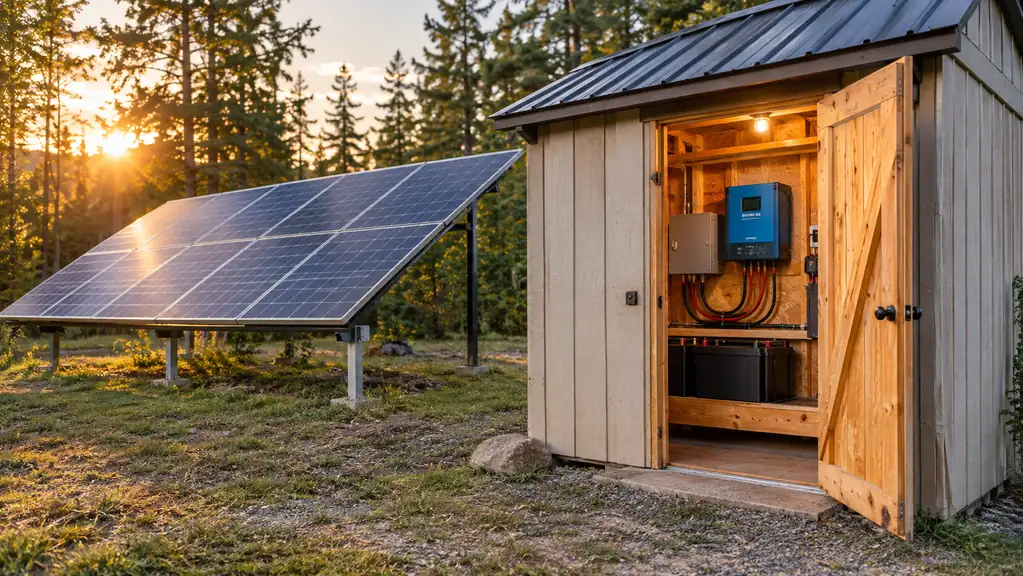
The Details That Matter After a Few Winters
The first winter I ran a fan on the stove, I learned that the stove top is not a flat, even surface. It has a hot spot over the firebox and cooler corners. The VODA wants to sit where the heat is steady. I put it near the middle, back from the door, and I leave it there. If I move it too far forward, it is slower to start. If I put it on a cooler corner, it may never spin on a low fire. That is not a defect. It is how a heat-powered fan works. You are not plugging it in. You are asking the stove to do the work.
The electric fan does not care about the hot spot. It will run on a cold stove, on a warm stove, or on a shelf across the room if the cord reaches. That is the trade. You get control, and you take on a cord and a load. In our cabin, the cord is the part I dislike most. It crosses the hearth, it gets warm, and it is one more thing to unplug when I clean. The VODA has no cord, and it does not run on command. You cannot tell it to run when the stove is cold. You cannot make it run faster than the stove is willing to heat it. I do not mind that. The fire decides for me.
I clean the fan the same weekend I sweep the pipe, usually the first Saturday of the month from November through March. I lift it off the stove, set it on the hearth, and run a soft brush over the four blades and the hub. Ash finds its way into everything in a cabin, and the fan is no exception. I have never had to take it apart. The base wipes down with a damp rag once the stove is cold, which takes a couple of hours on a mild day. The electric fan needed the same dusting, plus a check on the cord where it passed near the hearth, and that is the part I never liked.
After a few seasons, the VODA has been a low-fuss piece of gear. The aluminum body has not warped. The fan has not developed a rattle. The 600 g weight means it is easy to lift off when I sweep the hearth, and the 8.27 inch height clears the kettle when I set it to the side. The electric fan I borrowed was also fine, but it was a plug-in tool with a motor, a switch, and a cord. It did what it was told. That is useful. It is just not the same as a fan that is part of the stove's own heat and draft. One works for the room. The other works for the person standing next to it.
A fan that runs on stove heat is not a decision. It takes heat off the stove top and puts it into the room without a cord.
Who Should Buy Which
If you heat with wood as your main source, live off the grid, or run a battery bank that you watch, buy the VODA first. It is the fan that fits the way your place already works. It starts on its own, adds no load, and is quiet enough to forget. If you have grid power, heat in bursts, or want to move air before the stove is hot, the electric fan is the better tool. It gives you control and instant airflow. If you have both, keep the VODA on the stove and use the electric fan in the shop or the far room when you need a push.
I would not buy the VODA expecting it to cool a room in July or to run when the stove is cold. It will not. I would not buy the electric fan expecting it to be free of the power shed. It is not. The right choice is the one that matches your heat and your power, not the one with the longer feature list. Dana put it plain one night: one fan works for the stove, the other works for the person standing next to it. That is as good a summary as I have.
Put the heat where you sit, not up the flue
The VODA fan is the low-draw answer for a wood stove in a cabin that makes its own power. Check the listing, match it to your stove top, and see if it fits your setup.
Amazon Check Today's Price on Amazon →