
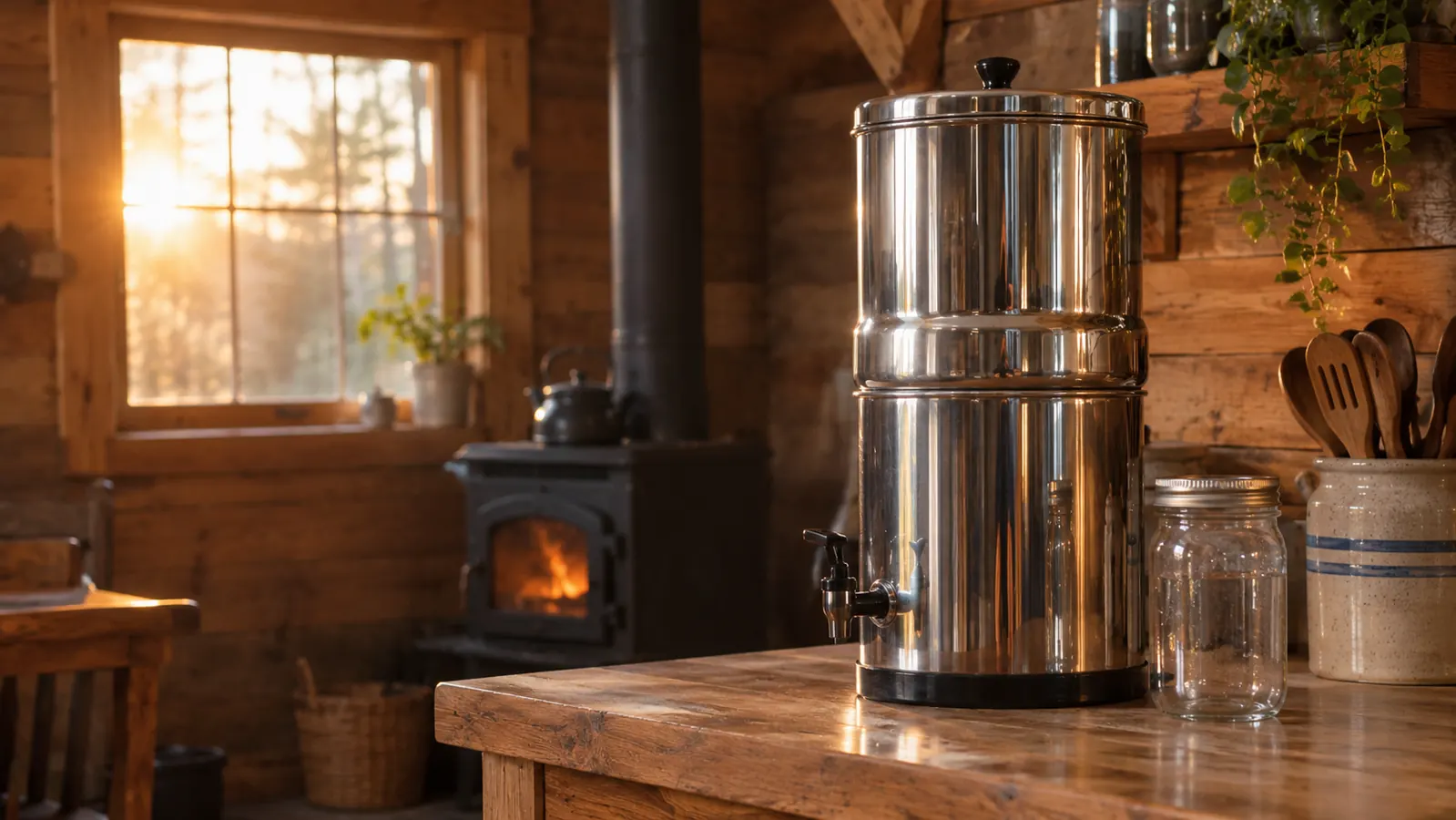
The Big Berkey came into our cabin in the fall of my fourth year off the grid, and it came in because I was tired of losing a whole morning to water. Our well is drilled, not shallow, and most of the year it runs clear. Twice a year, usually after a hard rain, the sediment lifts and what comes out of the tap looks like weak tea and tastes like a riverbank. Dana would not drink it. I did not much want to either. So for three days I boiled, and boiling a gallon at a time on a wood stove in August is a particular kind of misery that I do not recommend. I had looked at this unit for two years and kept putting it off, because it costs real money and gravity filters sounded like something from a cabin catalog rather than something for a man who just wanted a cold glass of water. Then the sediment came back and I stopped arguing with myself.
Four seasons later I can tell you what it does well, what it does slowly, and the two things about it that genuinely annoy me. This is not written from a spec sheet on a showroom floor. It is written from a kitchen counter where the thing has sat, filled and refilled, through two well screens, one ice storm, and a February week that hit minus eighteen.
The Quick Verdict
Worth the money if you need clean water that keeps working when the power does not, as long as you accept that it dribbles and you have to feed it.
Amazon Check Today's Price →Clean water with no cord, no pump, and nothing to fail at two in the morning
Two stainless steel chambers, two BB9-2 elements, and gravity doing the rest. If an outage is a normal part of your year, this is the piece of it worth owning.
Amazon Check Today's Price on Amazon →What the Big Berkey Actually Is
Two stainless steel chambers, stacked. You pour raw water into the top one, gravity pulls it through two Black Berkey BB9-2 filter elements, and it collects in the bottom chamber where a spigot waits. That is the whole machine. No pump, no cord, no pressure tank, no plumber, no wiring into the power shed. The listing gives the capacity as 2.25 gallons, which is 8.5 liters, and the assembled footprint as 8.5 inches across and 19.25 inches tall. On our counter it takes up less floor space than the dish drainer and it stands taller than the coffee canister, which matters if you have low cabinets over the worktop.
The specs are worth reading closely, because they tell you where the unit is honest and where you will have to be honest with yourself. Power source: gravity. Purification method: the proprietary black filter media inside the two elements. Maximum flow rate: 0.03 gallons per minute. Maximum supported TDS: 1000 parts per million. Installation type: countertop. Container type: stainless steel chambers. Included components: the filters. That is the entire promise, and it is a smaller promise than most filtration companies make. I like a small promise. It is easier to check.
TDS is the number most people skip, so here it is in plain terms. It stands for total dissolved solids, the minerals and salts carried in your water. This unit is rated to 1000 parts per million. Our well sits comfortably under that. If you are on water reading higher, hard city water or a farm well near a road salt run, this is not the tool for that job and no amount of filter elements will make it one. Test your water before you buy. A cheap tester and five minutes of reading will save you from buying the wrong thing, and I say that as a man who has bought the wrong thing more than once and has the shed full of evidence.
Setting It Up and the First Two Weeks
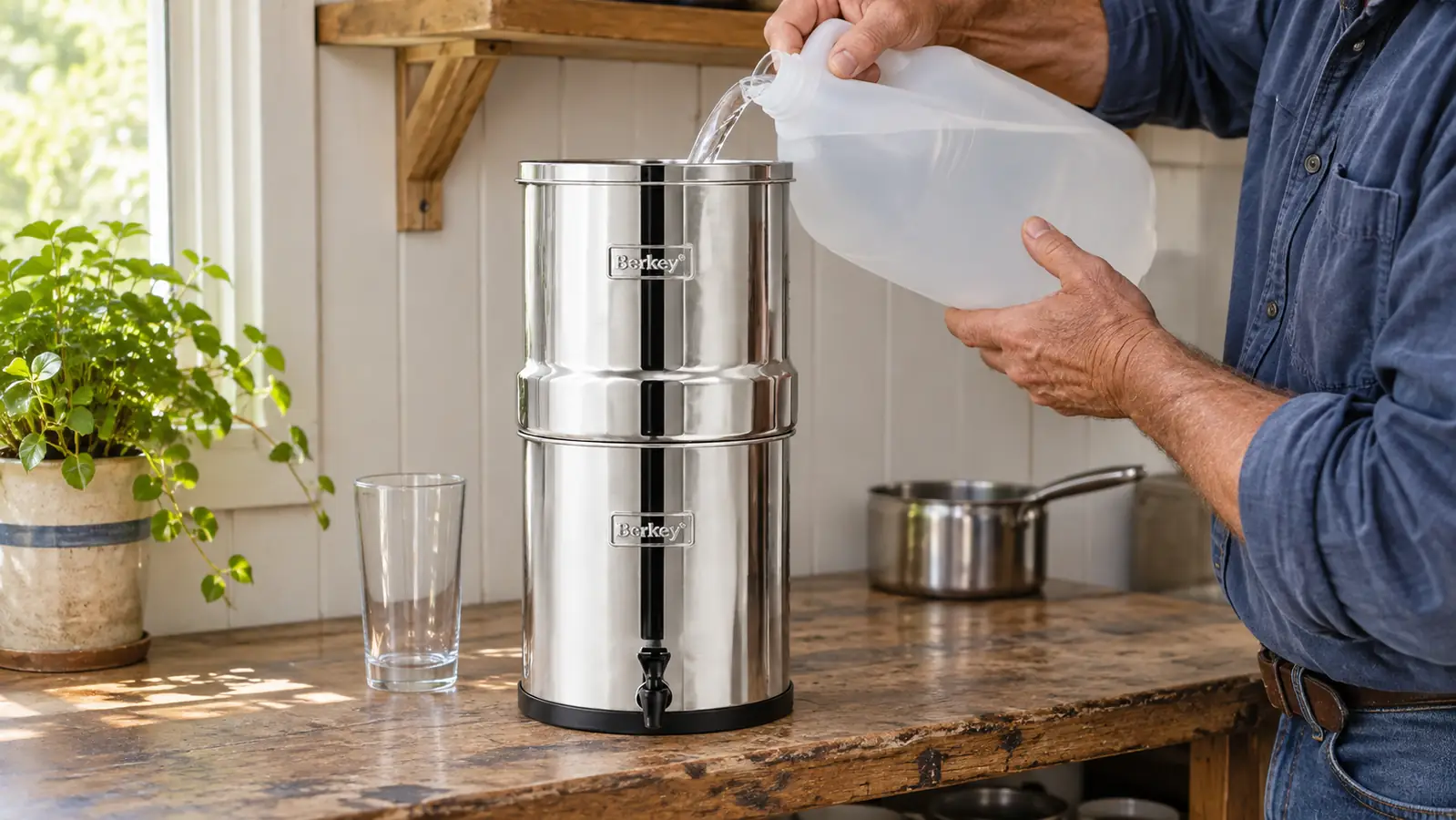
Assembly took me about twenty minutes with the instructions flat on the counter. You thread the two elements into the upper chamber, seat that chamber on the lower one, and prime the filters. Priming is the only fiddly part, and it means running water through each element until it drips freely on its own. Do that over the sink, not over the counter, and do it before anything goes into the top chamber. My first attempt had water everywhere because I was in a hurry. My second, following the sheet, took ten minutes and made no mess at all.
The first two gallons came through cloudy and I dumped them, which the instructions suggest and which is plain common sense. After that the water ran clear. There is a faint mineral taste for the first week or so that fades as the elements settle in. Well water through a carbon block tastes like well water with the hard edges knocked off. That is the best way I can put it. If you are used to chlorinated water, the difference will be noticeable, and to my palate it is a good noticeable.
How I've Used It, Season by Season
The routine has not changed in four years. I fill a five gallon jug from the well tap, carry it to the kitchen, and pour it into the top chamber until the reservoir is full. Then I walk away. By the time breakfast is eaten there is water in the bottom chamber and I draw a glass. When the upper chamber runs dry the flow stops by itself, which is the quiet genius of a gravity system, no float valve, no overflow, nothing to fail at two in the morning while you are asleep and the floor is getting wet.
Filling is the labor, and I want to be straight about it. Two and a quarter gallons is roughly a day and a half of drinking and cooking water for two careful people. In summer, when we are both outside working and drinking more, it is closer to a day. That means a fill most mornings and a second fill on the hot ones. It is not hard work. It is work that has to happen, like splitting kindling or hauling the ash bucket. A person who is not going to keep up with it will end up drinking straight from the tap out of laziness, and that defeats the whole point of owning the thing.
Winter is where any stainless steel water system needs managing. The listing gives an upper temperature rating of 1 degree Celsius, which is the manufacturer's way of saying do not let it freeze. Ours sits about eight feet from the wood stove and has never frozen, but during that February cold snap I moved it closer and drained the bottom chamber every night. That is a ten minute habit, not a hardship. A split chamber in January would be a genuine problem, because a replacement is not something you run out and get when the road is drifted shut.
Two and a quarter gallons, one fill, no cord, and a bit over an hour of patient waiting. That is the entire trade, and it has not changed in four years.
The Flow Rate, Without the Marketing
The published maximum is 0.03 gallons per minute. Do the arithmetic and that works out to about 1.8 gallons an hour, which means a full 2.25 gallon reservoir takes a little over an hour to pass through. That is the best case, with clean elements and cool water. The real number on a Tuesday in March, with elements that have been working since fall, is slower. I would call it an hour and a half and I would not argue with anyone who says two.
This matters because it changes how you use water. You do not decide at seven in the evening that you want a pitcher of water at seven. You fill in the morning, or you fill before supper, and you let it work while you do something else with your hands. We keep a two quart pot on the counter that gets topped off from the bottom chamber, so there is always drinking water ready even while the top chamber is still draining. That one habit removed every bit of impatience I had about flow rate in the first month, and I have not thought about it since.
Slow is also the reason the elements last as long as they do. Fast filtration through a thin membrane is easy to sell and hard to trust. Gravity pulling water through a dense carbon block at a trickle is the opposite, unglamorous and slow, and it is why people who have lived with one of these for years tend to stay with it. The trade is real. You give up speed and you get a system with no moving parts, no electricity, and nothing to break except the elements themselves.
What It Will Not Do
It will not make bad water good in every sense. It is a filter, not a distiller and not a reverse osmosis unit. High TDS, salt, and heavy dissolved mineral load sit outside what the specs support, and if your water reads above 1000 parts per million you need a different conversation with a different machine. It also will not soften water. Hard water goes in hard, and it comes out hard.
It will not heat anything and it will not chill anything. Room temperature is what you get. We keep a kettle on the stove for coffee and set a jug in the shaded north corner in August, which is how people managed before any of this was a problem worth solving with a purchase.
It will not clean itself, and it will not tell you when the elements are spent. You learn to taste and smell the difference, and you learn to wipe the chambers with a soft cloth every few weeks, because a film will build up on stainless steel in a cabin with a wood stove putting out fine ash all winter. The listing includes the two BB9-2 elements and nothing else. The cloth, the brush, and the spare set are on you. Buy the spare set before you need it. Waiting on a delivery with a dead filter and a full five gallon jug is a bad week, and I have had that week.
What I Liked
- Runs on gravity alone, so an outage is a non event
- Two BB9-2 elements included and no pump or electronics to fail
- Stainless steel chambers that stand up to a working cabin kitchen
- 2.25 gallons on the counter with no plumbing and no install
- Stops on its own when the top chamber empties
Where It Falls Short
- 0.03 gallons per minute means you plan, you do not pour
- Needs a fill most mornings for two people
- 19.25 inches tall, so it will not slide under a low cabinet
- Rated to 1000 parts per million TDS, so hard or salty water is out
- Has to be kept from freezing, which is a winter chore
What You Are Actually Paying For
This is not a cheap piece of kit and I am not going to pretend otherwise. What you are buying is a stainless steel vessel with no moving parts and two filter elements doing the work of a small treatment plant without drawing a single watt. Set that against four years of pitcher cartridges and the gap narrows more than the sticker suggests. Set it against a plumber, an under sink unit, and the wiring to feed it, and it becomes a different kind of purchase altogether, the kind that does not call an electrician.
The other part of the value is where it sits. Something that needs a cord stops working the day the inverter quits. Ours has run through three multi day outages, one of them an ice storm that took the lines down for four days. We had light from the solar array on the ground mount and water from the Berkey, and honestly that week felt less like an emergency than it should have. That is worth something, and I would rather pay for it once than think about it every time the wind picks up.
One more note on cost, since it is the question I get asked most at the feed store. The two elements are included and they are the part that wears out. Budget for replacements from the beginning rather than treating them as a surprise in year three. A man who buys the system and then runs the elements two years past their useful life has bought himself a stainless steel pitcher, not a filter, and he has paid filter money for it.
Who This Is For
This is for the household drawing water from a well, a cistern, or a spring that wants a glass they do not have to think about. It suits a cabin, a homestead, a camp, or a rural house where outages are simply part of the year. It suits anyone who has done the arithmetic on boiling and found it wanting, which in a wood heated place is roughly everyone by the second summer. And it suits the person who would rather buy one heavy thing once than a cheap thing every year and a half.
It also suits the household that wants the water question settled without adding another load to the power shed. Once it is full, it is not asking anything of the solar array, the batteries, or the inverter. In a place where every appliance is a line item on a watt budget, that counts for more than the catalog copy admits.
Who Should Skip It
Skip it if your water reads above 1000 parts per million TDS, if you have a salt problem, or if you have never tested your water and have no plan to. Skip it if the idea of filling a reservoir every morning sounds like a chore you will quietly stop doing by week three, because a gravity filter only works when it is fed. Skip it if you have no freeze safe spot to keep it and no intention of draining it when the cold comes. And skip it if you want water fast, right now, on demand. That is a different machine, with a cord and a pump and its own set of problems.
If an outage is a normal part of your year, this is the piece worth owning
2.25 gallons on the counter, two BB9-2 elements included, gravity doing all the work. Test your water first, then decide. That is the order I would do it in again.
Amazon Check Today's Price on Amazon →