
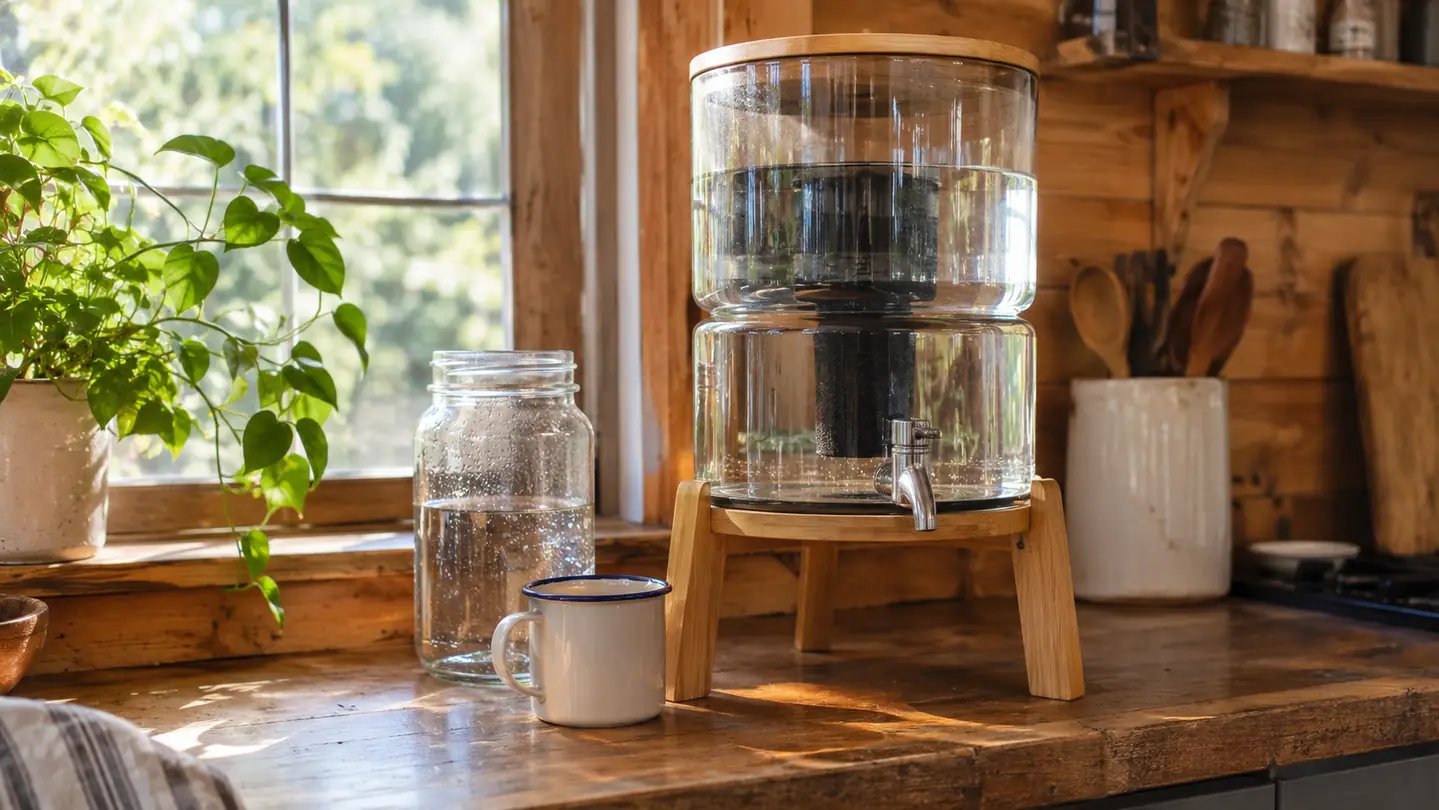
My well sits about ninety feet from the cabin door and it draws out of hard rock. The water comes up cold, clear, and tasting faintly of a penny. Fine for washing. Not what I wanted to hand Dana in a glass after a day of splitting wood, and not what I wanted to drink myself at two in the morning when the stove had gone out and my mouth tasted like a woodpile.
I tried the fridge pitcher first. It made the water colder and did nothing at all for the taste. I tried boiling, which handles the living things and leaves every dissolved mineral exactly where it found them. What finally worked was a gravity filter, and specifically the Big Berkey, a two chamber stainless unit with a pair of Black Berkey elements in it. Six years on it sits on the same counter and I still fill it twice a day.
What follows is the sequence I would give a neighbor, in the order I would give it. Test first, set up second, then the part most people skip, which is the daily routine that keeps the thing producing instead of sitting half full and forgotten behind the bread box.
The Unit That Ended My Boiling Habit
The Big Berkey holds 8.5 liters across two stainless chambers and runs on gravity alone. No power draw, no plumbing, no pump. Two authentic BB9-2 elements do the filtering, and it is rated for source water up to 1000 ppm total dissolved solids, which is the number that actually matters on a drilled well. 4.5 stars from 4,385 reviews.
Amazon Check Today's Price on Amazon →Step 1: Get a number for your raw water before you buy anything
A pen style TDS meter costs less than a decent pair of work gloves and it will tell you more about your water than any product page will. Fill a clean jar from the well tap, let it sit until it comes to room temperature, and take the reading. Then write the number down somewhere you will see it again, because you are going to want to compare it in six months.
My well runs in the low 300s. The Big Berkey is rated to handle source water up to 1000 ppm total dissolved solids, which leaves me a wide margin and is the reason I stopped worrying about the hardness. If your well reads above that 1000 mark, deal with the source before you spend anything on a countertop unit. No gravity filter is built to chew through water that mineral heavy, and you will spend your life scrubbing elements instead of drinking water.
Test twice a year, once after spring melt and once in late summer when the water table is at its lowest. A well that read fine in March can read differently by October, and the change is usually slow enough that you taste it before you measure it. If the property has a history of farm runoff, or you sit downhill from a septic field, pay for one proper lab panel so you know what you are dealing with. A gravity filter is very good at the job it was built for. It is not a substitute for knowing your source.
Step 2: Give it a counter with headroom, not a shelf
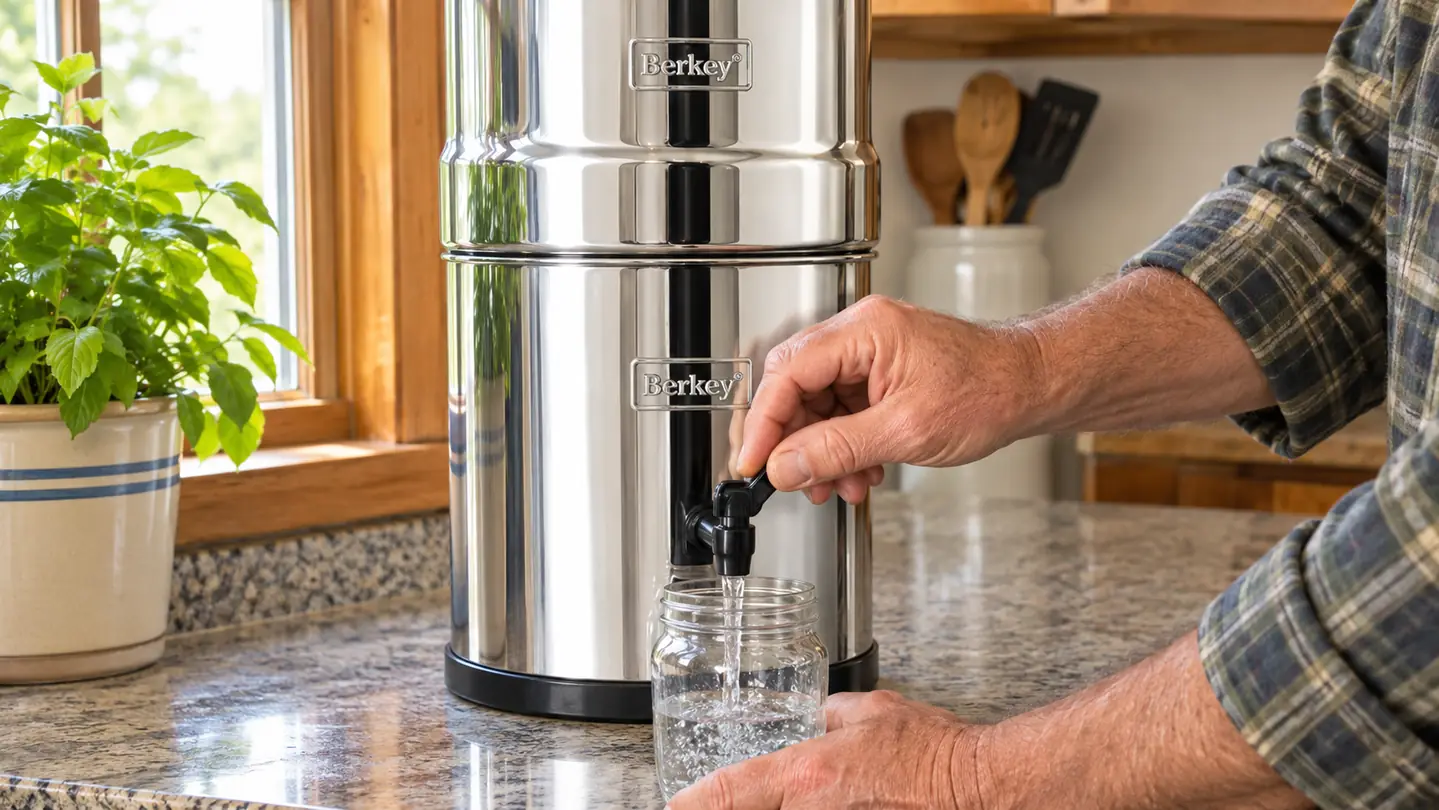
Assembled, the unit is about 8.5 inches across and 19.25 inches tall. The footprint is small enough for any counter. The headroom is the part people forget. You need room above it to lift the upper chamber off while it is still holding water, so measure the gap under your upper cabinets before you commit to a spot. Directly beneath a standard wall cabinet is exactly the wrong place, and you will find that out on the first fill.
Put it on a level surface close to where you actually draw drinking water, and put something under it. I cut a square of cork shelf liner for ours, which keeps it from sliding when I set a full top chamber down and keeps the counter from getting scratched. It has not moved in six years.
Before the first run, prime the two Black Berkey elements following the instructions that come with them. Priming takes a few gallons of water and more patience than you would expect, and skipping it is why a lot of people's first batch trickles and tastes flat. Once they are primed and seated, fill the upper chamber, let it pass through, and dump that first batch. Every gravity filter I have owned has wanted a flush before it was worth drinking from. This one is no different.
Step 3: Fill it at night so gravity has time to work
The rated maximum flow rate is 0.03 gallons per minute. That reads like a line on a spec sheet until you do the arithmetic. A full 8.5 liter fill is going to take somewhere around an hour to pass from the top chamber to the bottom, and longer as the elements load up with sediment. This is not a faucet. It is a slow drip, and the slowness is the entire reason it works with no pump and no power draw at all.
So build the routine around the slowness instead of fighting it. I fill the upper chamber after supper, set the top chamber back in place, and walk away. By morning the lower chamber is full and cool and the coffee gets made without a single decision. Twice a week I fill it at midday instead, so there is a full load waiting when I come in from the shop with my hands still black from the saw.
Two habits to avoid. Don't fill the upper chamber past where the elements sit, because water above them does not filter, it just sits there going stale. And don't pull the top chamber off mid cycle to see how it is coming along, since you will pour a half gallon of unfinished water down the front of your cabinets. Let it be. It knows what it is doing, and it has been doing it since long before either of us got here.
Step 4: Build a draw-off routine so the lower chamber never surprises you
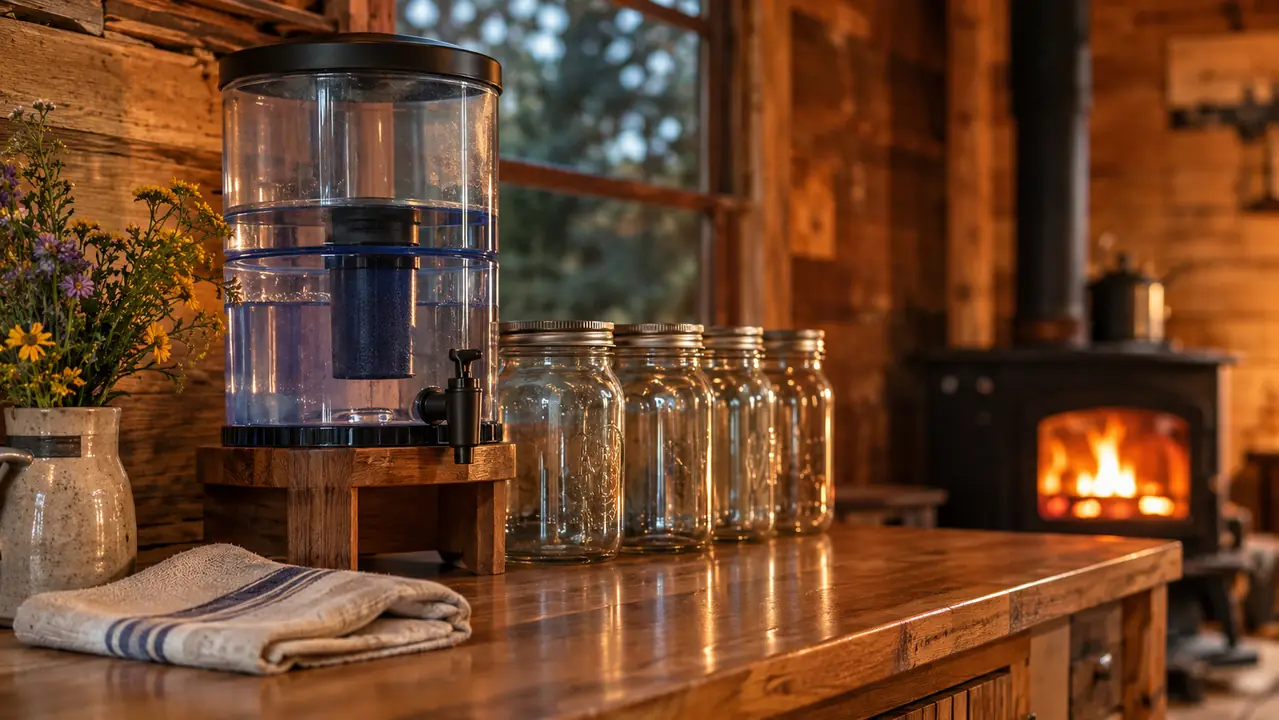
Two people in this cabin go through close to two gallons a day between drinking, coffee, and cooking, which is most of a full load. I keep a row of quart jars on the counter and fill them all in one go rather than drawing a cup at a time all afternoon. It sounds like a small thing. It is the difference between a filter that gets used and a filter that gets ignored.
When we leave for a weekend, I drain the lower chamber, dump whatever is in the upper one, and let the whole thing air out with the chambers separated. Come home, refill, and the first batch waters the plants on the porch. That takes four minutes and it keeps the unit from sitting full of flat water for a month while nobody is here to drink it.
The one habit worth building is keeping the upper chamber loaded. A filter with water in it is ready. A filter that has been sitting empty for a week is a chore you have to do before you can have a glass of water, and that is the exact point where people give up and go back to the fridge pitcher. Keep it full and the whole system disappears into the background of your day, which is what good equipment is supposed to do.
Step 5: Clean the chambers and retire the elements when they tell you to
Every few weeks I take the whole thing apart, wash both stainless chambers in warm water with a drop of dish soap, and rinse them hard. No scouring pads, no abrasives. The chambers are the easy part, and keeping them clean is what stops the unit from becoming something you hide behind the bread box when company comes.
The elements are the part that matters. When a fill starts taking most of a day, pull the pair and scrub them under running water with a soft brush. That brings most of them back. What it will not fix is an element that has simply given up, and the honest signal there is flow that stays slow after a scrub and water that starts tasting of the source again. Mine have gone years between sets, not months, and I keep a spare pair in the pantry so the day it happens is not the day we run out of drinking water.
If you are on really hard water, expect to scrub more often than the calendar suggests, and recheck your TDS number before you blame the elements. The unit is rated to 1000 ppm and it will tell you when it is unhappy by slowing down. That is not a malfunction. That is the thing doing its job and asking you to do yours.
We go through about two gallons a day, and I have not boiled a pot of drinking water since the spring of 2020.
What Else Helps
If your well pulls grit after a hard rain, wrap the top of the upper chamber with a piece of clean cotton cloth, or let a bucket settle overnight and pour off the clear water. Sediment is what kills flow rate faster than anything else, and a scrap of cloth saves you a scrubbing session every month.
Spring water off a hillside usually runs lower in dissolved solids than a drilled well, which is easier on the elements, but it carries its own grit and its own biology. Same sequence applies. Test it, settle it, then filter it. Do not skip the first step because the water looked clean coming out of the ground, because everything looks clean coming out of the ground.
Winter does not change much for the Big Berkey since it lives indoors on the counter, but it changes your habits. Frozen lines, a lower water table, and a wood stove running all day all push a body toward drinking more water, not less. A full unit on the counter is the easiest thing in the cabin to keep up with when the temperature outside is in the single digits.
What this setup is not: it is not fast, and it is not a whole house answer. It makes drinking and cooking water at the rate of a slow drip, and if you want to run a shower or a washing machine off it you have bought the wrong thing. Know that going in and you will be happy with it for years.
Keep a spare set of elements and a stack of clean jars. The two failures I have seen in six years were not filter failures, they were logistics failures. No clean vessel to pour into, or no spare element on the shelf when one finally quit. Fix the logistics and the filtering takes care of itself, and you get to stop thinking about water for another season.
The Piece of Water Gear You Set Up Once and Stop Thinking About
Two stainless chambers, two BB9-2 elements, 8.5 liters of capacity, and no power draw at all. If your well tests under 1000 ppm, this is the simplest thing you can put on a counter and walk away from. 4.5 stars across 4,385 reviews.
Amazon Check Today's Price on Amazon →