
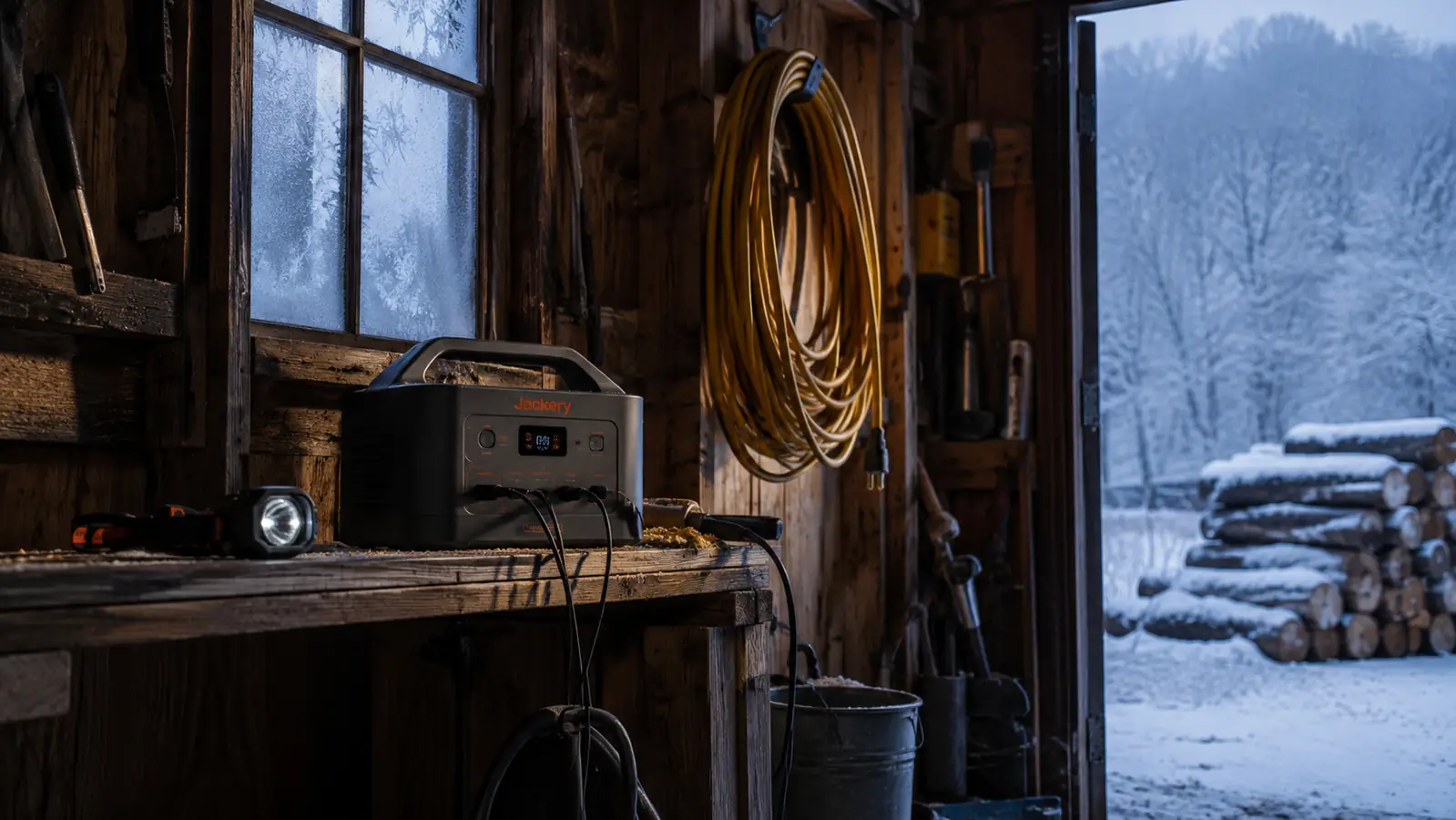
The first winter I ran the cabin, I lost power at 4:40 on a Tuesday afternoon. Not a storm, just a limb on the line a mile down the road, and by six o'clock the house was dark, the fridge was running warm, and I was standing in the power shed with a flashlight in my teeth trying to remember which breaker fed the well pump. I got the pump running again that night. I did not get the meat back.
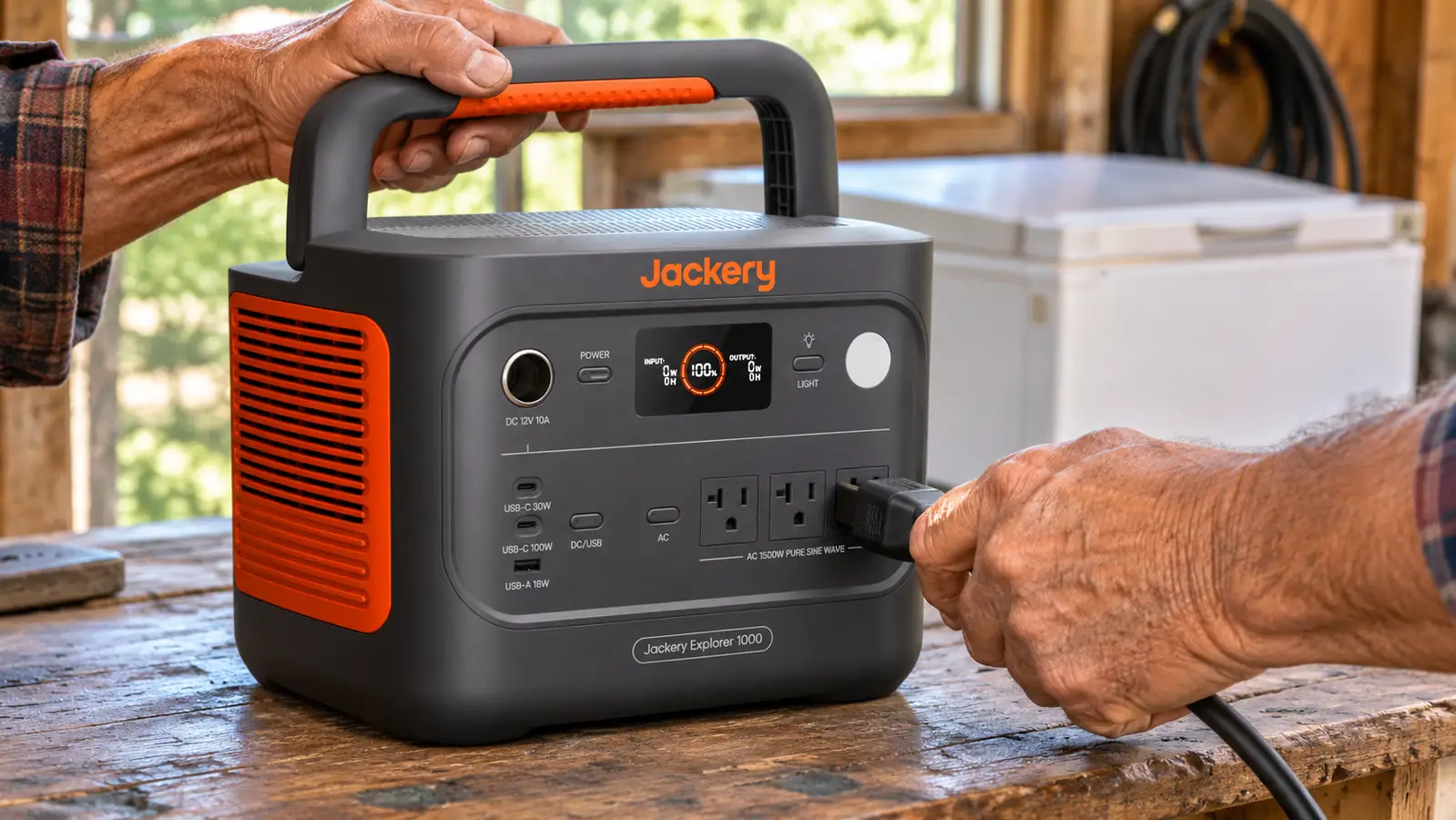
Six years later there is a Jackery Explorer 1000 v2 sitting on a shelf in that shed, and the difference between those two nights is not the box. It is the plan around the box. The unit holds 1,024 watt hours, puts out 1,500 watts through two pure sine wave AC ports, and weighs 23.4 pounds with a foldable handle, which means I can carry it from the shed to the kitchen with one hand. What it cannot do is guess. So before the next outage I sat down with a meter and a notebook and figured out what my fridge and my well pump actually pull. Here is that process, in the order I would do it again.
One box on the shelf beats a dark house at 4:40 in the afternoon.
The Explorer 1000 v2 is the piece I check first when the sky turns. 1,024Wh of capacity, 1,500 watts, 23.4 pounds, and about 50 minutes from empty to full on wall power.
Amazon Check Today's Price on Amazon →Start With the Two Loads That Decide Everything
A fridge and a well pump are not the same kind of problem. A fridge is a slow, patient load that sips power all day and then asks for a hard kick when the compressor starts. A well pump is a short, violent load that asks for everything at once and then goes quiet. If you size for the fridge you will be fine for a day and a half. If you size for the pump you will buy twice the battery you needed. So I measure them separately and I plan for them separately.
The second thing I do is honest arithmetic about run time. A 1,024 watt hour battery is not a 1,024 watt hour gift. You lose a little to the inverter, you lose more to cold, and you lose the most to not knowing what you plugged in. Once I had the real numbers written on a card and taped inside the shed door, everything else got simple. Guessing is what makes people buy the wrong unit twice.
Step 1: Measure What Your Fridge Actually Pulls
I use a plug-in energy meter, the kind that goes between the wall and the appliance and counts up over time. It is the most useful tool I own for this job, and I have used it on three appliances since. Plug the fridge into it and leave it alone for a week. Not a day. A week, so you catch the defrost cycle and the hot afternoon.
The number you want is daily watt hours, not the sticker on the door. Mine came out around 1.1 kilowatt hours a day in spring and closer to 1.6 in a hot August, because the cabin gets warm and the compressor works harder. A newer fridge will land lower. A chest freezer on an external thermostat, run as a fridge, will land lower still. The label tells you almost nothing about real life. The meter tells you the truth.
Write the daily number on a card, then divide your battery capacity by it. That is your run time before you touch anything else, and it is the number that decides whether you are buying a bridge or a lifestyle. With 1,024 watt hours and a fridge that eats 1.1 a day, you have one realistic day, maybe a little more. Now you know what you own, and nobody can talk you into something else.
Step 2: Find Out What Your Well Pump Actually Needs
This is the step where most people get sold the wrong thing, and it is not the salesman's fault. Look at the pump itself, or at the breaker that feeds it. If it is a two-pole breaker, you have a 240 volt pump, which usually means a submersible sitting down a drilled well. That is what I have. The Jackery Explorer 1000 v2 is a 120 volt unit. It will not run a 240 volt pump, and no wattage printed on a carton changes that.
If you have a shallow jet pump or a 120 volt transfer pump, the math is different and usually workable. Find the running watts on the pump plate, then find the starting watts or the locked rotor amps. A pump that runs at 800 watts can pull close to three times that for a second or two on start. The Explorer 1000 v2 is rated at 1,500 watts, so a small 120 volt pump sits inside its reach, but get the starting number before you bet a cold morning on it.
My setup is a split, and it has been the same split for six years. The 240 volt submersible stays on its own circuit and runs off the array inverter when the sun is up, or the generator when it is not. The power station carries the fridge, the lights, the router and the chargers. That is not a compromise I settled for. It is the arrangement that keeps the batteries small, the wiring simple and the water running. If a deep well plus a 120 volt box is the whole plan, it is the wrong plan, and better to hear that now than in February.
Step 3: Treat the Power Station as a Bridge, Not a Replacement
A power station is a bridge. It carries the house over a gap, from the moment the line goes down to the moment the generator catches or the sun comes back. Bridges get sized to the gap, not to the whole river. Once I started thinking about it that way, I stopped trying to power everything and started making sure the things that matter would run for the hours that actually matter.
The Jackery Explorer 1000 v2 has a 10 millisecond switchover rated for home backup, which means if the fridge is plugged into it while the unit is also plugged into the wall, the fridge never notices the outage. Ten milliseconds is faster than a compressor can flinch. That is the feature I lean on most, and it is the one nobody mentions when they talk about camping with one of these.
The rest is discipline. Two AC ports, two USB-C, one USB-A, one DC car port, seven outlets in all, plus a house rule that the fridge gets first call on every watt. Lights are LED and they sit on their own small batteries. Phones charge off USB. Nothing with a heating element goes anywhere near the unit. A space heater or a coffee maker will empty 1,024 watt hours faster than you can finish a cup, and I have watched a neighbor prove it on a thirty degree night.
The meter said my fridge uses about 1.1 kilowatt hours a day. The Explorer 1000 v2 holds 1,024 watt hours. That is one honest day of refrigeration, and knowing the number is what stopped me guessing.
Step 4: Set It Up So Nobody Has to Think at 2 A.M.
An outage at two in the morning is not a thinking event. You are half awake, the house is black, and every decision you make is a bad one. So make the decisions in daylight, once, and then label them so your half awake self can follow instructions.
In my shed the fridge circuit wears a strip of blue tape with the word FRIDGE on it, and a heavy extension cord already runs to the kitchen with the plug hanging where I can find it by feel. The power station lives on a shelf at chest height, charged, handle folded up, AC button off so it does not drain while it sits. A headlamp hangs on a nail beside it. None of this is clever. All of it is the difference between fifteen minutes and three hours.
One more thing: keep the unit where it stays warm. Cold cuts usable capacity, and a shed in February is cold. Mine sits inside the insulated part of the shed, up off the concrete, and in the worst of January I carry it into the cabin. At 23.4 pounds it is light enough to move without wrecking my knee, which at fifty-two I count as a real feature rather than a spec sheet line.
Step 5: Recharge Before It's Empty, Not After
The habit that keeps this working is charging early and often. The Jackery Explorer 1000 v2 goes from empty to full in about 50 minutes on a wall outlet, which is fast enough that I have no good excuse. Whenever the forecast calls for ice or wind, I top it off the night before and top it off again on the first calm day after. A battery that sits at half for a month is a battery you cannot count on in a week.
When the outage runs long, solar is the second path, and it is a slow one. Plan on most of a decent sunny day to get back to something useful, and plan on clean panels pointed properly. I check the state of charge from the app while I am out feeding the stove, and I write the number in the log by the door. Two lines a day is all it takes, and that log has saved me twice.
LiFePO4 cells are the reason I stopped fussing over this part. They tolerate being topped off, and they do not have the drama of the older chemistry. Six years off the grid has taught me that boring batteries are the good ones, and that the charger you actually use beats the charger with the better brochure.
The Mistakes I Made First
I bought my first battery for the wrong load. I sized it against the well pump because that was the scary thing, and then I had a box big enough to start a pump twice a day and not much left over for a fridge that runs all night. The fridge is the load that runs while you sleep. Size for the thing that runs the most hours, not the thing that makes the most noise.
The second mistake was leaving the inverter on all the time. It draws a small trickle that turns into a real number over a week, and it also tempts you to leave things plugged in that should not be. Now the unit runs with the AC side off unless the fridge is on it. The third mistake was trusting my memory instead of the meter. I was wrong about my fridge by nearly half, and I was wrong in the direction that made me feel better.

What Else Helps
A pressure tank is the best comfort item in an off-grid water system. It lets the pump run in long, efficient stretches instead of short nervous bursts, and it gives you a few gallons of push with no power at all. If you are pumping into a cistern or a stock tank, put a float switch on it and stop walking out to check the level in your slippers.
Second, kill the phantom loads. The router, the television, the chargers with the little lights, they add up to more than people believe. I put the entertainment gear on one switched power strip and turn it off at night. Third, keep the paper log. Battery level, time, what was running. When something goes wrong you will have a record instead of a feeling, and the record is usually right.
And keep a little gratitude about it. There are nights out here when the wind comes down through the pines and the only sound in the cabin is the fridge running off a battery the size of a toolbox. I did not build this place to be impressive. I built it to be warm and quiet, and a good share of that quiet comes from having planned the power before I needed it.
The fridge keeps running. That is the whole point.
The Jackery Explorer 1000 v2 gives you 1,024Wh, 1,500 watts through pure sine wave AC ports, 23.4 pounds with a foldable handle, and about 50 minutes to full. It is the piece I check before every storm.
Amazon Check Today's Price on Amazon →