
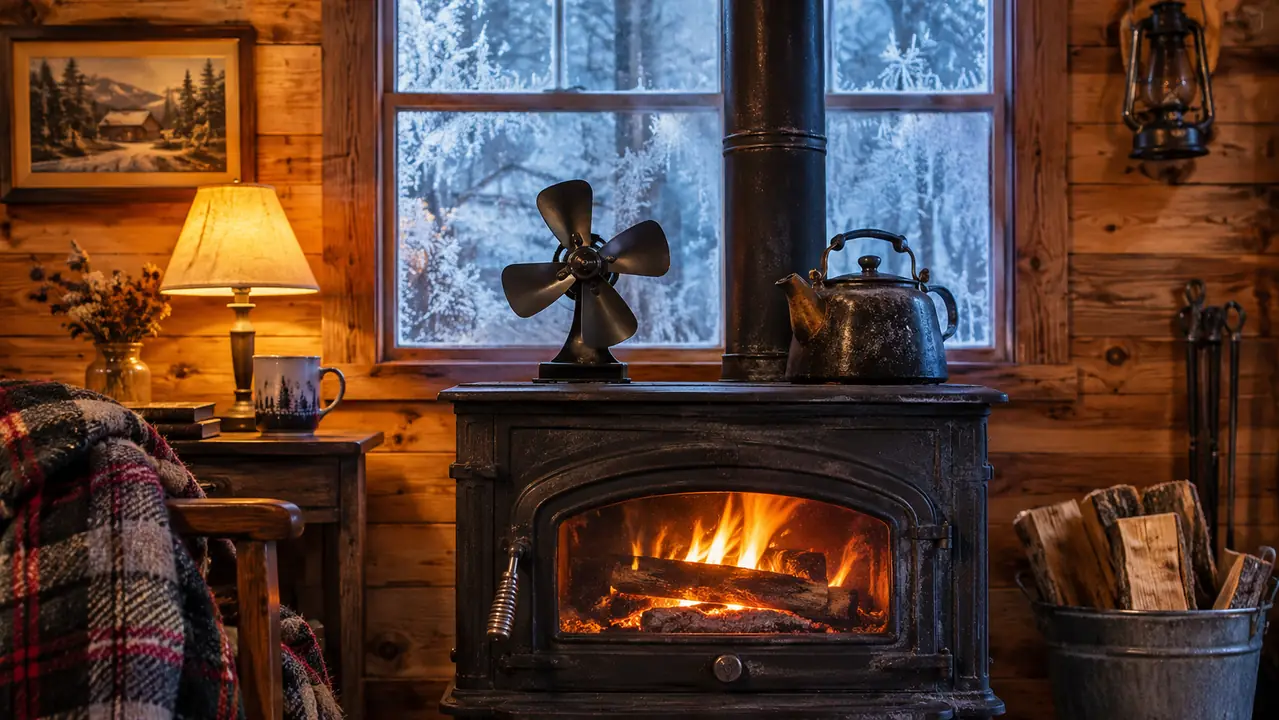
My cabin is twenty-four by thirty-two, one open room downstairs with a bedroom at each end, and a single wood stove sitting more or less in the middle of the front room. For the first four winters I heated the front half and let the back half fend for itself. Sixty-eight degrees by the stove, fifty-four at the bedroom door, and a wife who did not complain but slept in a fleece hat. I tried opening the doors wide, I tried a box fan on an inverter that drained a battery bank in an evening, and I thought about moving the stove, which is a job I do not recommend to anyone with a back. None of it moved heat the way I wanted. What finally did was a small fan that sits on the stovetop and runs off the heat coming out of it.
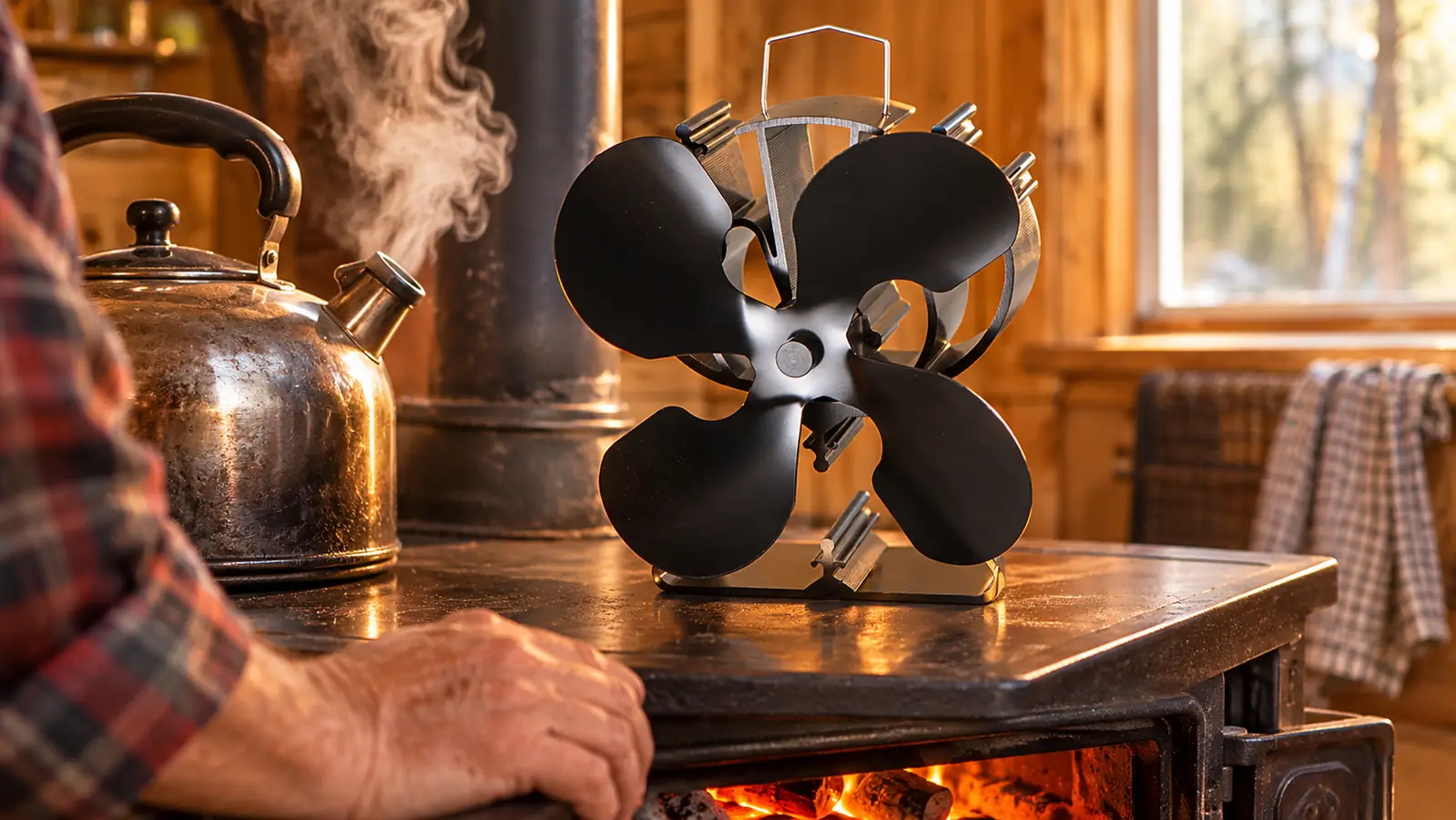
The one on my stove is a VODA, a heat powered fan with four aluminum blades, and it has never been plugged in because there is nothing to plug in. It starts turning once the stovetop is hot enough, spins at 240 rpm, and makes about as much noise as a quiet refrigerator, 25 decibels according to the listing. Three watts of work, done by the fire instead of the solar array. That last part matters in January, when the panels are under snow and the batteries are doing everything they can just to run the well pump. A fan that draws nothing from the power shed is a fan I can leave on all day without thinking about it.
Your Stove Already Makes the Heat. Move It.
The VODA fan sits on the stovetop, spins up from the heat, and pushes warm air toward the rooms that need it. No cord, no batteries, nothing drawn from your solar array.
Amazon Check Today's Price on Amazon →Five Steps That Actually Moved the Heat
Step 1: Heat the Stove, Then Set the Fan Flat
The fan will not do anything on a cold stove, and that is not a defect. It is heat activated, which means the stovetop has to come up in temperature before the blades start moving. On my stove that takes about twenty minutes from a cold start with good dry ash and maple. Set the fan on a flat section of the top, toward the back but not on the flue pipe itself. The pipe runs hotter than the top plate and the fan does not need that kind of heat. Mine sits about six inches back from the front edge, clear of the door swing, on a plate level enough that the fan does not walk around. It weighs 600 grams, roughly a pound and a quarter, so it is not going to stress a steel top. If your stovetop is warped or has a raised seam, find the flattest part you have and check it again once the stove is hot.
Give it a little elbow room. The fan is 4.72 inches deep and 8.27 inches wide and tall, small enough to sit on most stovetops without crowding a kettle, but hot air has to come up through those blades. A kettle set right against the back of the fan will block the flow and make the fan look useless when it is doing its job. I keep the kettle on the left, the fan on the right, and a trivet in the middle for the coffee pot. That arrangement has not changed in five winters.
Step 2: Point the Air at a Doorway, Not at the Middle of the Room
The blades do not push a hard column of air like a box fan. Two hundred forty rpm is a gentle, steady stream, and gentle is the point. Stand three feet away and you will barely feel it on your hand. Stand eight feet away, in the doorway of the cold room, and you will. So aim the fan at the opening you want heat to reach, not at the sofa. In my place the stove faces the front door, the hall to the bedrooms runs off the right side of the front room, and the fan sits angled maybe thirty degrees toward that hall. Before I turned it that way, all the heat stacked up under the front room ceiling and the hall stayed cold.
Height matters too. Warm air wants to rise, and the fan is pushing it sideways along the top of the stove. If your doorway has a header above it, that warm air will hit the header and curl back into the room unless the stream is aimed low enough to pass under it. I tipped mine down a touch by sliding a thin shim under the back edge. Some people will tell you to put a fan on the floor to push cold air toward the stove instead. That works in some houses. In a cabin with one stove and a low ceiling, the top-down push got heat to the bedroom faster and with less fiddling.
One caution. Do not aim the fan at a wall and hope the heat bounces. It will, a little, but you lose most of the push. If the doorway is off to the side, turn the whole fan, not just the grille, and recheck that it is still sitting flat.
Step 3: Give the Cold Air Somewhere to Go
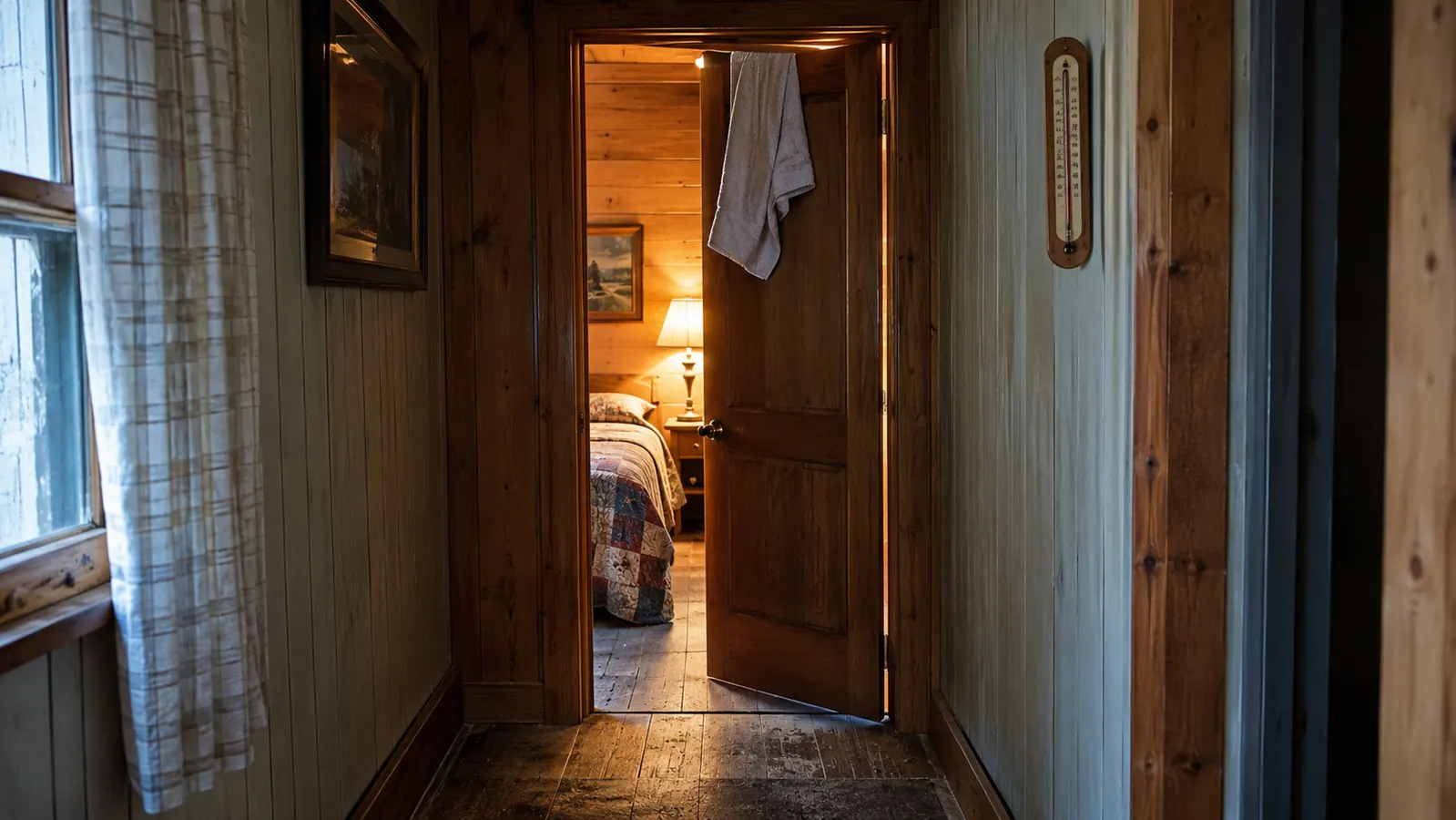
Heat moving into a room is only half the loop. If the bedroom is closed tight, warm air goes in the door, cools, and sits there, and very little new warm air follows it. Cold air has to come back along the floor to the stove to be heated again. I crack the bedroom door about two inches by hanging a folded towel over the top corner, which holds it open just enough and does not let it swing. Sounds like a fiddle, but it works. The gap lets the cold air slide out along the floorboards while the warm air moves in up top.
Same idea for a loft or a stairwell. Open the door at the bottom of the stairs and let the loop run. And keep the path clear. A rug bunched up in the doorway, a basket of firewood parked in the hall, a laundry basket pushed against the gap, all of it slows the return air and makes the fan look weak. I move the wood basket out to the porch in November and do not bring it back in until April. That one habit did as much for the back bedroom as the fan did.
If your cabin has a closed bedroom door at night because of sound or kids, prop it during the day and let the room bank heat before bedtime. Then close it and the room holds what it has. That is not as good as a full loop, but it beats a cold room at ten at night.
Step 4: Judge It After Forty Minutes, Not Four
The first time I set the fan on the stove I gave it four minutes, felt nothing, and decided I had wasted my money. Then I went out to split wood, came back forty minutes later, and the hall was warm. The stove had come up, the fan had been turning for half an hour, and the loop had finally established itself. That is the honest test. Same firebox load, same outside temperature, one thermometer at the bedroom door, read at the one hour mark with the fan running and again on a matching night without it.
That is where my number comes from. Sixty-five degrees at the bedroom door with the fan, fifty-four without it, same load of ash and maple, same outside temperature around twelve degrees. It is not a furnace. It is a steady nudge that moves heat you already paid for in firewood from one end of the cabin to the other. The 25 decibel noise level is honest too. I can hear mine if I stand next to it with the room silent. From the couch, with the fire crackling, I do not hear it at all.
Step 5: Keep the Blades Clean and Leave It Running
Wood smoke leaves a film. By February the blades on mine pick up a light dusting of ash and haze, and a dusty blade moves less air. When the stove is cold, wipe the blades with a dry rag. Four blades, maybe two minutes of work. Do not lean on them. They are aluminum and they will bend, and a bent blade will wobble and lose its push. I do this once a month through the heating season and once at the end of it before the fan goes on the shelf in the power shed.
The other thing is to leave it alone. The VODA is heat powered, so it starts when the stove is hot and stops when the stove cools. There is nothing to remember and nothing to recharge, which is exactly what I want in a house where everything else needs my attention. I set it on the stove in October and take it off in April. Running it every single day, not just on the cold snaps, is what keeps the far rooms livable. A fan that only runs on the worst nights never really gets the loop going.
What Else Helps
A fan is one part of a system. The rest of mine is unglamorous. Door sweeps on the two exterior doors. A heavy curtain across the front window that gets drawn at dark. A rolled towel at the bottom of the bedroom door on windy nights. Closing off the mud room, which is really a porch with ambitions, so the stove is not trying to heat a space nobody sits in. If you have the power to spare, a ceiling fan on low will do more for a tall room than a second stove fan will, because it breaks up the layer of hot air at the ceiling. In my cabin the ceiling is low enough that the stove fan does that job by itself.
And a word about the fire. Wet wood makes steam, steam makes creosote, and a smoldering fire does not put much heat into the stovetop. Split your wood, stack it under cover, and give it a year. A hot, clean fire plus a fan does more than a bigger firebox ever will. I keep a stovetop thermometer and try to run between 400 and 500 degrees on the top plate. Below that the fan turns slowly and the room stays cool. Above it the stove is working harder than it needs to and the wood goes faster.
Sixty-five degrees at the bedroom door with the fan running. Fifty-four without it. Same stove, same load of ash and maple, same twelve degree night.
What I Got Wrong the First Winter
I put the fan too far forward, right behind the door, so half its air went up toward the flue collar instead of out into the room. I also expected it to heat the whole cabin in an hour. It does not work that way. It moves air steadily, and steady takes time. If you set it up on a Saturday morning and check it at lunch, you will know whether it is doing its job.
The other mistake was closing the bedroom door at night, which killed the loop I had spent all day building. Now I leave it cracked and we both sleep better for it. Six winters in, the VODA is still on the stove, the blades still turn, and the fleece hat stays in the drawer. I am grateful for small things like that, and a warm bedroom at the end of a long cabin is not a small thing in February.
Six Winters on the Same Stove, Same Fan
Four aluminum blades, 240 rpm, heat powered, nothing to plug into the power shed. It starts when the stove is hot and stops when it cools.
Amazon Check Today's Price on Amazon →