
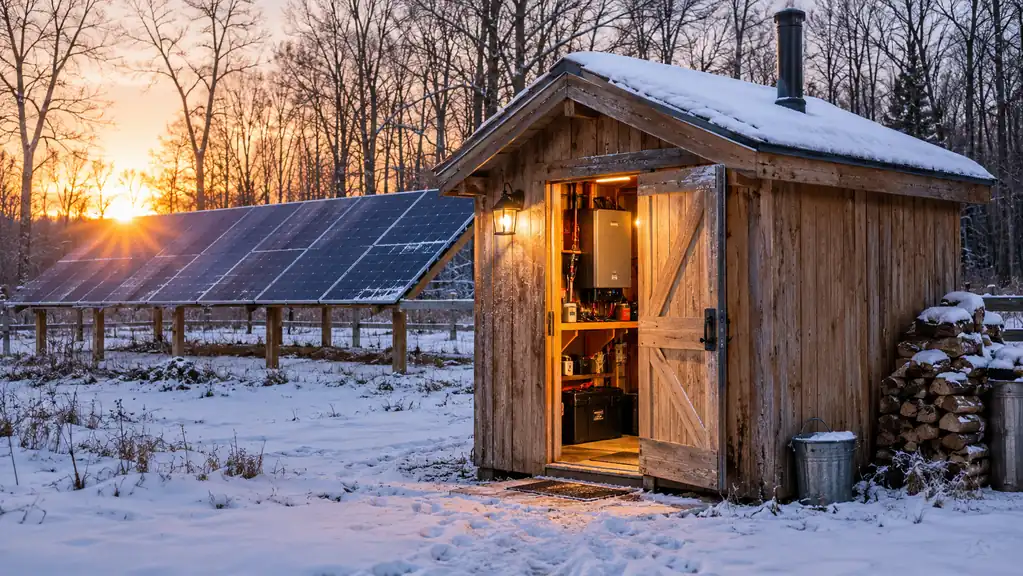
When an ice storm took my solar array down for four days in March, I ran my cabin off the Jackery Explorer 1000 v2. Lights, the router, two phones, a laptop, and the small chest freezer out in the shed. It did all of that without a complaint. What it would not do is run the well pump, and that is where I want to start, because it is the part that never shows up in the product photos.
I am Caleb Rourke. I am fifty two, I spent most of my working life as a millwright, and Dana and I have lived in a twenty four by thirty two foot cabin on fourteen wooded acres about an hour outside Syracuse for six years. We are off the grid, which means when the power goes there is no line crew coming and no phone call to make. Six months with the Explorer in the power shed has sorted the manufacturer claims into two piles, the ones that hold up in a New York winter and the ones that only hold up on a spec sheet. This is the honest version, including the parts that cost me a morning of troubleshooting.
The Quick Verdict
Runs my lights, router, phones and chest freezer through a four day outage and weighs just over twenty three pounds. It cannot run a 240 volt well pump or a space heater for long, and to its credit it does not pretend to.
Amazon Check Today's Price →Read the output line before you read anything else
The 1024Wh Explorer 1000 v2 is on Amazon with the full spec sheet listed. The AC output number is the one that decides whether this works in your house or not.
Amazon Check Today's Price on Amazon →How I Have Actually Used It
Most weeks the Jackery does nothing at all. It sits on a shelf in the power shed, topped off, waiting. That is the honest reality of a power station in a working off grid home. It is not a daily driver. It is insurance, and like any insurance you only find out whether you bought the right coverage when something goes wrong. In six months I have leaned on it for three outages, one weekend of framing a woodshed, and one fishing trip where the truck battery was not something I wanted to gamble on.
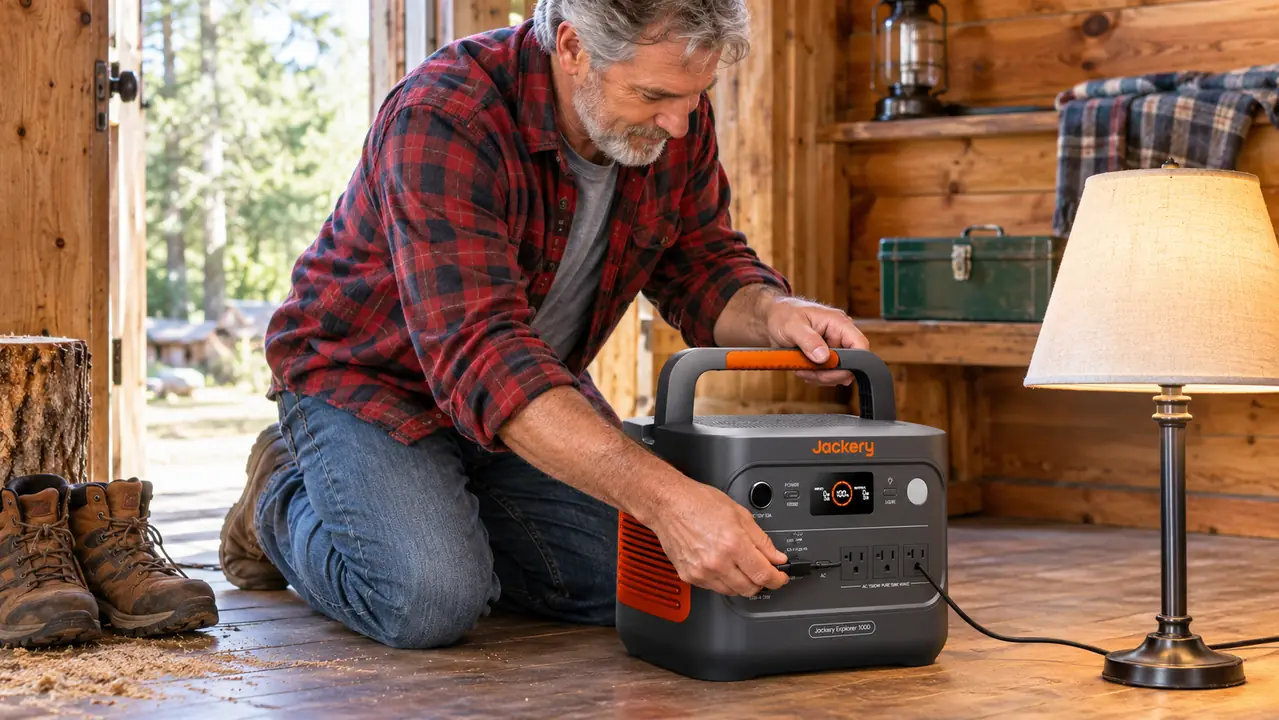
The outages are where it earns its keep. Our longest stretch was that March ice storm, four days. I set the unit inside the cabin door and ran one cord to the router and one to a power strip with two LED lamps on it. The phones and the laptop went on the USB-C ports. It carried that load for days, and I recharged it in the afternoons once the array shook the ice loose. The storm hit on a Tuesday night, the twelfth of March, and the panels were still shedding ice on Saturday morning. I kept a paper tally taped to the shelf because I wanted an honest number instead of a memory. By the fourth morning the machine was down to about thirty percent, and that was with the freezer run in blocks and the lamps off when we turned in at nine. It held. Barely, and with care, but it held.
The other honest thing I will tell you is that I tried to run a circular saw on it and it shut down. I was framing a shelf, I did not want to drag a cord three hundred feet to the generator, and the saw pulled more than the machine wanted to give. It cut once, coughed, and the unit went into overload. Nothing broke. It reset and carried on. But if your plan is to use this as a job site power source for power tools, plan on a smaller saw or a bigger machine, and do not blame the box when it protects itself.
What It Runs Without Complaining
Here is the list from the ice storm, in plain terms. Two LED lamps. One internet router. Two phones and a laptop on the USB ports. A small chest freezer in the shed, which I ran in two hour blocks, morning and evening, rather than leaving it plugged in overnight. March in that shed runs around thirty five degrees, so the freezer was not fighting much heat, but it held temperature and nothing spoiled. The cabin stayed lit and I stayed in touch with the outside world, which in an outage is worth more than people give it credit for until they have sat through one.
The router is on the machine permanently now. The Explorer has a fast transfer to battery, ten milliseconds by the spec, and that is quick enough that the router does not reboot when the cabin power blips. That matters more than it sounds. In a house running off an inverter and a battery bank, small blips happen, and every reboot means a minute of no internet and a modem that has to renegotiate with the tower. Before this, the router sat on a small consumer backup that lasted about eleven minutes and beeped the whole time it was doing it. When that battery aged out I did not replace it, because the Explorer does the same job with far more reserve behind it. I have not had a single drop since, and if the whole cabin goes dark the internet stays up long enough for me to get a message out and decide what to do next.
Between the outlets, the machine covers everything in a small cabin. Two AC receptacles, two USB-C ports, one USB-A port, and a twelve volt car socket. I use the car socket for a small fan in summer when the cabin gets sticky in the afternoon. Dana charges her phone on the USB-A because she has an older cable and no interest in changing it. It is not a lot of outlets. It is enough outlets, as long as you are not trying to run a shop off it.
The fishing trip is worth describing because it is the kind of thing people actually buy these for. I took the Explorer to a lake north of here for a weekend in July, mostly to see whether it would be a nuisance. It was not. It charged two phones, ran a small fan in the tent at night, and made coffee in the morning without me thinking about it. I brought it home with charge to spare. If that is your whole use case, you will be happy and you will never touch the limits I have bumped into.
What It Will Not Run
The well pump is the one that stings. Our pump is a 240 volt submersible down a drilled well, and the Explorer puts out 120 volts. There is no adapter, no cord and no clever arrangement that changes that. This is the biggest misunderstanding I see in reviews, people buying a power station expecting it to carry the house, then finding out the water stops. The pump sits two hundred and forty feet down a six inch casing and draws 240 volts at the panel. To run it I would need a 240 volt source, and a split phase inverter of that size is a different piece of equipment in a different weight class. I priced it out in my first year off the grid and decided the generator was the cheaper answer. It still is. If your pump is 240 volts, this machine is not whole home backup, it is a lights and electronics backup, and the water has to be planned separately.
Heat is the second one. We heat with the wood stove, so it is not a problem for us, but I watch people buy these things expecting to run a space heater through a cold snap. Run the arithmetic. A fifteen hundred watt heater pulls the entire continuous output of this machine and drains a thousand watt hour battery in about forty minutes. That is not a failing. That is simply what a thousand watt hours is, and no amount of wishful thinking changes the division.
Anything with a hard starting motor belongs on the same list. A table saw, an air compressor, a big shop vac, a chest freezer that has been sitting in a warm shed and has to start against pressure. Motors pull several times their running watts for a second or two on startup, and the machine will protect itself by shutting down rather than letting the surge through. It is doing exactly its job. It just means the job you had in mind may not be the job it can do, and you want to know that before the power is already out.
It ran a router, four lamps, two phones, a laptop and a chest freezer for four days. It would not run the well pump for four seconds.

The Things Nobody Tells You
The fifty minute fast charge is real, and it is a grid feature. You need a wall outlet pushing serious current to hit that number. My cabin has no wall outlet. I charge from the panels when the sun is out and from the generator when it is not, and both are slower than the number printed on the box. If you have grid power, the fast charge is a genuine convenience and worth having. If you live like I do, ignore that line entirely and think hard about how you will actually put electrons back into the thing.
Solar recharging in upstate New York is a seasonal thing, and nobody selling you a power station wants to say so. From May to September I can top the machine off with the array without thinking about it. In December and January the sun sits low behind the treeline and the honest answer is that a gray week will not charge this machine at all. I have four panels on a ground mount, tilted for the low sun, and on a clear day in January they will give maybe a third of what they manage in June. On the gray stretches, the ones that run five days straight in February, they give nothing worth measuring. I check the Jackery on the first of each month from November through March and top it from the generator if it has drifted below half. That is the routine. It is not glamorous, and it is the reason I still keep fuel on hand.
The other thing I did not expect is how much it changed my habits. Because I know the machine is full and the freezer can run in blocks, I stopped treating every flicker of the lights as a crisis. That is worth something in a house where you are the utility company. The night the main inverter shut down on low battery in February, I did not have to do anything in the dark. I plugged the lamps into the Explorer, told Dana to finish her chapter, and dealt with the actual problem in the morning with a clear head and a cup of coffee.
The weight is honest. Just over twenty three pounds with the foldable handle is light enough that I can carry it one handed up the cabin steps and heavy enough that I would not want to haul it a quarter mile through snow. It lives in the shed and travels to the cabin when it is needed. If you are buying this to move between a truck bed, a tent and a boat every weekend, weigh that twice before you commit, because you will be lifting it more often than you think.
There is app control, and it works. I paired it the first week without trouble. It is genuinely useful when the unit is out in the shed and I want to know where it stands without pulling my boots on. I do not use it much beyond that, because I am usually standing right next to the machine anyway. It is a nice extra, not a reason to buy, and I would not let it sway a decision either way.
What I Liked
- Carried the cabin through a four day ice storm on lights, router, phones, laptop and a chest freezer
- Fast transfer kept the router from rebooting during small power blips
- Just over twenty three pounds with a foldable handle, so one person can move it
- LiFePO4 chemistry means sitting at full charge does not hurt it
- Two AC outlets, two USB-C, one USB-A and a twelve volt socket cover a small cabin
Where It Falls Short
- 120 volts only, so a 240 volt well pump is out of the question
- A fifteen hundred watt heater will empty it in about forty minutes
- Winter solar recharging in the Northeast is slow and unreliable
- Hard starting motors trip the overload before they do useful work
- The fifty minute fast charge needs a wall outlet, which off grid owners do not have
Who This Is For
This machine fits a cabin, a camp, a small workshop, or a house with grid power that wants a quiet backup for the essentials. It fits anyone whose critical loads are lights, communications, a laptop job and a fridge or freezer they are willing to run in blocks. It fits a person who wants something they can lift, store indoors, and still trust in three years when the first set of chemistry would have started to fade. And it fits the person setting up an off grid place who understands that a power station is the second layer of the system, not the foundation.
It also fits the person who already owns a generator and is tired of running it all night for two lamps and a router. That is a real use case and a good one. The Explorer will not wake the neighbors at two in the morning and it will not need fuel. I have done both, and I know which one I would rather listen to.
Who Should Skip It
Skip it if your well pump is 240 volts and you were counting on this to carry water. Skip it if you heat with electric baseboard or a space heater in a cold climate, because no battery of this size will do that job for more than a few minutes. Skip it if your plan is to run power tools off it all afternoon. And skip it if you want a week of autonomy in January without a generator or a large array, because the honest math does not get you there. I am grateful for ours. I am also clear eyed about what it does and does not do, and you should be too before you spend anything.
Quiet backup for the loads that actually matter
Two AC outlets, two USB-C, one USB-A and a twelve volt socket. Match that against the loads you really have, then decide.
Amazon Check Today's Price on Amazon →