
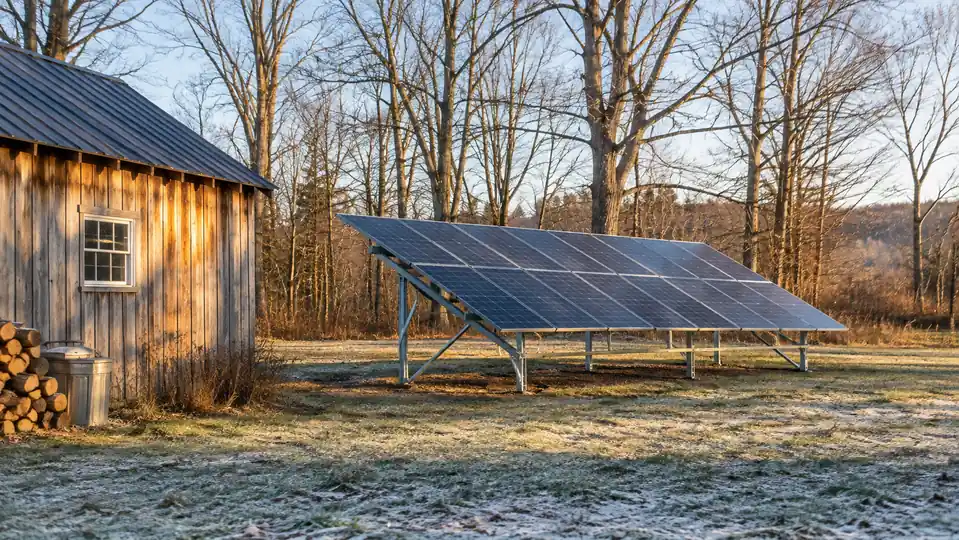
The thing I'd want a friend to tell me before he spends anything on the Renogy 200W kit is this. The panels are better than the controller, and neither one is junk. I've run this kit for two seasons on a ground mount behind my power shed, feeding the same battery bank as my older array, and I'd buy it again. I'd just buy it knowing what I know now, which is that a pulse width modulated controller has a ceiling and you will eventually meet it. That isn't a knock. It's the shape of the thing.
Dana and I live on 14 wooded acres about an hour outside Syracuse, in a 24 by 32 foot cabin I finished myself. Six years off the grid now. Wood stove for heat, drilled well for water, a small solar array on a ground mount, and a shed out back I call the power shed because that's where the power lives. When I added this kit it wasn't our first solar and it won't be our last. It was the piece I wanted for the shoulder seasons, and that is exactly what I got.
The Quick Verdict
Honest, well-made monocrystalline panels paired with a PWM controller that leaves a measurable slice of your harvest on the table. Buy it as a starter or a supplement, not as your final answer.
Amazon Check Today's Price →The kit I'd buy again, with both eyes open
200 watts of monocrystalline panel and a 30A controller that runs four proper charging stages. Add a battery and a mount and you have a working system this weekend.
Amazon Check Today's Price on Amazon →How I've Used It
The panels went up in April on a ground mount I welded out of scrap angle iron and set at roughly my latitude, fixed, no tracking. Cable runs down the hill to the power shed where the controller sits on the plywood wall next to the older charge controller. I tied it into the 12-volt bank that also takes charge from the main array. No cleaning schedule beyond a rag when the pollen gets thick in May, and a broom after snow.
The first mount I built was wrong and I'll say so. I used lighter stock, set it at a shallow angle, and braced it in one plane because I was in a hurry before the ground thawed out of the frost. It held through May and June, then we got a line of weather out of the northwest in early July and I watched the whole frame rock maybe two inches at the top corner. Not a disaster. A warning. I cut it down, welded a proper A-frame with bracing in both planes, set the panel face at roughly my latitude, and sunk four posts two feet deep instead of two posts at eighteen inches. That frame hasn't moved since. The lesson cost me a Saturday and a handful of rod, and it's the same lesson every time: the mount is not the accessory, the mount is the foundation.
What I wanted was shoulder-season help. November and March are the cruel months up here. The days are short, the hardwoods still throw shade at the wrong hour, and the main array works at half of its June output. Two hundred more watts on a fixed mount earns its keep in that window. It did. That's the honest bottom line on why this kit stayed bolted to the ground.
It's also the easiest system I've ever walked a neighbor through. Panels, controller, cable, battery. I can explain the whole thing in ten minutes on the tailgate of my truck because there genuinely isn't more to it. That simplicity is the kit's best feature. It's also the reason for its one real limitation, which we'll get to.
What Comes in the Box, and What Doesn't
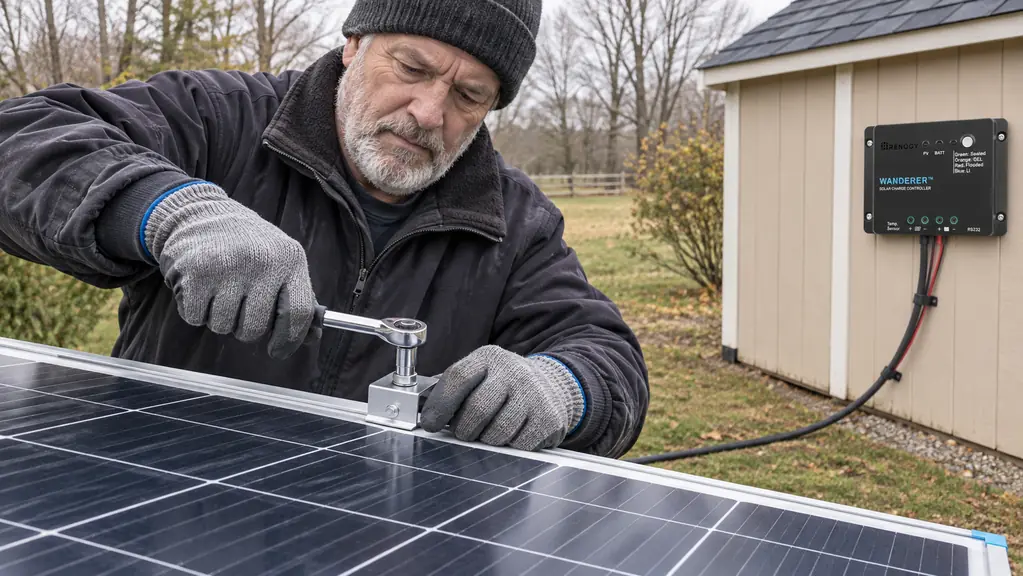
You get the panels, the 30A Wanderer PWM charge controller, and cable. That's the kit. You do not get a battery, an inverter, a mount, or fuses. The listing says so plainly if you read it slowly, and most people don't read it slowly. I've watched two neighbors buy a solar kit expecting a working system in a box and then discover they still needed the expensive half.
Plan the whole thing before you click. A 200-watt array wants a battery bank sized to hold what it makes. The controller's 30 amp capacity is more than these panels will ever push into a 12-volt bank, which is fine, it leaves room for one more panel down the road. Then you need a mount, and mounting is where first-timers lose a weekend. The panels have aluminum frames and they want real fasteners and real wind bracing. Mine are bolted through angle iron with nylock nuts. I've seen a panel take flight in a March gust and it is not a thing you want to witness twice.
The neighbor who got the worst of it is a retired schoolteacher up the ridge, and he did what a lot of people do. He leaned his panels against a stack of pallets in October, meaning to build a frame in the spring, and a gust took one end over in February. Cracked glass, dead panel, and a hole in the back of his woodshed where it landed. He's fine, the shed is fine, and he now owns a welded frame. When I tell you to spend the weekend on the mount, I'm not being fussy. I'm thinking about that particular Tuesday.
The PWM Controller Is the Tradeoff Nobody Leads With
PWM stands for pulse width modulation, and what it does is simple enough to explain on a napkin. It connects the panel to the battery in short pulses so the battery mostly sees its own voltage. The panel, on a cold bright morning, is producing well above that. The difference gets left behind in the controller.
An MPPT controller does the opposite. It lets the array run at its own best voltage and converts the excess down into something the battery can use. On a cold morning with a depleted bank that difference is real, not theoretical. I've measured it on my own gear, same sun, same bank, and the MPPT side of my shed recovers meaningfully more watt-hours across a day than the PWM side does. The Renogy controller is a solid example of its type. It is also, plainly, a PWM unit.
I did that comparison properly in the fall of the second year, over four days, because I wanted a number instead of an opinion. Two identical flooded batteries, both drawn down to roughly the same resting voltage the night before, one on the Renogy controller and one on the MPPT unit. Panels side by side on the same frame, same tilt, same shade. Clear days, cold mornings, first frost on the grass by then. The Renogy side consistently finished the day lower. Not by a landslide, and I'm not going to hand you a made-up percentage, but by enough that after four days the gap had opened to something I could see on a meter without squinting. Multiply that by a winter and it's a real slice of the harvest.
So here's the honest headline. The panels are good and the controller is the part you will outgrow. If your plan is a pump house, a shed, a few lights, a camp used on weekends, PWM is completely reasonable and the savings buy a lot of cable. If your plan is a cabin you live in year round, you will eventually be shopping for MPPT and wondering why you didn't start there. I know because I did.
Same sun, same bank, the MPPT side of my shed recovers meaningfully more watt-hours across a day than the PWM side does.
What the Panels Themselves Are Like
The panels are monocrystalline, rated at 22 percent efficiency, and they behave the way decent monocrystalline panels should. On a clear cold morning they come up fast and hold. Hail hasn't hurt them. A branch came down in a storm and bounced off the frame without cracking anything, which is luck more than engineering, but I'll take it. Cleaning matters more than people think. A dirty panel in July is a lazy panel.
I keep a five-gallon bucket and an old towel by the shed and I go over the glass every few weeks from April through October. You would be surprised what a difference it makes on a morning after a dry spell when the pollen has settled. The first time I did it I wrote down the before and after on the controller's own readout, and the cleaned panel was pulling harder inside of a minute. Dirt is a tax. It's an easy tax to stop paying.
The warranty is five years on material and workmanship. I've never filed a claim, so I can't tell you how that process goes, only that it's written down and it runs longer than a lot of what gets sold alongside it. About 1,500 other buyers have rated this kit and the average sits around 4.6, which lines up with my experience once you account for the people who bought it expecting an MPPT system and got PWM.
What the First Hard Winter Taught Me
Renogy's own figure on the listing is roughly 1000 watt-hours a day, based on five hours of sun. That's a fair number for a fair assumption. It is not an upstate New York December. In late December I'm lucky to see two usable hours through the hardwoods, and some mornings the panels sit under snow until I get out there with a broom and a bad attitude.
That first winter I kept a spiral notebook in the shed, and I still have it. Voltage at sunup, voltage at dark, what the radio and lights had drawn, whether it snowed. Reading back through January and February is a humbling exercise. There were stretches of four and five days where the bank lost ground every single day and never once caught up, and the only reason we were fine was that I'd cut the load to almost nothing. The kit did its job. The kit was never going to be enough on its own in those weeks, and the notebook is what made me admit it instead of guessing.
Run the arithmetic honestly and the kit tells you what it is. Five good hours, a thousand watt-hours. Two thin winter hours through bare trees, a fraction of that, before any controller losses. None of it is a defect and none of it is Renogy's fault. It's latitude and timber. If you live where I live, you plan for it rather than complaining about it.
What got us through the first hard winter was shrinking the load, not growing the array. The radio went on a timer. I stopped running the small inverter for things that had a 12-volt option. I got honest about how much the shed lights actually needed to be on. A kit like this teaches load discipline faster than any book, because you can watch the bank voltage in the evening and see exactly what you spent that day.
What I Liked
- Monocrystalline panels rated at 22 percent efficiency that make real power in thin light
- Simple enough that a first-timer can assemble the whole thing in an afternoon
- The 30A controller has headroom above what 200 watts will produce, so one more panel stays an option
- Four-stage charging (bulk, boost, float, and equalization) treats a flooded bank properly
- Built-in protections including short circuit protection, backed by a 5-year material and workmanship warranty
Where It Falls Short
- The PWM controller leaves measurable watt-hours on the table compared with an MPPT unit
- No battery, no inverter, no mount, and no fuses in the box
- The 1000 watt-hour daily figure assumes five hours of sun that northern winters do not deliver
- You will likely replace the controller before you replace the panels

The Number on the Box vs. the Number in Your Battery
One more honest note about how PWM behaves over a long cable run. Because the controller holds the array near battery voltage, the current on that run is higher than it would be with an MPPT working at a higher voltage. Higher current through the same wire means more loss in the wire. Keep the run short, or use fatter cable than you think you need. I learned this the ordinary way, by measuring at both ends and being annoyed at the answer.
My run is about forty feet down the hill, and I measured it with a cheap clamp meter at both ends on a bright cold morning in the second November. The difference between what left the panels and what arrived at the controller was small, but it was there, and it was bigger than I'd assumed when I picked the wire off the shelf. If I were doing it again I'd go a size heavier on that run and not think twice about the few extra dollars. Wire is the cheapest thing in a solar system and the easiest thing to undersize.
The controller does four-stage charging: bulk, boost, float, and equalization. The equalization stage is worth knowing about if you run flooded lead acid, because it's the stage that stirs the electrolyte and keeps the plates honest, and plenty of cheap controllers quietly skip it. This one doesn't. That's a genuine reason to respect the box even if you plan to swap it out eventually.
The protections are real too. Short circuit protection is listed, and there are the usual built-in safeguards behind it. I shorted a lead by accident doing exactly what you're not supposed to do, and the controller shrugged it off and kept charging. That's the kind of thing you only appreciate after you've done it once.
What I'd Do Differently
If I were starting this kit from scratch, I'd buy it as panels and set the controller aside for a spare, then put an MPPT unit on the main bank. That isn't a knock on the Wanderer. It's just that I now know my system is a year-round system and the controller is the cheapest place to gain watt-hours. A man learns that once and stops arguing with himself about it.
Second thing, I'd put the mount closer to the shed. My run is about forty feet and every one of those feet costs me a little in a PWM setup. Twenty feet would have been better and would have cost me one more post hole. I chose the sunnier spot over the shorter wire and I'd probably choose it again, but I'd at least do the arithmetic first instead of after.
Third, I'd buy the battery before the panels instead of the other way around. It's the least interesting part of a solar system and the part that decides whether the rest of it does anything useful. I'm grateful for the setup we have, in the plain way I'm grateful for most things that just work, but I'd have gotten there a season sooner with a better order of operations.
Who This Is For
This kit suits the person building a first small system who wants a known-good starting point, and the person like me who already has an array and wants more panel for the shoulder seasons without overthinking it. A shed, a pump house, a camp used on weekends, a bank that needs topping up between visits. It suits anyone who values simple over perfect. If you're handy, patient, and working to a budget, the arithmetic works out.
Who Should Skip It
Skip it if this is going to be the only charging source for a home you live in year round, especially north of the Mason-Dixon and especially under trees. Skip it if you already know you want MPPT, because you'll be paying for a controller you're going to shelve. Skip it if you're not going to buy a battery and a mount, because panels alone do nothing but sit there. And skip it if you want a system that tells you what it's doing, because this one is a quiet, unglamorous box.
Buy the panels. Budget for the controller.
Solid 200 watts of monocrystalline panel, a five-year warranty behind them, and a controller that runs bulk, boost, float, and equalization properly. Add a battery and a mount and you're charging.
Amazon Check Today's Price on Amazon →