
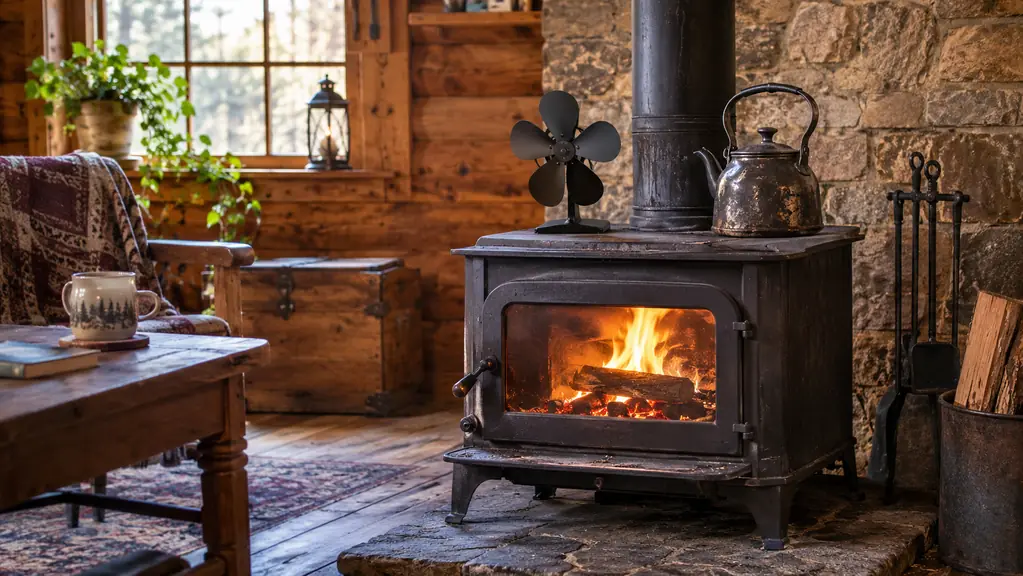
Two winters back I set a heat powered stove fan on my wood stove expecting a gimmick, and I want to give you the version of this review I wish I had read first. This is that version. The VODA Wood Stove Fan has been on my stove top through two full heating seasons in a 24 by 32 foot cabin I finished myself on 14 wooded acres about an hour outside Syracuse. I have run it through January cold, through the sloppy shoulder weeks when the fire idles all day, and through a stretch in February when the sun never showed and the battery bank was tight. Some of it earned its keep. Some of it I had to work around. A few things I only learned by getting them wrong, and those are the parts worth your time.
The listing shows a 4.1 average across a large pile of ratings, and after two seasons I understand why it lands there and not higher. The fan does exactly what the engineering says it should. The disappointment, when people feel it, comes from what they expected it to do. Both halves of that are worth walking through before you spend anything.
The Quick Verdict
A genuinely useful, genuinely quiet air mover that takes nothing off your battery bank, as long as you accept that it moves heat rather than makes it.
Amazon Check Today's Price →Runs on the heat you already made, not on one watt from your panels
No cord, no batteries, nothing to unplug before bed. It spins up when the stove is hot and settles down when the fire does. See today's price on Amazon.
Amazon Check Today's Price on Amazon →What Nobody Tells You About Heat Powered Stove Fans
Start with the part the listing gets right. This thing has no cord, no batteries and no plug. Nothing about it touches my battery bank, and in January that matters more than any number on a box. My panels on the ground mount do fine from April to October. From November to March they are a suggestion, and I am careful about what I leave running. Every watt I do not pull out of storage is a watt I do not have to replace. A fan that runs on hot aluminum instead of electrons is a good fit for how we live out here.
Now the part that gets left out of the copy. The fan does not make heat. It cannot. What it does is take the layer of hot air sitting on and above the stove top and push it out into the room instead of letting it climb to the ceiling and stay there. Anybody who has heated with wood knows that pattern. The stove throws heat up, the ceiling gets warm, your feet stay cold, and you end up in a chair with a blanket over your knees wondering why the room is not doing what the stove is doing. A fan on the top plate breaks that up. In my cabin the change is real. It is not dramatic. It is the difference between a room that feels warm at eye level and a room that feels warm down at the floorboards where you actually sit.
The other thing nobody says plainly is that the VODA fan is a passenger, not a driver. It runs off the stove's own heat, so it starts when the stove gets hot and quits when the stove cools. That means it does nothing on a cold morning before you light, and nothing in the two hours after the fire has burned down to coals. People read heat powered and hear always on. It is not always on. It is on when your fire is on, which is either the most sensible thing about it or the most frustrating, depending on what you were expecting when the box showed up.
How I've Used It
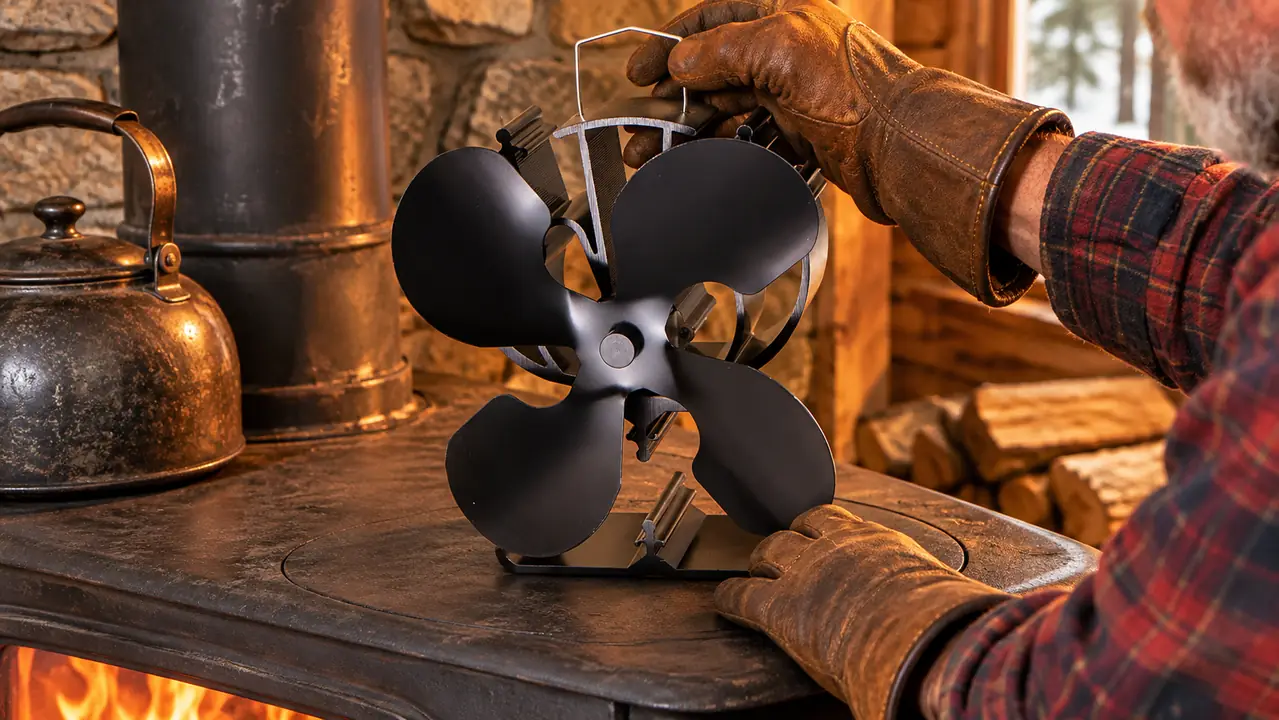
The VODA fan arrives with a user manual and nothing to assemble. Four blades on an aluminum body, about 600 grams, and the footprint measures 8.27 inches across by 8.27 inches tall and 4.72 inches deep. That depth number matters on a stove top. It leaves room for the kettle, which on my stove is not a small consideration.
I have run it in three spots over two seasons. The first season it sat dead center on the top plate. The second season I moved it back and to the left and aimed it down the long axis of the room. Both worked. The second worked better, and I will explain why further down. What I have not done is leave it on the stove during a hard burn, and I will explain that too.
For context on how we heat: the stove is the only heat in the cabin. There is no backup furnace and no propane wall unit. When the fire is going, the stove is the whole system and the woodpile by the door is the fuel line. That makes the fan a small piece of a bigger routine rather than a gadget I notice. In two seasons I have not had a single problem with it. No rattle that did not turn out to be the stove top, no failure, nothing to fix. For something with only the blades and the base to go wrong, that is not a surprise. It is still worth saying out loud, because a lot of off grid gear does not survive two winters up here.
Maintenance has amounted to wiping dust off the blades in the fall and setting the fan down on a clean flat spot each time I move it. That is the whole list. No oil, no filter, no battery to replace in the spring. I appreciate that more than I expected to.
The Noise Question, Answered Plainly
The listing rates it at 25 decibels and 240 rpm. Numbers on a page do not tell you much, so here is what it sounds like in a room with no other noise in it. At three feet you hear air moving and a very soft mechanical hum underneath the air. From the kitchen side of the cabin you hear nothing. It has never woken Dana, and she is a light sleeper who has heard every mouse in this place for six years.
The VODA fan is quieter than the fire. On a cold night with a load of hardwood in the box, the stove itself makes more noise than the fan does, between the pull of the draft and the metal ticking as it heats and settles. It is quieter than the kettle on the same top plate. If the fan is the loudest thing in your cabin, you have a very quiet cabin.
Where it does get noisy is contact, not the blades. The base needs a flat, clean surface. The first week mine sat on a spot with a little ash grit under it and the base buzzed against the top plate, a low rattle you felt in your teeth more than heard. I wiped the plate, set it down flat, and the rattle went away and never came back. If yours rattles, look at the surface under it before you blame the fan.
There is a small tick when it first spins up, once the stove is hot enough to get the blades turning. It lasts about a second. That is the only sound it makes that I would call a noise rather than moving air.
It will not make your fire burn better and it will not heat a second room. What it does is move the heat you already paid for off the top plate and down to where you are sitting, and it does that without a single watt off my panels.
Placement Is Most of the Job
This is the thing I would tell a neighbor before anything else. A stove fan pushes air one direction. Mine moves air off the blades and out, one way, like a small fan pointed where you aim it. That means placement decides whether you feel it at all. Set it facing a wall ten inches away and you will swear the thing does nothing, then write a review saying so.
Keep it on the flat top plate, clear of the flue collar and the stovepipe, and out of the path where you swing the door open and drop splits. The top plate is the only place it belongs. It needs cooler air to work against, so do not box it in behind the kettle or a humidifier pot. Give it a few inches of open air around the blades and let it breathe.
Then move it. Put it somewhere, run it a week, then turn it ninety degrees or slide it a foot and run it another week. I know that sounds fussy for a fan. It takes ten minutes spread over two weeks and it is the difference between a fan you forget about and a fan that visibly changes the room. On my stove the best spot is back and left, aimed down the long axis toward the chairs. The far end of the cabin is warmer by a margin I can feel on my face when I come in from the woodpile. Slide the fan six inches toward the center of the plate and that margin shrinks. Same fan, same fire, same wood.
One more note on handling. The body is 600 grams of aluminum and it sits on a hot stove, so it gets hot. I use a stove glove to move mine, and I mostly move it when the stove is cold or when I am resetting it for the evening. Do not grab it barehanded after an hour of burning. That is not a fault in the product. That is a stove.
The Temperature Limits Nobody Mentions
The fan has one hard limit and it is built into how it works. It needs heat to run. Below a certain point on the top plate the blades stop, and nothing you do to the fan changes that. On a cold start, that means twenty to thirty minutes after you light before it does anything at all. If you are up at five to get the fire going, the fan is not helping you at five. It is helping you at five-thirty, once the steel has come up.
The second limit is the top end. A stove fan sits in the hottest place in your house, and there is a point where you should lift it off. On my stove that is during a hard burn, when I have loaded heavy for a single digit night and the top plate is running hotter than it does in normal use. I pick the VODA fan up and set it on the hearth stone until the stove settles back down. I do that for the fan's sake and because I do not want it in my way while I am working the door with a glove on.
The third limit is the one that makes some people unhappy. The fan will not make your stove burn better. It sits on top of the stove and the firebox is underneath. Nothing about a fan on the top plate reaches the fire, the draft or the coal bed. If somebody tells you a stove fan makes your wood last longer or your chimney run cleaner, they are describing a different device or they are selling you something. What this does is move room air. That is the whole job, and it does the job.
The fourth limit is the size of the job. It moves one room. My cabin is 24 by 32 and the stove sits roughly in the middle, so the fan helps the whole main floor because there are no walls in the way. It does nothing for the loft and nothing for a closed bedroom. If your stove is in a corner and the room you want warm is through a doorway around a bend, a fan on the top plate will not reach it. You need a different answer for that, probably a different fan, one that moves more air than this one does.
One caution before you buy anything heat powered. If your stove or insert has a glass or ceramic top surface, check with the maker before you set a fan on it. Mine is cast iron and does not care what sits on it.
What I Liked
- Runs with no cord and no batteries, so it draws nothing from a battery bank or a generator
- Rated at 25 decibels, and in practice quieter than the fire and the kettle
- Four blades at 240 rpm move a noticeable amount of air for something this size
- Small footprint at 8.27 inches wide, so it shares the stove top with a kettle
- Light enough to lift with one gloved hand at 600 grams
- Starts and stops with the stove, so there is nothing to remember and nothing to switch off
Where It Falls Short
- Does nothing until the stove is properly hot, then quits when the fire dies
- Moves air in one room only and will not reach a closed second room
- Needs a clean flat spot on the top plate or the base will buzz against the metal
- One direction airflow means placement matters more than most people expect
- I lift mine off during hard burns, which is one more thing to remember
- Hot to handle on a hot stove, so you need a glove to move it
Who This Is For
This fan is for someone heating with a wood stove who wants the room warm at sitting height and not just up at the ceiling, and who either has no easy power at the stove or does not want to spend it there. Off grid, that is most of us. On a battery bank in a New York winter, a fan that draws nothing is worth more than a fan that moves more air. It is also for anyone who tried a corded fan on the hearth and got tired of the cord across the floor, the noise, or remembering to switch it off before turning in.
It suits a cabin, a camp, a workshop or a small house with the stove in the main room. The 8.27 inch footprint and the 600 grams make it easy to move around the plate and easy to put on a shelf in June. If your stove is cast iron, flat on top, and doing the real work of heating your place, this fits the way you already live.
Who Should Skip It
Skip it if you want heat in a second room, if you want something working overnight without you tending the fire, or if you expect your wood use to drop in a way you can measure. None of that is what a heat powered fan does. Skip it if your stove top is small or crowded. A fan fighting a kettle, a humidifier pot and a trivet for space ends up on a shelf by February, and that is money you will not get back.
And skip it if silence is non negotiable for you. It is rated at 25 decibels and in my cabin it is near enough to silent, but it is not zero. There is air moving in the room and a soft hum under it. You will hear it for a week. After that you will hear it only when the fire dies and the sound stops.
Two winters on my stove top and I never had to run a cord to it
If the stove is your heat and the power is your own, this is the version of a stove fan that fits that life. Nothing to plug in, nothing to remember, nothing drawn off your battery bank. See today's price on Amazon.
Amazon Check Today's Price on Amazon →